Author Archive
meanwhile, at angs+
We’ve had three seminar-sessions so far, and the seminar-blog ‘angs+’ contains already 20 posts and counting. As blogging is not a linear activity, I will try to post here at regular intervals to report on the ground we’ve covered in the seminar, providing links to the original angs+ posts.
This year’s goal is to obtain a somewhat definite verdict on the field-with-one-element hype.
In short, the plan is to outline Smirnov’s approach to the ABC-conjecture using geometry over $\mathbb{F}_1$, to describe Borger’s idea for such an $\mathbb{F}_1$-geometry and to test it on elusive objects such as $\mathbb{P}^1_{\mathbb{F}_1} \times_{\mathbb{F}_1} \mathsf{Spec}(\mathbb{Z})$ (relevant in Smirnov’s paper) and $\mathsf{Spec}(\mathbb{Z}) \times_{\mathbb{F}_1} \mathsf{Spec}(\mathbb{Z})$ (relevant to the Riemann hypothesis).
We did start with an historic overview, using recently surfaced material such as the Smirnov letters. Next, we did recall some standard material on the geometry of smooth projective curves over finite fields, their genus leading up to the Hurwitz formula relating the genera in a cover of curves.
Using this formula, a version of the classical ABC-conjecture in number theory can be proved quite easily for curves.
By analogy, Smirnov tried to prove the original ABC-conjecture by viewing $\mathsf{Spec}(\mathbb{Z})$ as a ‘curve’ over $\mathbb{F}_1$. Using the connection between the geometric points of the projective line over the finite field $\mathbb{F}_p$ and roots of unity of order coprime to $p$, we identify $\mathbb{P}^1_{\mathbb{F}_1}$ with the set of all roots of unity together with $\{ [0],[\infty] \}$. Next, we describe the schematic points of the ‘curve’ $\mathsf{Spec}(\mathbb{Z})$ and explain why one should take as the degree of the ‘point’ $(p)$ (for a prime number $p$) the non-sensical value $log(p)$.
To me, the fun starts with Smirnov’s proposal to associate to any rational number $q = \tfrac{a}{b} \in \mathbb{Q} – \{ \pm 1 \}$ a cover of curves
$q~:~\mathsf{Spec}(\mathbb{Z}) \rightarrow \mathbb{P}^1_{\mathbb{F}_1}$
by mapping primes dividing $a$ to $[0]$, primes dividing $b$ to $[\infty]$, sending the real valuation to $[0]$ or $[\infty]$ depending onw whether or not $b > a$ and finally sending a prime $p$ not involved in $a$ or $b$ to $[n]$ where $n$ is the order of the unit $\overline{a}.\overline{b}^{-1}$ in the finite cyclic group $\mathbb{F}_p^*$. Somewhat surprisingly, it does follow from Zsigmondy’s theorem that this is indeed a finite cover for most values of $q$. A noteworthy exception being the map for $q=2$ (which fails to be a cover at $[6]$) and of which Pieter Belmans did draw this beautiful graph

True believers in $\mathbb{F}_1$ might conclude from this graph that there should only be finitely many Mersenne primes… Further, the full ABC-conjecture would follow from a natural version of the Hurwitz formula for such covers.
(to be continued)
#cestGrothendieck
In Belgium the hashtag-craze of the moment is #cestjoelle. Joelle Milquet is perceived to be the dark force behind everything, from the crisis in Greece, over DSK, to your mother-in-law coming over this weekend? #cestjoelle.
Sam Leith used the same meme in his book the coincidence engine.
A hurricane assembling a passenger jet out of old bean-cans? #cestGrothendieck
All shops in Alabama out of Chicken & Broccoli Rica-A-Roni? #cestGrothendieck
Frogs raining down on Atlanta? #cestGrothendieck
As this is a work of fiction, Alexandre Grothendieck‘s name is only mentioned in the ‘author’s note’:
“It is customary to announce on this page that all resemblances to characters living or dead are entirely coincidental. It seems only courteous to acknowledge, though, that in preparing the character of Nicolas Banacharski I was inspired by the true-life story of the eminent mathematician Alexandre Grothendieck.”
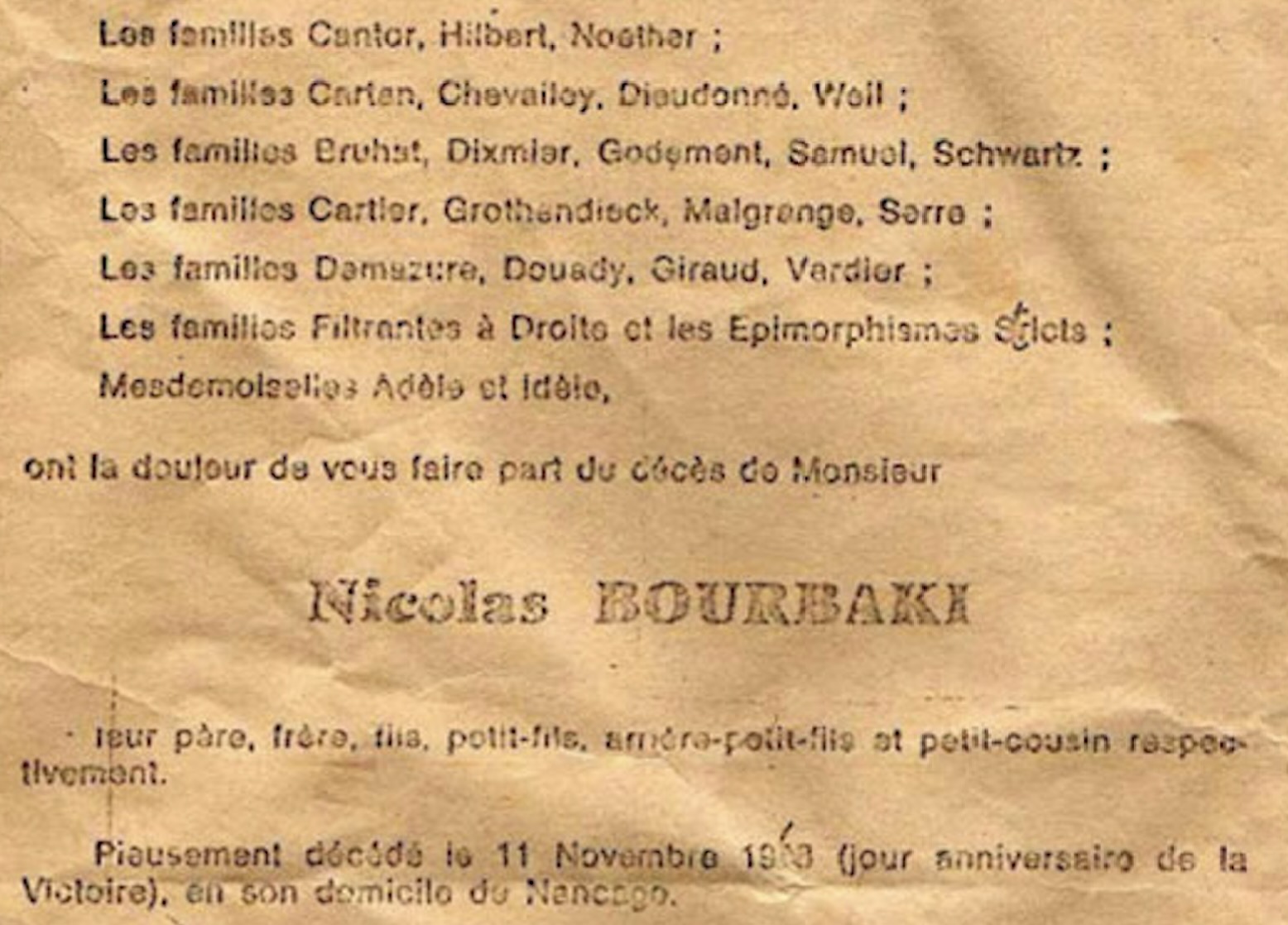
The name ‘Nicolas Banacharski’ is, of course, chosen on purpose (the old Bourbaki NB-joke even makes an appearance). The character ‘Isla Holderness’ is, of course, Leila Schneps, the ‘Banacharski ring’ is, of course, the Grothendieck circle. But, I’d love to know the name of the IRL-’Fred Nieman’, who’s described as ‘an operative for the military’.
Sam Leith surely knows all the Grothendieck-trivia which shouldn’t come as a surprise because he wrote in 2004 a piece for the Spectator on the ‘what is a metre?’ incident (see also this n-category cafe post).
The story of ‘the coincidence engine’ is that Grothendieck did a double (or was it triple) bluff when he dropped out of academia in protest of military money accepted by the IHES. He went into hiding only to work for a weapons company and to develop a ‘coincidence bomb’. As more and more unlikely events happen during a car-ride by a young Cambridge postdoc though the US (to propose to his American girlfriend), the true Grothendieck-aficianado (and there are still plenty of them in certain circles) will no doubt begin to believe that the old genius succeeded (once again) and that Ana’s (Grothendieck’s mother) $\infty$-ring is this devilish (pun intended) device…
However,
“There was no coincidence engine. Not in this world. It existed only in Banacharski’s imagination and in the imaginations he touched. But there was a world in which it worked, and this world was no further than a metre from our own. Its effect spilled across, like light through a lampshade.
And with that light there spilled, unappeased and peregrine, fragments of any number of versions of an old mathematician who had become his own ghost. Banacharski was neither quite alive nor quite dead, if you want the truth of it. He was a displaced person again, and nowhere was his home.”
3 related new math-sites
F_un Mathematics
Hardly a ‘new’ blog, but one that is getting a new life! On its old homepage you’ll find a diagonal banner stating ‘This site has moved’ and clicking on it will guide you to its new location : cage.ugent.be/~kthas/Fun.
From now on, this site will be hosted at the University of Ghent and maintained by Koen Thas. So, please update your bookmarks and point your RSS-aggregator to the new feed.
Everyone interested in contributing to this blog dedicated to the mathematics of the field with one element should contact Koen by email.
angst
Though I may occasionally (cross)post at F_un mathematics, my own blog-life will center round a new blog to accompany the master-course ‘seminar noncommutative geometry’ I’m running at Antwerp University this semester. Its URL is noncommutative.org and it is called :
Here, angs is short for Antwerp Noncommutative Geometry Seminar and the additions @t resp. + are there to indicate we will experiment a bit trying to find useful interactions between the IRL seminar, its blog and social media such as twitter and Google+.
The seminar (and blog) are scheduled to start in earnest september 30th, but I may post some prep-notes already. This semester the seminar will try to decode Smirnov’s old idea to prove the ABC-conjecture in number theory via geometry over the field with one element and connect it with new ideas such as Borger’s $\mathbb{F}_1$-geometry using $\lambda$-rings and noncommutative ideas proposed by Connes, Consani and Marcolli.
Again, anyone willing to contribute actively is invited to send me an email or to comment on ‘angst’, tweet about it using the hashtag #angs (all such tweets will appear on the frontpage) or share its posts on Google+.
Noncommutative Arithmetic Geometry Media Library
Via the noncommutative geometry blog a new initiative maintained by Alain Connes and Katia Consani was announced : the Noncommutative Arithmetic Geometry Media Library.
This site is dedicated to maintain articles, videos, and news about meetings and activities related to noncommutative arithmetic geometry. The website is still `under construction’ and the plan is to gradually add more videos (also from past conferences and meetings), as well as papers and slides.
wp-latex’ sweet revenge : wp+MathJax-> ePub
In the early days of math-blogging, one was happy to get LaTeXRender working. Some years later, the majority of math-blogs were using the, more user-friendly, wp-latex plugin to turn LaTeX-code into png-images. Today, everyone uses MathJax which works with modern CSS and web fonts instead of equation images, so equations scale with surrounding text at all zoom levels.
However, MathJax has one downside : it doesn’t parse in ePub-readers. Peter Krautzberger wrote a post Epub and mathematics in which he suggested two methods to turn MathJax into ePub, but after dozens of experiments I still fail to reproduce these.
No doubt, someone will soon come up with a working alternative, but for the impatient here’s a quick but dirty method to turn your MathJax powered wordpress post into ePub :
the tools
- download and install the ePub export plugin. It automatically creates an ePub file when a post or page is published or updated. The ePubs are stored in the uploads directory (to be found in the wp-contents directory).
- download and install the wp-latex plugin. MathJax uses the normal \$ tex-delimeters whereas wp-latex requires \$latex, so this plugin doesn’t interfere with the default use of MathJax.
- download the wp2latex python script. It converts a standard LaTeX file into a format that is ready to be copied into WordPress.
the routine
- Edit the post you want to convert to ePub. Copy the contents of the post box to a file say post1.tex and save this in the same directory containing the latex2wp.py script.
- In Terminal go to that directory and type the command ‘python latex2wp.py post1.tex’. It will produce a new file post1.html in the same directory.
- Copy the contents of post1.html into the post box of your WordPress-post and press the update button. This time the TeX-commands in your post will be rendered using wp-latex and the ePub export-plugin will have created an ePub-version of it.
- Locate this newly created ePub file in the relevant wp-contents/uploads/ folder (file has a number.epub name) and, if wanted, change its name into something easier to recognize and copy it somewhere outside the uploads directory. This will be your desired ePub-version of the post.
- Replace the contents of the post box of your WordPress-post with the contents of the post1.tex file and hit the ‘Update’ button, to restore your original post (powered by MathJax).
- Email your ePub-file to your iPad and open it with iBooks. Not quite as nice as MathJax-parsed TeX but a lot better than reading unparsed TeX-commands.
master seminar ncg 2011
Note to students following this year’s ‘seminar noncommutative geometry’ : the seminar starts friday september 30th at 13h in room G 0.16.
However, if you have another good reason to be in Ghent on thursday september 22nd, consider attending the inaugural lecture of Koen Thas at 17h in auditorium Emmy Noether, campus De Sterre, Krijgslaan 281, 9000 Gent.
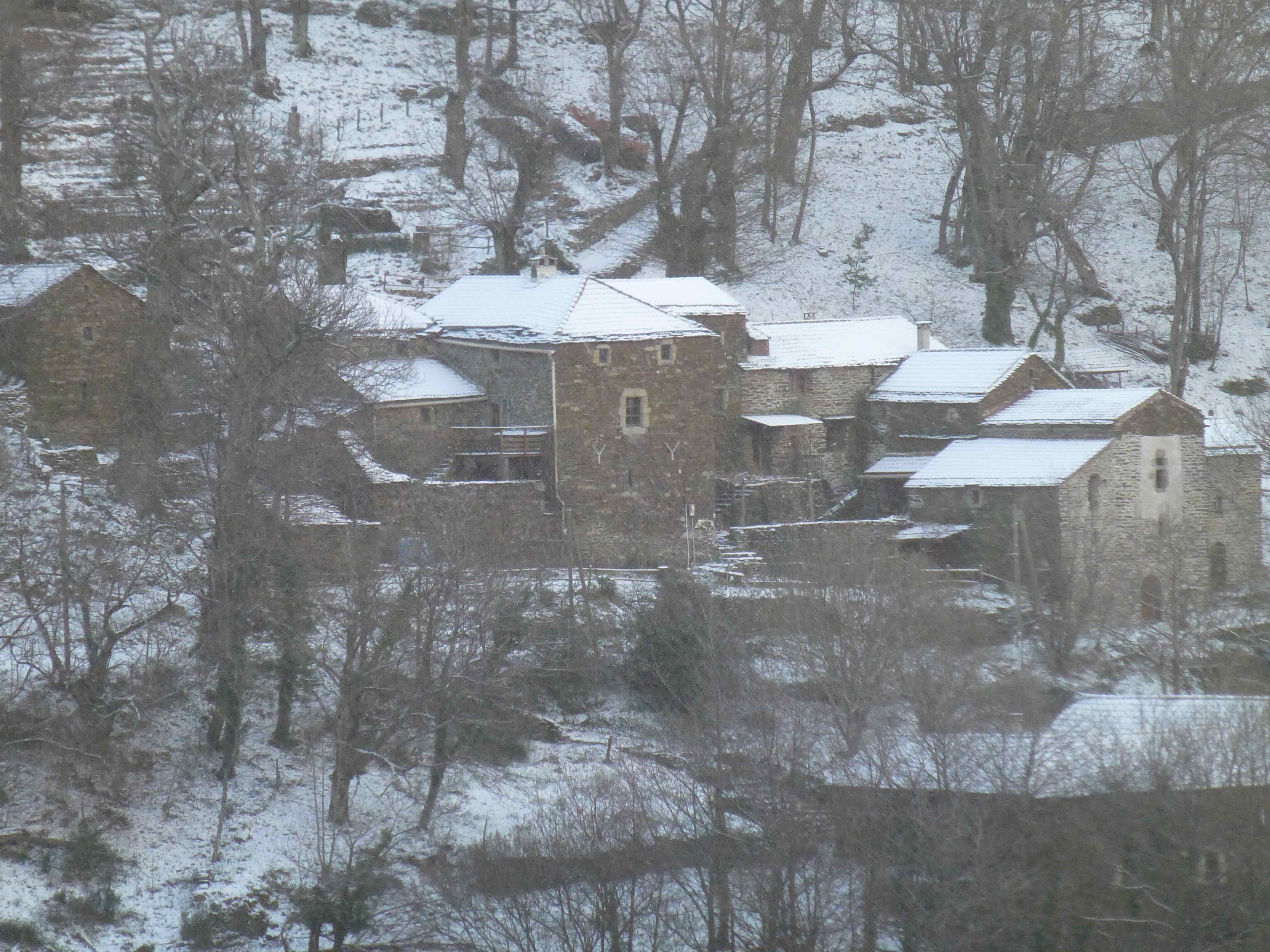
Koen’s lecture has one of the longest titles i’ve seen : “De lange weg – een verhaal over wiskundige problemen die denkers al eeuwenlang teisteren, zonderlingen die in afgelegen berghutten de existentie van de duivel willen aantonen, en een mythisch object dat niet bestaat, maar waar we toch naar zoeken” (“The long road – a story on mathematical problems torturing scientists for centuries, weirdos trying to prove the existence of the Devil in desolated mountain-huts and the search for a mythical object that doesn’t exist”).
Knowing Koen a bit I’d say it will be on the Riemann hypothesis, Grothendieck’s theory of motives and the field with one element. A sneak preview of our upcoming seminar, quoi?
More information on the event and to register see here.