Posts Tagged ‘monster’


Arnold’s trinities version 2.0

Friday, June 20th, 2008

Arnold has written a follow-up to the paper mentioned last time called “Polymathematics : is mathematics a single science or a set of arts?” (or here for a (huge) PDF-conversion).

On page 8 of that paper is a nice summary of his 25 trinities :

I learned of this newer paper from a comment by Frederic Chapoton who maintains a nice webpage dedicated to trinities.

In his list there is one trinity on sporadic groups :

\xymatrix{& BabyMonster \ar@{-}[rd] & \\ F_{24} \ar@{-}[ru] \ar@{-}[rr] & & Monster}

where F_{24} is the Fischer simple group of order 2^{21}.3^{16}.5^2.7^3.11.13.17.23.29 = 1255205709190661721292800, which is the third largest sporadic group (the two larger ones being the Baby Monster and the Monster itself).

I don’t know what the rationale is behind this trinity. But I’d like to recall the (Baby)Monster history as a warning against the trinity-reflex. Sometimes, there is just no way to extend a would be trinity.

The story comes from Mark Ronan’s book Symmetry and the Monster on page 178.

Let’s remind ourselves how we got here. A few years earlier, Fischer has created his ‘transposition’ groups Fi22, Fi23, and Fi24. He had called them M(22), M(23), and M(24), because they were related to Mathieu’s groups M22,M23, and M24, and since he used Fi22 to create his new group of mirror symmetries, he tentatively called it M^{22}.
It seemed to appear as a cross-section in something even bigger, and as this larger group was clearly associated with Fi24, he labeled it M^{24}. Was there something in between that could be called M^{23}?
Fischer visited Cambridge to talk on his new work, and Conway named these three potential groups the Baby Monster, the Middle Monster, and the Super Monster. When it became clear that the Middle Monster didn’t exist, Conway settled on the names Baby Monster and Monster, and this became the standard terminology.

Marcus du Sautoy’s account in Finding Moonshine is slightly different. He tells on page 322 that the Super Monster didn’t exist. Anyone knowing the factual story?

Some mathematical trickery later revealed that the Super Monster was going to be impossible to build: there were certain features that contradicted each other. It was just a mirage, which vanished under closer scrutiny. But the other two were still looking robust. The Middle Monster was rechristened simply the Monster.

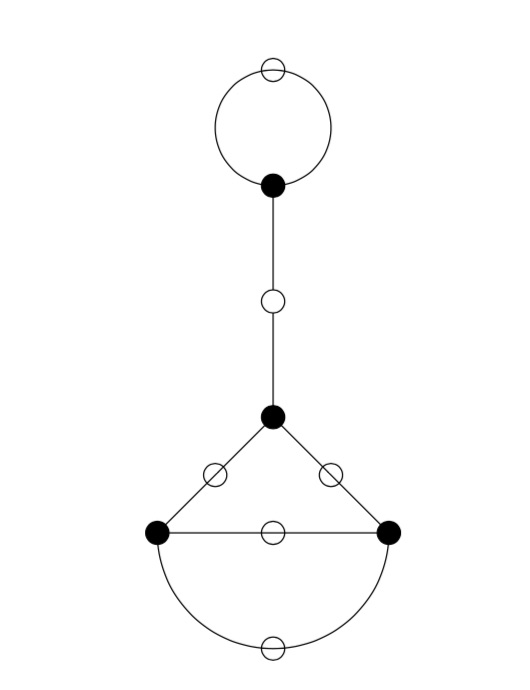
And, the inclusion diagram of the sporadic simples tells yet another story.

Anyhow, this inclusion diagram is helpful in seeing the three generations of the Happy Family (as well as the Pariahs) of the sporadic groups, terminology invented by Robert Griess in his 100+p Inventiones paper on the construction of the Monster (which he liked to call, for obvious reasons, the Friendly Giant denoted by FG). The happy family appears in Table 1.1. of the introduction.

It was this picture that made me propose the trinity on the left below in the previous post. I now like to add another trinity on the right, and, the connection between the two is clear.

\xymatrix{& Conway \ar@{-}[rd] & \\ Mathieu \ar@{-}[ru] \ar@{-}[rr] & & Monster} constructed using \xymatrix{& Leech \ar@{-}[rd] & \\ Golay \ar@{-}[ru] \ar@{-}[rr] & & Griess}

Here Golay denotes the extended binary Golay code of which the Mathieu group M_{24} is the automorphism group. Leech is of course the 24-dimensional Leech lattice of which the automorphism group is a double cover of the Conway group Co_1. Griess is the Griess algebra which is a nonassociative 196884-dimensional algebra of which the automorphism group is the Monster.

I am aware of a construction of the Leech lattice involving the quaternions (the icosian construction of chapter 8, section 2.2 of SPLAG). Does anyone know of a construction of the Griess algebra involving octonions???

Monstrous frustrations

Thursday, June 19th, 2008

Thanks for clicking through… I guess.

If nothing else, it shows that just as much as the stock market is fueled by greed, mathematical reasearch is driven by frustration (or the pleasure gained from knowing others to be frustrated).

I did spend the better part of the day doing a lengthy, if not laborious, calculation, I’ve been postponing for several years now. Partly, because I didn’t know how to start performing it (though the basic strategy was clear), partly, because I knew beforehand the final answer would probably offer me no further insight.

Still, it gives the final answer to a problem that may be of interest to anyone vaguely interested in Moonshine :

What does the Monster see of the modular group?

I know at least two of you, occasionally reading this blog, understand what I was trying to do and may now wonder how to repeat the straightforward calculation. Well the simple answer is : Google for the number 97239461142009186000 and, no doubt, you will be able to do the computation overnight.

One word of advice : don’t! Get some sleep instead, or make love to your partner, because all you’ll get is a quiver on nine vertices (which is pretty good for the Monster) but having an horrible amount of loops and arrows…

If someone wants the details on all of this, just ask. But, if you really want to get me exited : find a moonshine reason for one of the following two numbers :

791616381395932409265430144165764500492= 2^2 * 11 * 293 * 61403690769153925633371869699485301

(the dimension of the monster-singularity upto smooth equivalence), or,

1575918800531316887592467826675348205163= 523 * 1655089391 * 15982020053213 * 113914503502907

(the dimension of the moduli space).

Arnold’s trinities

Tuesday, June 17th, 2008

Referring to the triple of exceptional Galois groups L_2(5),L_2(7),L_2(11) and its connection to the Platonic solids I wrote : “It sure seems that surprises often come in triples…”. Briefly I considered replacing triples by trinities, but then, I didnt want to sound too mystic…

David Corfield of the n-category cafe and a dialogue on infinity (and perhaps other blogs I’m unaware of) pointed me to the paper Symplectization, complexification and mathematical trinities by Vladimir I. Arnold. (Update : here is a PDF-conversion of the paper)

The paper is a write-up of the second in a series of three lectures Arnold gave in june 1997 at the meeting in the Fields Institute dedicated to his 60th birthday. The goal of that lecture was to explain some mathematical dreams he had.

The next dream I want to present is an even more fantastic set of theorems and conjectures. Here I also have no theory and actually the ideas form a kind of religion rather than mathematics.
The key observation is that in mathematics one encounters many trinities. I shall present a list of examples. The main dream (or conjecture) is that all these trinities are united by some rectangular “commutative diagrams”.
I mean the existence of some “functorial” constructions connecting different trinities. The knowledge of the existence of these diagrams provides some new conjectures which might turn to be true theorems.

Follows a list of 12 trinities, many taken from Arnold’s field of expertise being differential geometry. I’ll restrict to the more algebraically inclined ones.

1 : “The first trinity everyone knows is”

\xymatrix{& \mathbb{C} \ar@{-}[rd] & \\ \mathbb{R} \ar@{-}[ru] \ar@{-}[rr] & & \mathbb{H}} but I would like to alter it into \xymatrix{& \mathbb{H} \ar@{-}[rd] & \\ \mathbb{C} \ar@{-}[ru] \ar@{-}[rr] & & \mathbb{O}}

where \mathbb{H} are the Hamiltonian quaternions. The trinity on the left may be natural to differential geometers who see real and complex and hyper-Kaehler manifolds as distinct but related beasts, but I’m willing to bet that most algebraists would settle for the trinity on the right where \mathbb{O} are the octonians.

2 : The next trinity is that of the exceptional Lie algebras E6, E7 and E8.

\xymatrix{& E_7 \ar@{-}[rd] & \\ E_6 \ar@{-}[ru] \ar@{-}[rr] & & E_8}

with corresponding Dynkin-Coxeter diagrams

Arnold has this to say about the apparent ubiquity of Dynkin diagrams in mathematics.

Manin told me once that the reason why we always encounter this list in many different mathematical classifications is its presence in the hardware of our brain (which is thus unable to discover a more complicated scheme).
I still hope there exists a better reason that once should be discovered.

Amen to that. I’m quite hopeful human evolution will overcome the limitations of Manin’s brain…

3 : Next comes the Platonic trinity of the tetrahedron, cube and dodecahedron

\xymatrix{& Cube \ar@{-}[rd] & \\ Tetra \ar@{-}[ru] \ar@{-}[rr] & & Dode}

Clearly one can argue against this trinity as follows : a tetrahedron is a bunch of triangles such that there are exactly 3 of them meeting in each vertex, a cube is a bunch of squares, again 3 meeting in every vertex, a dodecahedron is a bunch of pentagons 3 meeting in every vertex… and we can continue the pattern. What should be a bunch a hexagons such that in each vertex exactly 3 of them meet? Well, only one possibility : it must be the hexagonal tiling (on the left below). And in normal Euclidian space we cannot have a bunch of septagons such that three of them meet in every vertex, but in hyperbolic geometry this is still possible and leads to the Klein quartic (on the right). Check out this wonderful post by John Baez for more on this.

4 : The trinity of the rotation symmetry groups of the three Platonics

\xymatrix{& S_4 \ar@{-}[rd] & \\ A_4 \ar@{-}[ru] \ar@{-}[rr] & & A_5}

where A_n is the alternating group on n letters and S_n is the symmetric group.

Clearly, any rotation of a Platonic solid takes vertices to vertices, edges to edges and faces to faces. For the tetrahedron we can easily see the 4 of the group A_4, say the 4 vertices. But what is the 4 of S_4 in the case of a cube? Well, a cube has 4 body-diagonals and they are permuted under the rotational symmetries. The most difficult case is to see the 5 of A_5 in the dodecahedron. Well, here’s the solution to this riddle

there are exactly 5 inscribed cubes in a dodecahedron and they are permuted by the rotations in the same way as A_5.

7 : The seventh trinity involves complex polynomials in one variable

\xymatrix{& \mathbb{C}[z,z^{-1}] \ar@{-}[rd] & \\ \mathbb{C}[z] \ar@{-}[ru] \ar@{-}[rr] & & \mathbb{C}[z,z^{-1},(z-1)^{-1}] }

the Laurant polynomials and the modular polynomials (that is, rational functions with three poles at 0,1 and \infty.

8 : The eight one is another beauty

\xymatrix{& TrigonoNumbers \ar@{-}[rd] & \\ Numbers \ar@{-}[ru] \ar@{-}[rr] & & EllipticNumbers }

Here ‘numbers’ are the ordinary complex numbers \mathbb{C}, the ‘trigonometric numbers’ are the quantum version of those (aka q-numbers) which is a one-parameter deformation and finally, the ‘elliptic numbers’ are a two-dimensional deformation. If you ever encountered a Sklyanin algebra this will sound familiar.

This trinity is based on a paper of Turaev and Frenkel and I must come back to it some time…

The paper has some other nice trinities (such as those among Whitney, Chern and Pontryagin classes) but as I cannot add anything sensible to it, let us include a few more algebraic trinities. The first one attributed by Arnold to John McKay

13 : A trinity parallel to the exceptional Lie algebra one is

\xymatrix{& 28-biTangents \ar@{-}[rd] & \\ 27-Lines \ar@{-}[ru] \ar@{-}[rr] & & 120-Tritangents }

between the 27 straight lines on a cubic surface, the 28 bitangents on a quartic plane curve and the 120 tritangent planes of a canonic sextic curve of genus 4.

14 : The exceptional Galois groups

\xymatrix{& L_2(7) \ar@{-}[rd] & \\ L_2(5) \ar@{-}[ru] \ar@{-}[rr] & & L_2(11) }

explained last time.

15 : The associated curves with these groups as symmetry groups (as in the previous post)

\xymatrix{& KleinQuartic \ar@{-}[rd] & \\ Dodecahedron \ar@{-}[ru] \ar@{-}[rr] & & ? }

where the ? refers to the mysterious genus 70 curve. I’ll check with one of the authors whether there is still an embargo on the content of this paper and if not come back to it in full detail.

16 : The three generations of sporadic groups

\xymatrix{& Conway \ar@{-}[rd] & \\ Mathieu \ar@{-}[ru] \ar@{-}[rr] & & Monster }

Do you have other trinities you’d like to worship?

bloomsday 2 : BistroMath

Monday, June 16th, 2008

Exactly one year ago this blog was briefly renamed MoonshineMath. The concept being that it would focus on the mathematics surrounding the monster group & moonshine. Well, I got as far as the Mathieu groups…

After a couple of months, I changed the name back to neverendingbooks because I needed the freedom to post on any topic I wanted. I know some people preferred the name MoonshineMath, but so be it, anyone’s free to borrow that name for his/her own blog.

Today it’s bloomsday again, and, as I’m a cyclical guy, I have another idea for a conceptual blog : the bistromath chronicles (or something along this line).

Here’s the relevant section from the Hitchhikers guide

Bistromathics itself is simply a revolutionary new way of understanding the behavior of numbers. …
Numbers written on restaurant checks within the confines of restaurants do not follow the same mathematical laws as numbers written on any other pieces of paper in any other parts of the Universe.
This single statement took the scientific world by storm. It completely revolutionized it.So many mathematical conferences got hold in such good restaurants that many of the finest minds of a generation died of obesity and heart failure and the science of math was put back by years.

Right, so what’s the idea? Well, on numerous occasions Ive stated that any math-blog can only survive as a group-blog. I did approach a lot of people directly, but, as you have noticed, without too much success… Most of them couldnt see themselves contributing to a blog for one of these reasons : it costs too much energy and/or it’s way too inefficient. They say : career-wise there are far cleverer ways to spend my energy than to write a blog. And… there’s no way I can argue against this.

Whence plan B : set up a group-blog for a fixed amount of time (say one year), expect contributors to write one or two series of about 4 posts on their chosen topic, re-edit the better series afterwards and turn them into a book.

But, in order to make a coherent book proposal out of blog-post-series, they’d better center around a common theme, whence the BistroMath ploy. Imagine that some of these forgotten “restaurant-check-notes” are discovered, decoded and explained. Apart from the mathematics, one is free to invent new recepies or add descriptions of restaurants with some mathematical history, etc. etc.

One possible scenario (but I’m sure you will have much better ideas) : part of the knotation is found on a restaurant-check of some Italian restaurant. This allow to explain Conway’s theory of rational tangles, give the perfect way to cook spaghetti to experiment with tangles and tell the history of Manin’s Italian restaurant in Bonn where (it is rumoured) the 1998 Fields medals were decided…

But then, there is no limit to your imagination as long as it somewhat fits within the framework. For example, I’d love to read the transcripts of a chat-session in SecondLife between Dedekind and Conway on the construction of real numbers… I hope you get the drift.

I’m not going to rename neverendingbooks again, but am willing to set up the BistroMath blog provided

  • Five to ten people are interested to participate
  • At least one book-editor shows an interest
    update : (16/06) contacted by first publisher
You can leave a comment or, if you prefer, contact me via email (if you’re human you will have no problem getting my address…).

Clearly, people already blogging are invited and are allowed to cross-post (in fact, that’s what I will do if it ever gets so far). Finally, if you are not willing to contribute blog-posts but like the idea and are willing to contribute to it in any other way, we are still auditioning for chanting monks

The small group of monks who had taken up hanging around the major research institutes singing strange chants to the effect that the Universe was only a figment of its own imagination were eventually given a street theater grant and went away.

And, if you do not like this idea, there will be another bloomsday-idea next year…

the McKay-Thompson series

Saturday, March 22nd, 2008

Monstrous moonshine was born (sometime in 1978) the moment John McKay realized that the linear term in the j-function

j(q) = \frac{1}{q} + 744 + 196884 q + 21493760 q^2 + 864229970 q^3 + \hdots

is surprisingly close to the dimension of the smallest non-trivial irreducible representation of the monster group, which is 196883. Note that at that time, the Monster hasn’t been constructed yet, and, the only traces of its possible existence were kept as semi-secret information in a huge ledger (costing 80 pounds…) kept in the Atlas-office at Cambridge. Included were 8 huge pages describing the character table of the monster, the top left fragment, describing the lower dimensional irreducibles and their characters at small order elements, reproduced below

If you look at the dimensions of the smallest irreducible representations (the first column) : 196883, 21296876, 842609326, … you will see that the first, second and third of them are extremely close to the linear, quadratic and cubic coefficient of the j-function. In fact, more is true : one can obtain these actual j-coefficients as simple linear combination of the dimensions of the irrducibles :

\begin{cases} 196884 &= 1 + 196883 \\
21493760 &= 1 + 196883 + 21296876 \\
864229970 &= 2 \times 1 + 2 \times 196883 + 21296876 + 842609326
\end{cases}

Often, only the first relation is attributed to McKay, whereas the second and third were supposedly discovered by John Thompson after MKay showed him the first. Marcus du Sautoy tells a somewhat different sory in Finding Moonshine :

McKay has also gone on to find these extra equations, but is was Thompson who first published them. McKay admits that “I was a bit peeved really, I don’t think Thompson quite knew how much I knew.”

By the work of Richard Borcherds we now know the (partial according to some) explanation behind these numerical facts : there is a graded representation V = \oplus_i V_i of the Monster-group (actually, it has a lot of extra structure such as being a vertex algebra) such that the dimension of the i-th factor V_i equals the coefficient f q^i in the j-function. The homogeneous components V_i being finite dimensional representations of the monster, they decompose into the 194 irreducibles X_j. For the first three components we have the decompositions

\begin{cases} V_1 &= X_1 \oplus X_2 \\
V_2 &= X_1 \oplus X_2 \oplus X_3 \\
V_3 &= X_1^{\oplus 2 } \oplus X_2^{\oplus 2} \oplus X_3 \oplus X_4
\end{cases}

Calculating the dimensions on both sides give the above equations. However, being isomorphisms of monster-representations we are not restricted to just computing the dimensions. We might as well compute the character of any monster-element on both sides (observe that the dimension is just the character of the identity element). Characters are the traces of the matrices describing the action of a monster-element on the representation and these numbers fill the different columns of the character-table above.

Hence, the same integral combinations of the character values of any monster-element give another q-series and these are called the McKay-Thompson series. John Conway discovered them to be classical modular functions known as Hauptmoduln.

In most papers and online material on this only the first few coefficients of these series are documented, which may be just too little information to make new discoveries!

Fortunately, David Madore has compiled the first 3200 coefficients of all the 172 monster-series which are available in a huge 8Mb file. And, if you really need to have more coefficients, you can always use and modify his moonshine python program.

In order to reduce bandwidth, here a list containing the first 100 coefficients of the j-function

jfunct=[196884, 21493760, 864299970, 20245856256, 333202640600, 4252023300096, 44656994071935, 401490886656000, 3176440229784420, 22567393309593600, 146211911499519294, 874313719685775360, 4872010111798142520, 25497827389410525184, 126142916465781843075, 593121772421445058560, 2662842413150775245160, 11459912788444786513920, 47438786801234168813250, 189449976248893390028800, 731811377318137519245696, 2740630712513624654929920, 9971041659937182693533820, 35307453186561427099877376, 121883284330422510433351500, 410789960190307909157638144, 1353563541518646878675077500, 4365689224858876634610401280, 13798375834642999925542288376, 42780782244213262567058227200, 130233693825770295128044873221, 389608006170995911894300098560, 1146329398900810637779611090240, 3319627709139267167263679606784, 9468166135702260431646263438600, 26614365825753796268872151875584, 73773169969725069760801792854360, 201768789947228738648580043776000, 544763881751616630123165410477688, 1452689254439362169794355429376000, 3827767751739363485065598331130120, 9970416600217443268739409968824320, 25683334706395406994774011866319670, 65452367731499268312170283695144960, 165078821568186174782496283155142200, 412189630805216773489544457234333696, 1019253515891576791938652011091437835, 2496774105950716692603315123199672320, 6060574415413720999542378222812650932, 14581598453215019997540391326153984000, 34782974253512490652111111930326416268, 82282309236048637946346570669250805760, 193075525467822574167329529658775261720, 449497224123337477155078537760754122752, 1038483010587949794068925153685932435825, 2381407585309922413499951812839633584128, 5421449889876564723000378957979772088000, 12255365475040820661535516233050165760000, 27513411092859486460692553086168714659374, 61354289505303613617069338272284858777600, 135925092428365503809701809166616289474168, 299210983800076883665074958854523331870720, 654553043491650303064385476041569995365270, 1423197635972716062310802114654243653681152, 3076095473477196763039615540128479523917200, 6610091773782871627445909215080641586954240, 14123583372861184908287080245891873213544410, 30010041497911129625894110839466234009518080, 63419842535335416307760114920603619461313664, 133312625293210235328551896736236879235481600, 278775024890624328476718493296348769305198947, 579989466306862709777897124287027028934656000, 1200647685924154079965706763561795395948173320, 2473342981183106509136265613239678864092991488, 5070711930898997080570078906280842196519646750, 10346906640850426356226316839259822574115946496, 21015945810275143250691058902482079910086459520, 42493520024686459968969327541404178941239869440, 85539981818424975894053769448098796349808643878, 171444843023856632323050507966626554304633241600, 342155525555189176731983869123583942011978493364, 679986843667214052171954098018582522609944965120, 1345823847068981684952596216882155845897900827370, 2652886321384703560252232129659440092172381585408, 5208621342520253933693153488396012720448385783600, 10186635497140956830216811207229975611480797601792, 19845946857715387241695878080425504863628738882125, 38518943830283497365369391336243138882250145792000, 74484518929289017811719989832768142076931259410120, 143507172467283453885515222342782991192353207603200, 275501042616789153749080617893836796951133929783496, 527036058053281764188089220041629201191975505756160, 1004730453440939042843898965365412981690307145827840, 1908864098321310302488604739098618405938938477379584, 3614432179304462681879676809120464684975130836205250, 6821306832689380776546629825653465084003418476904448, 12831568450930566237049157191017104861217433634289960, 24060143444937604997591586090380473418086401696839680, 44972195698011806740150818275177754986409472910549646, 83798831110707476912751950384757452703801918339072000]

This information will come in handy when we will organize our Monstrous Easter Egg Race, starting tomorrow at 6 am (GMT)…

AWSOM Powered