Posts Tagged ‘brain’


Arnold’s trinities

Tuesday, June 17th, 2008

Referring to the triple of exceptional Galois groups L_2(5),L_2(7),L_2(11) and its connection to the Platonic solids I wrote : “It sure seems that surprises often come in triples…”. Briefly I considered replacing triples by trinities, but then, I didnt want to sound too mystic…
David Corfield of the n-category cafe and a dialogue on infinity (and perhaps other blogs I’m unaware of) pointed me to the paper Symplectization, complexification and mathematical trinities by Vladimir I. Arnold. (Update : here is a PDF-conversion of the paper)

The paper is a write-up of the second in a series of three lectures Arnold gave in june 1997 at the meeting in the Fields Institute dedicated to his 60th birthday. The goal of that lecture was to explain some mathematical dreams he had.

The next dream I want to present is an even more fantastic set of theorems and conjectures. Here I also have no theory and actually the ideas form a kind of religion rather than mathematics.
The key observation is that in mathematics one encounters many trinities. I shall present a list of examples. The main dream (or conjecture) is that all these trinities are united by some rectangular “commutative diagrams”.
I mean the existence of some “functorial” constructions connecting different trinities. The knowledge of the existence of these diagrams provides some new conjectures which might turn to be true theorems.

Follows a list of 12 trinities, many taken from Arnold’s field of expertise being differential geometry. I’ll restrict to the more algebraically inclined ones.

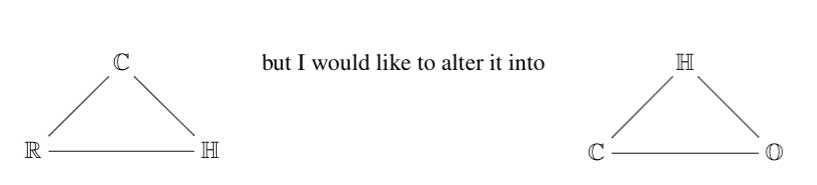
1 : “The first trinity everyone knows is”

\xymatrix{& \mathbb{C} \ar@{-}[rd] & \\ \mathbb{R} \ar@{-}[ru] \ar@{-}[rr] & & \mathbb{H}} but I would like to alter it into \xymatrix{& \mathbb{H} \ar@{-}[rd] & \\ \mathbb{C} \ar@{-}[ru] \ar@{-}[rr] & & \mathbb{O}}

where \mathbb{H} are the Hamiltonian quaternions. The trinity on the left may be natural to differential geometers who see real and complex and hyper-Kaehler manifolds as distinct but related beasts, but I’m willing to bet that most algebraists would settle for the trinity on the right where \mathbb{O} are the octonians.

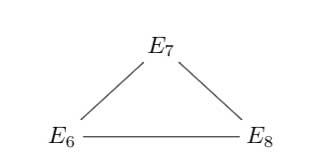
2 : The next trinity is that of the exceptional Lie algebras E6, E7 and E8.

\xymatrix{& E_7 \ar@{-}[rd] & \\ E_6 \ar@{-}[ru] \ar@{-}[rr] & & E_8}

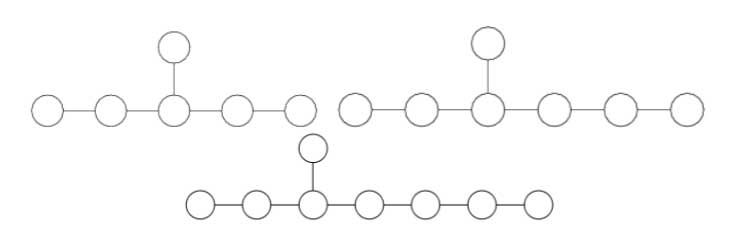
with corresponding Dynkin-Coxeter diagrams

Arnold has this to say about the apparent ubiquity of Dynkin diagrams in mathematics.

Manin told me once that the reason why we always encounter this list in many different mathematical classifications is its presence in the hardware of our brain (which is thus unable to discover a more complicated scheme).
I still hope there exists a better reason that once should be discovered.

Amen to that. I’m quite hopeful human evolution will overcome the limitations of Manin’s brain…

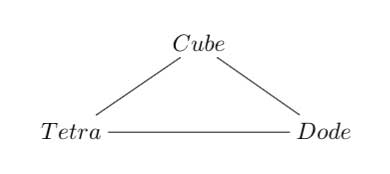
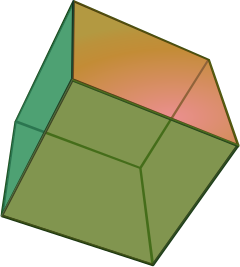
3 : Next comes the Platonic trinity of the tetrahedron, cube and dodecahedron

\xymatrix{& Cube \ar@{-}[rd] & \\ Tetra \ar@{-}[ru] \ar@{-}[rr] & & Dode}

Clearly one can argue against this trinity as follows : a tetrahedron is a bunch of triangles such that there are exactly 3 of them meeting in each vertex, a cube is a bunch of squares, again 3 meeting in every vertex, a dodecahedron is a bunch of pentagons 3 meeting in every vertex… and we can continue the pattern. What should be a bunch a hexagons such that in each vertex exactly 3 of them meet? Well, only one possibility : it must be the hexagonal tiling (on the left below). And in normal Euclidian space we cannot have a bunch of septagons such that three of them meet in every vertex, but in hyperbolic geometry this is still possible and leads to the Klein quartic (on the right). Check out this wonderful post by John Baez for more on this.

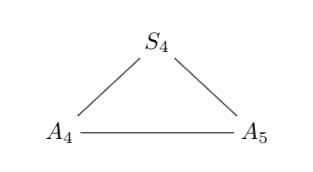
4 : The trinity of the rotation symmetry groups of the three Platonics

\xymatrix{& S_4 \ar@{-}[rd] & \\ A_4 \ar@{-}[ru] \ar@{-}[rr] & & A_5}

where A_n is the alternating group on n letters and S_n is the symmetric group.

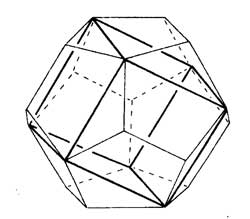
Clearly, any rotation of a Platonic solid takes vertices to vertices, edges to edges and faces to faces. For the tetrahedron we can easily see the 4 of the group A_4, say the 4 vertices. But what is the 4 of S_4 in the case of a cube? Well, a cube has 4 body-diagonals and they are permuted under the rotational symmetries. The most difficult case is to see the 5 of A_5 in the dodecahedron. Well, here’s the solution to this riddle

there are exactly 5 inscribed cubes in a dodecahedron and they are permuted by the rotations in the same way as A_5.

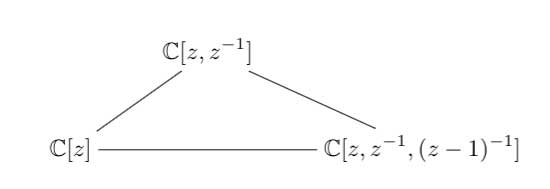
7 : The seventh trinity involves complex polynomials in one variable

\xymatrix{& \mathbb{C}[z,z^{-1}] \ar@{-}[rd] & \\ \mathbb{C}[z] \ar@{-}[ru] \ar@{-}[rr] & & \mathbb{C}[z,z^{-1},(z-1)^{-1}] }

the Laurant polynomials and the modular polynomials (that is, rational functions with three poles at 0,1 and \infty.

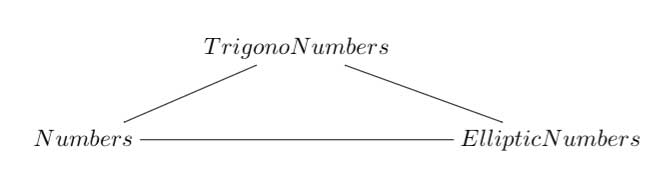
8 : The eight one is another beauty

\xymatrix{& TrigonoNumbers \ar@{-}[rd] & \\ Numbers \ar@{-}[ru] \ar@{-}[rr] & & EllipticNumbers }

Here ‘numbers’ are the ordinary complex numbers \mathbb{C}, the ‘trigonometric numbers’ are the quantum version of those (aka q-numbers) which is a one-parameter deformation and finally, the ‘elliptic numbers’ are a two-dimensional deformation. If you ever encountered a Sklyanin algebra this will sound familiar.

This trinity is based on a paper of Turaev and Frenkel and I must come back to it some time…

The paper has some other nice trinities (such as those among Whitney, Chern and Pontryagin classes) but as I cannot add anything sensible to it, let us include a few more algebraic trinities. The first one attributed by Arnold to John McKay

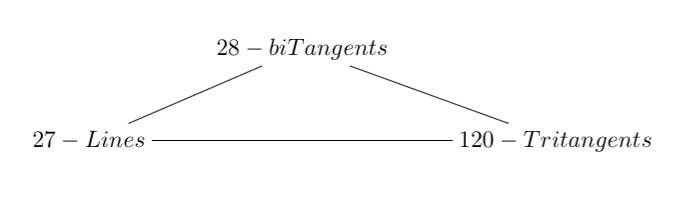
13 : A trinity parallel to the exceptional Lie algebra one is

\xymatrix{& 28-biTangents \ar@{-}[rd] & \\ 27-Lines \ar@{-}[ru] \ar@{-}[rr] & & 120-Tritangents }

between the 27 straight lines on a cubic surface, the 28 bitangents on a quartic plane curve and the 120 tritangent planes of a canonic sextic curve of genus 4.

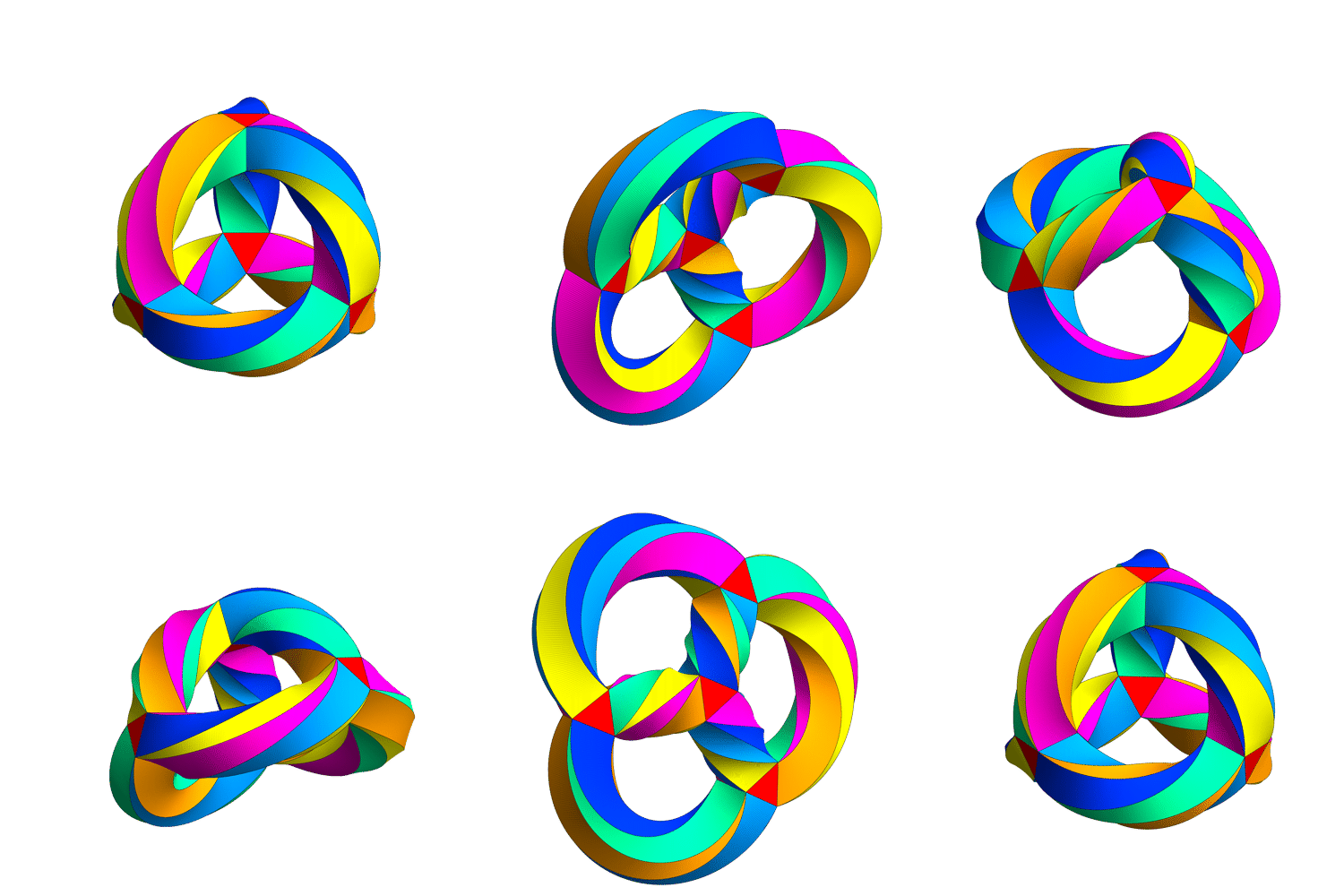
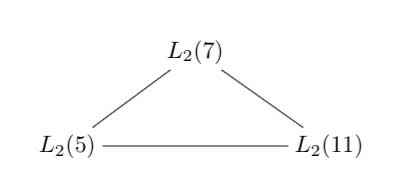
14 : The exceptional Galois groups

\xymatrix{& L_2(7) \ar@{-}[rd] & \\ L_2(5) \ar@{-}[ru] \ar@{-}[rr] & & L_2(11) }

explained last time.

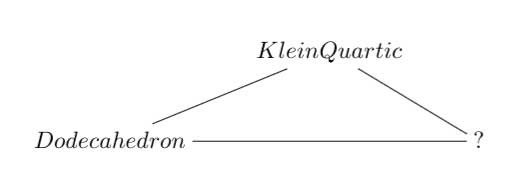
15 : The associated curves with these groups as symmetry groups (as in the previous post)

\xymatrix{& KleinQuartic \ar@{-}[rd] & \\ Dodecahedron \ar@{-}[ru] \ar@{-}[rr] & & ? }

where the ? refers to the mysterious genus 70 curve. I’ll check with one of the authors whether there is still an embargo on the content of this paper and if not come back to it in full detail.

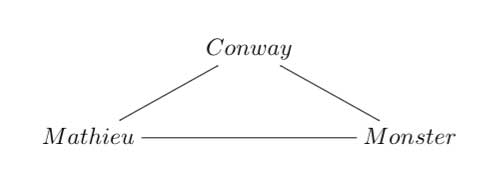
16 : The three generations of sporadic groups

\xymatrix{& Conway \ar@{-}[rd] & \\ Mathieu \ar@{-}[ru] \ar@{-}[rr] & & Monster }

Do you have other trinities you’d like to worship?

wankers

Thursday, April 10th, 2008

You may not have noticed, but I’m in a foul mood for weeks now because of comments and reactions to the last line of the post on Finding Moonshine. I wrote

Du Sautoy is a softy! I’d throw such students out of the window…

and got everyone against me for this (first floor) defenestration threat…

That’s OK! I sometimes post what’s on my mind and if you don’t like it you are free to leave a comment, and, usually I won’t even bother to reply to it. But occasionally, stuff is bottling up un-healthily.

So, I thought it was a good idea to have a prolonged easter-vacation, somewhere in the south of France. The weather, food, rest, drinks, company and all that were just gorgeous

but …

A quick recap. Here’s the relevant section in duSautoy’s book again :

One of my graduate students has just left my office. He’s done some great work over the past three years and is starting to write up his doctorate, but he’s just confessed that he’s not sure that he wants to be a mathematician. I’m feeling quite sobered by this news. My graduate students are like my children. They are the future of the subject. Who’s going to read all the details of my papers if not my mathematical offspring? The subject feels so tribal that anyone who says they want out is almost a threat to everything the tribe stands for.
Anton has been working on a project very close to my current problem. There’s no denying that one can feel quite disillusioned by not finding a way into a problem. Last year one of my post-docs left for the City after attempting to scale this mountain with me. I’d already rescued him from being dragged off to the City once before. But after battling with our problem and seeing it become more and more complex, he felt that he wasn’t really cut out for it.
What is unsettling for me is that they both questioned the importance of what we are doing. They’ve asked that ‘What’s it all for?’ question, and think they’ve seen the Emperor without any clothes.
Anton has questioned whether the problems we are working on are really important. I’ve explained why I think these are fundamental questions about basic objects in nature, but I can see that he isn’t convinced. I feel I am having to defend my whole existence. I’ve arranged for him to join me at a conference in Israel later this month, and I hope that seeing the rest of the tribe enthused and excited about these problems will re-inspire him. It will also show him that people are interested in what he is dedicating his time to.

For starters, I’m getting old so I’m from those long-forgotten days when you had to do a Ph.D. to prove that you could conduct research independently.

A fortiori this meant that the topic of your thesis was your own choice and interest. The role of your Ph.D. advisor was to get you going and, occasionally, to warn you when you were straying too far afield but that was it.

You, and only you, were responsible to get the thesis finished and defended.

Today, the Ph.D. is just another item on the market to be consumed.

Graduate students shop around looking for the advisor having the best sales-pitch, offers the best deal and, if possibly, the best after-phd service aka the promise of an academic career.

Topic and main outline of the proofs are provided by the advisor and an exceptionally good student today means that (s)he proved a few results along the way on her/his own.

University policy and the promotion-rat-race appear to make the Ph.D. more important to the advisor than to the defendent.

Independence of research today means that after your PhD is obtained, you ditch your advisor and try to get into the slipstream of another more powerful guru, having better after-phd service prospects…

For those who stick with their old advisor, the moment of truth comes when they fail to get a renewal of their grant or a permanent position.

At that time one can hear complaints such as : “That persons’ student got ranked ahead of me and I always thought you were better than that person?” or “The better ranked people for the position are all doing that topic instead of ‘ours’, so I guess your topic isn’t so important after all!”. duSautoy’s captures it all in this one key sentence :

They’ve asked that ‘What’s it all for?’ question, and think they’ve seen the Emperor without any clothes.

As if, failing to get a permanent position is the advisors fault, more than yours…

Just for once, try to be honest to yourself : count the number of hours a day your brain-power gets you over 120 IQ. Substract from this the number of hours a day lost surfing the web idly, trying to read unreadable hep-th papers, socializing, kissing asses, socializing, doing fun things with you fellow graduate students, socializing, working on a relation, chatting, texing, emailing insults but softening it all with a closing smily :) , socializing, etc… (you know the daily-drill of a 20-30-something phd-student a lot better than I do)

I’ll be damned if you get a positive outcome. But if you do, I’ll be happy to take you on as a PhD student…

Well, it’s no threat, it’s a promise : the first ex-student who gets me into a ‘why was it all good for?’ discussion will experience first floor defenestration! (provided I’ll get my window open in time)

And, to soften it all, I’ll add the obligatory :)

yahoo pipes on iTouch

Thursday, January 24th, 2008

The next thing on my tech-to-do-list : learn all about Yahoo Pipes :

Pipes is a powerful composition tool to aggregate, manipulate, and mashup content from around the web. Like Unix pipes, simple commands can be combined together to create output that meets your needs. Here are a few popular ways the service can be used:
- create your ultimate custom feed by combining many feeds into one, then sorting, filtering and translating them.
- geocode your favorite feeds and browse the items on an interactive map.
- remix your favorite data sources and use the Pipe to power a new application.
- build custom vertical search pages that are impossible with ordinary search engines.
- power widgets/badges on your web site.
- consume the output of any Pipe in RSS, JSON, KML, and other formats.

I’ve posted before on setting up your own lifestream, or your own planet, or scraping feeds, or subscribing to my brain, or … whatever. The good news is : all these ideas are now superseded by Pipes!

Pipes is a free online service that lets you remix popular feed types and create data mashups using a visual editor. You can use Pipes to run your own web projects, or publish and share your own web services without ever having to write a line of code. You make a Pipe by dragging pre-configured modules onto a canvas and wiring them together in the Pipes Editor. Once you’ve built a Pipe, you’ll be able save it on our server and then call it like you would any other feed. Pipes offers output in RSS 2.0, RSS 1.0 (RDF), JSON and Atom formats for maximum flexibility. You can also choose to publish your Pipe and share it with the world, allowing other users to clone it, add their own improvements, or use it as a subcomponent in their own creations.

This is the essential message to get : yahoo-pipes allows you to remix the web, filtering out all noise! And the good news is

  1. There are plenty of public pipes around to get you going, and
  2. Pipes has an iTouch-friendly interface (see above left). All you have to do is to Safari to iphone.pipes.yahoo.com and use them.

Here are a few public-pipes you can use out of the box!

  • iPhone / iPod Touch: The Most Comprehensive Feed Ever!, doing what it promises : giving you the best iTouch-posts without having to roam for them.
  • JSON Geocoder, returning lat/lon/address info from the the given address.
  • Uber Blog Search, Search all the blogosphere with one query. Hits Google, Ask, Technorati, and icerocket then returns the unique results. Below the web-interface giving the results for ‘noncommutative’…

and finally, one of my favorites, implementing to some extend the Lifestream-idea (iTouch-interface above left)

  • lifefeed - virable, Easily Aggregate your social whereabouts great for blogs profiles and more! Aggregates Your Feeds From: -Digg -Last.fm -Twitter -Flickr -Del.icio.us and your very own blog Adopt and Improve, enjoy!

I’ll promise to spend some time soon to set up my very own pipes and make them available…

wednesday bookshelf

Wednesday, February 21st, 2007

The Newtonian Legacy is a free online book by Nick Evans. If you want a (somewhat over-positively) review about it, head here. For me, it just didn’t work but then I’m an avid consumer of thrillers and like to be surprised. I read though to page 80 (of 138) which is pretty good as I usually lay down an unreadable book much sooner (most are lend from the public library, so I’d rather start a new one as soon as it becomes tiresome). But then I wanted to ‘learn about the frontier of particle physics within a fast paced crime adventure’. One exchange is pretty telling though (p. 40-41)

“Rule is don”t get involved in popularising science.” “That”s a bit harsh. We have to tell people what we”re doing if we want them to fund us,” said Carl. “Yeah, but it”s all lies. The theories are all mathematics, yet we say all words. That”s why we get these nut cases writing to us sometimes with “new theoriesiÃÇ. They”ve just read a popular science book and mistaken it for the core of science. They change some words and think they have a new theory. They don”t understand that you have to get the numbers right for every experiment you can think of. It”s just misleading.” “Well, OK,”conceded Carl, “but you can make the point that you”re just reporting a simplification and that if people want the real thing, they”d need maths.”Everyone sought inspiration in their pints again.

So, that’s why it is impossible to write about mathematics for a general public! Anyway, a bit frustrated I went to my favorite bookshops and read a blurb which sounded all too familiar.

Oxford, 2006: a young woman is found brutally murdered, her throat cut. Her heart has been removed and in its place lies an apparently ancient gold coin. Twenty-four hours later, another woman is found. The MO is identical, except that this time her brain has been removed, and a silver coin lies glittering in the bowl of her skull. The police are baffled but when police photographer, Philip Bainbridge and his estranged lover, Laura Niven become involved, they discover that these horrific, ritualistic murders are not confined to the here and now. And a shocking story begins to emerge which intertwines Sir Isaac Newton, one of seventeenth-century England’s most powerful figures, with a deadly conspiracy which echoes down the years to the present day, as lethal now as it was then. Before long those closest to Laura are in danger, and she finds herself the one person who can rewrite history; the only person who can stop the killer from striking again…

The first half of the book is rather promising (and at least its well written). Mathematics even makes a short appearance as daugther Jo is studying maths. Not that she contributes much of her talent to the story (apart from contributing to solving one riddle) and in the end it seems to be much more important to date the right boyfriend than to do math! The book really becomes laughable when the couple is trapped in a maze 100 feat below the Bodleian library. Pure Indiana Jones-remake : expecting pitfalls? here they come! what else do we remember of the movie? arrow-traps! sure enough they appear. Oh, this must be that movie, so whats next? well, sure enough (p. 343 “A massive block of stone crashed down from the lintel of the archway, landing squarely with a thump on the dusty floor. They were sealed in.” Presumably the authors inspiration dried out!

Mind you, I do not want to be negative on principle. Sometimes (too rare) I do read an enjoyable, interesting, intelligent thriller. The last one Ive read was

Brother Grimm by Craig Russell is a must read if you are into serial-killer stories. Heres the synopsis

A girl’s body lies, posed, on the pale sand of a Hamburg beach, a message concealed in her hand. ‘I have been underground, and now it is time for me to return home…’ Jan Fabel, of the Hamburg murder squad, struggles to interpret the twisted imagery of a dark and brutal mind. Four days later, a man and a woman are found deep in woodland, their throats slashed deep and wide, the names ‘Hansel’ and ‘Gretel’, in the same, tiny, obsessively neat writing, rolled tight and pressed into their hands. As it becomes clear that each new crime is a grisly reference to folk stories collected almost two hundred years ago by the Brothers Grimm, the hunt is on for a serial killer who is exploring our darkest, most fundamental fears - a predator who kills and then disappears into the shadows. He is a monster we all learned to fear in childhood.

An original point of view, an unorthodox setting (Hamburg!), interesting and real life personages what more do you want? Oh, you want to learn something from reading a bestseller? To me, this book was an eye-opener. Ever wondered why all these serial-killer-books become bestsellers? Here’s the answer (p. 227)

“Weiss toke a novel from the bookshell before him!! ‘Today we continuously reinvent these tales. The same stories, new characters. This is a bestseller - a story about the hunt for a serial killer who ritually dismembers his victims. These are our fairy tales today. These are our fables, our Maerchen. Instead of elves and kobolts and hungry wolves lurking in the dark corners of the woods, we have cannibals and dissectors and abductors lurking in the dark corners of our cities. It is in our nature to guise our evil as something extraordinary or something different: books and films about aliens, sharks, vampires, ghosts, witches. The fact of the matter is that there is one beast that is more dangerous, more predatory, tan any other in the history of nature. Us.”

bookmarks tuesday cleanup

Tuesday, February 20th, 2007

Geeky Mom : Why am I blogging?. Been there before. Sooner or later all non-pseudonomenous bloggers are faced with the same dilemmas. There’s really no answer or advice to give except : blog when you feel like it, if not do something different, after all its just one of those billion of blogs around.

Texmaker : another LaTeX-frontend, possibly having a few extras such as : a structure-pane including labels you gave to formulas, theorems etc. (click on them brings you to them). Intend to use it now as I’m in another rewrite of the never-ending-book..

Microformats : “Designed for humans first and machines second, microformats are a set of simple, open data formats built upon existing and widely adopted standards.” May have another look.

Quicksilver : a recurring link. At times when I feel learning key-strokes may save me a lot of time I have (another) go at Quicksilver. Last week, Ive reinstalled this blog more or less post by post and used keystrokes to send a line in the SQL-file of the database dump of NEB as a clipping to Scrivener to MultiMarkdown it further. I used the app Service Scrubber to define my own key-strokes. Must have another go at Quicksilver soon. Im sure it distinguishes ‚”power mac users” from the rest of us.

List of GTDTools : a good list of GTD-software. I’m probably just too chaotic for GTD to improve my workflow but somehow I cannot resist trying some of these things out.

LifeDEV : One of those sites that tells me I should take GTD more seriously

DoIt : One of these GTD-tools. It is said to go well with Quicksilver, so maybe, one day.

Think : Here a little seemingly completely useless tool which works well (at least for me). No, it does not make you think, but at least it helps you while you are thinking (or doing anything a bit focussed). Install it and enjoy! The principle is that it just blocks out all other open windows (and there are keystrokes (yes, again) to get you quickly in and out.) Besides, it looks great. It’s in my dock and this says it all

Thinkature : a brainstorming tool. Dont know why I did bookmark this. Perhaps one day, a few years from now

Stafford Talk : a talk by Toby Stafford I came across by accident. Maybe there are other interesting talks on the site?

Science Scouts : a great idea! Give yourself badges for how well you do science (or talk/write about science). Have to collect my badges soon. I’m sure this only works for people with a scouting-history, but who knows?

MacResearch : Here’s a site that may become useful. MacResearch.org is an open and independent community for scientists using Mac OS X and related hardware in their research. It is the mission of this site to cultivate a knowledgeable and vibrant community of researchers to exchange ideas and information, and collectively escalate the prominence of Apple technologies in the scientific research community. They have some interesting articles and tutorials on e.g. DevonThink and BibDesk etc. Worth to revisit.

Jennifer in love : well‚ should I say something about this? probably best not.

Breakthrough CLI : another pamphlet in favor of the Command Line! A must read for those who perfer GUIs to CLIs.

CLI - the site : Rod is working hard on CLI-20. Whenever he releases version 2.0, neverendingbooks will be among the first sites to run it. I still love the idea.

Why do I bother? : an n-category post I got briefly interested in, but was somehow flooded by professional math-philosophers

Newton Legacy Reviewed : just that, a first review on the next bookmark.

the Newton Legacy : a free online book, a murder mystery with a physics touch. Perhaps this is the best investment of time/energy : write a popular science book rather than another paper. Read half way through it (sorry but not the best prose Ive read so far), may continue but was held up reading a (real) murder mystery Equinox featuring also Newton and alchemy (must be in the air somehow), also not the best mystery read so far

Stalking with Googleearth : no comment

(to be continued)

AWSOM Powered