Posts Tagged ‘symmetry’


the “uninteresting” case p=5

Friday, July 4th, 2008
I was hoping you would write a post on the ‘uninteresting case’ of p=5 in this context. Note that the truncated tetrahedron has (V,E,F)=(12,18,8) which is a triple that appears in the ternary (cyclic) geometry for the cube. This triple can be 4 hexagons and 4 triangles (the truncated tetrahedron) OR 4 pentagons and 4 squares!

Kea commented and I didnt know the answer to the ‘obvious’ question :

how can one get the truncated tetrahedron from either of the two conjugacy classes of order 5 elements in L_2(5)=A_5, each consisting of 12 elements.

Fortunately the groups involved are small enough to enable hand-calculations. Probably there is a more elegant way to do this, but I was already happy to find this construction…

This time, there is just one conjugacy class of subgroups isomorphic to A_4 (the symmetry group of the (truncated) tetrahedron) in L_2(5)=A_5. Take one of the two conjugacy classes C of 5-cycles in A_5 and use the following notation for its 12 elements :

A=(1,2,3,4,5), B=(1,2,4,5,3), C=(1,2,5,3,4), D=(1,3,5,4,2), E=(1,3,2,5,4), F=(1,3,4,2,5), G=(1,5,4,3,2), H=(1,5,3,2,4), I=(1,5,2,4,3), J=(1,4,2,3,5), K=(1,4,5,2,3), L=(1,4,3,5,2)

We’d like to view these elements as the vertices of a truncated tetrahedron, so we need to find the 4 triangles and the 6 connecting edges between them. The first task calls for order 3 elements, the second one for order two elements.

Take a conjugacy class of order 3 elements in A_4 say T=\{ (2,4,3),(1,2,3),(1,3,4),(1,4,2) \} and observe that when one computes the products of T with a fixed 5-cycle in the conjugacy class C there is a unique element among the four obtained that belongs to the conjugacy class C. This gives a cyclic action on C with orbits of length 3 (the triangles). Here they are :

A–> J –> F –> A, B–>C–>H–>B, D–>G –> E–>D, I–>L–>K–>I

For the edges, take the conjugacy class S= \{ (1,2)(3,4),(1,3)(2,4),(1,4)(2,3) \} of order two elements in A_4 and compute for any 5-cycle c in C the products cSc and observe that among the elements obtained there is again one element belonging to C. This gives the following pairing

A<-->C, B<-->I, D<-->F, E<-->H, G<-->L and J<-->K and a bit of puzzling shows that all this can indeed be realized within a truncated tetrahedron (on the right). As to her other request

… and how about a post on how 1 + 4 + 9 + … + 24^2 = 70^2 is REALLY a statement about unifying cusps and holes (genus) as degrees of freedom in quantum geometry.

The scarecrow will need to take some time to think before giving his answer…

the buckyball curve

Wednesday, July 2nd, 2008

We are after the geometric trinity corresponding to the trinity of exceptional Galois groups

\xymatrix{& L_2(7) \ar@{-}[rd] & \\ L_2(5) \ar@{-}[ru] \ar@{-}[rr] & & L_2(11) } <------> \xymatrix{& \text{Klein quartic} \ar@{-}[rd] & \\ \text{Buckyball} \ar@{-}[ru] \ar@{-}[rr] & & \text{Buckyball curve} }

The surfaces on the right have the corresponding group on the left as their group of automorphisms. But, there is a lot more group-theoretic info hidden in the geometry. Before we sketch the L_2(11) case, let us recall the simpler situation of L_2(7).

There are some excellent web-page on the Klein quartic and it would be too hard to try to improve on them, so we refer to John Baez’ page and Greg Egan’s page for more details.

The Klein quartic is the degree 4 projective plane curve defined by the equation x^3y+y^3z+z^3x=0. It can be tiled with a set of 24 regular heptagons, or alternatively with a set of 56 equilateral triangles and these two tilings are dual to each other

In the triangular tiling, there are 56 triangles, 84 edges and 24 vertices. The 56 triangles come in 7 bunches of 8 each and we give the 7 bunches of triangles each a different color as in the pictures below made by Greg Egan. Observe that in the hyperbolic tiling all triangles look alike, but in the picture on the left most of them get warped as we try to embed the quartic in 3-space (which is impossible to do properly). The non-warped triangles (the red ones) come into pairs, the top and bottom triangles of a triangular prism, one prism at each of the four ‘vertices’ of a tetrahedron.

The automorphism group L_2(7) acts on these triangles as S_4 acts on the triangles in a truncated cube.

The buckyball construction from a conjugacy class of order 11 elements from L_2(11) recalled last time, has an analogon L_2(7), leading to the truncated cube.

In L_2(7) there are two conjugacy classes of subgroups isomorphic to S_4 (the rotation-symmetry group of the cube) as well as two conjugacy classes of order 7 elements, each consisting of precisely 24 elements, say C and D. The normalizer subgroup of C has order 21, so there is a cyclic group of order 3 acting non-trivially on the conjugacy class C with 8 orbits consisting of three elements each. These are the eight triangles of the truncated cube identified above as the red triangles.

Shifting perspective, we can repeat this for each of the seven different colors. That is, we have seven truncated cubes in the Klein quartic. On each of them a copy of S_4 acts and these subgroups form one of the two conjugacy classes of S_4 in the group L_2(7). The colors of the triangles of these seven truncated cubes are indicated by bullets in the picture above on the right. The other conjugacy class of S_4’s act on ‘truncated anti-cubes’ which also come in seven bunches of which the color is indicated by a square in that picture.

If you spend enough time on it you will see that each (truncated) cube is completely disjoint from precisely 3 (truncated) anti-cubes. This reminds us of the Fano-plane (picture on the left) : it has 7 points (our seven truncated cubes), 7 lines (the truncated anti-cubes) and the incidence relation of points and lines corresponds to the disjointness of (truncated) cubes and anti-cubes! This is the geometric interpretation of the group-theoretic realization that L_2(7) \simeq PGL_3(\mathbb{F}_2) is the isomorphism group of the projective plane over the finite field \mathbb{F}_2 on two elements, that is, the Fano plane. The colors of the picture on the left indicate the colors of cubes (points) and anti-cubes (lines) consistent with Egan’s picture above.

Further, the 24 vertices correspond to the 24 cusps of the modular group \Gamma(7). Recall that a modular interpretation of the Klein quartic is as \mathbb{H}/\Gamma(7) where \mathbb{H} is the upper half-plane on which the modular group \Gamma = PSL_2(\mathbb{Z}) acts via Moebius transformations, that is, to a 2×2 matrix corresponds the transformation

\begin{bmatrix} a & b \\ c & d \end{bmatrix} <---->  z \mapsto \frac{az+b}{cz+d}

Okay, now let’s briefly sketch the exciting results found by Pablo Martin and David Singerman in the paper From biplanes to the Klein quartic and the buckyball, extending the above to the group L_2(11).

There is one important modification to be made. Recall that the Cayley-graph to get the truncated cube comes from taking as generators of the group S_4 the set \{ (3,4),(1,2,3) \}, that is, an order two and an order three element, defining an epimorphism from the modular group \Gamma= C_2 \ast C_3 \rightarrow S_4.

We have also seen that in order to get the buckyball as a Cayley-graph for A_5 we need to take the generating set \{ (2,3)(4,5),(1,2,3,4,5) \}, so a degree two and a degree five element.

Hence, if we want to have a corresponding Riemann surface we’d better not start from the action of the modular group on the upper half-plane, but rather the action via Moebius transformations of the Hecke group

H^5 \simeq C_2 \ast C_5 = \langle z \mapsto -\frac{1}{z}, z \mapsto z+ \phi \rangle

where \phi = \frac{1 + \sqrt{5}}{2} is the golden ratio.

But then, there is an epimorphism H^5 \rightarrow L_2(11) (as this group is generated by one element of degree 2 and one of degree 5) and let \Lambda denote its kernel. Observe that \Lambda is the analogon of the modular subgroup \Gamma(7) used above to define the Klein quartic.

Hence, Martin and Singerman define the buckyball curve as the modular quotient X=\mathbb{H}/\Lambda which is a Riemann surface of genus 70.

The terminlogy is motivated by the fact that, precisely as we got 7 truncated cubes in the Klein quartic, we now get 11 truncated icosahedra (that is, buckyballs) in X. The 11 coming, analogous to the Klein case, from thefact that there are precisely two conjugacy classes of subgroups of L_2(11) isomorphic to A_5, each class containing precisely eleven elements! The 60 vertices of the buckyball again correspond to the fact that there are 60 cusps in this case.

So, what is the analogon of the Fano plane in this case? Well, observe that the Fano-plane is a biplane of order two. That is, if we take as ‘points’ the points of the Fano plane and as ‘lines’ the complements of lines in the Fano plane then this defines a biplane structure. This means that any two distinct ‘points’ are contained in two distinct ‘lines’ and that two distinct ‘lines’ intersect in two distinct ‘points’. A biplane is said to be of order k is each ‘line’ consist of k-2 ‘points’. As the complement of a line in the Fano plane consists of 4 points, the Fano plane is therefore a biplane of order 2. The intersection pattern of cubes and anti-cubes in the Klein quartic is this biplane structure on the Fano plane.

In a similar way, Martin and Singerman show that the two conjugacy classes of subgroups isomorphic to A_5 in L_2(11), each containing exactly 11 elements, correspond to 11 embedded buckyballs (and 11 anti-buckyballs) in the buckyball-curve X and that the intersection relations among them describe the combinatorial structure of a biplane of order three if we view the 11 buckys as ‘points’ and the anti-buckys as ‘lines’.

That is, the buckyball curve is a perfect geometric counterpart of the Klein quartic for the two trinities

\xymatrix{& L_2(7) \ar@{-}[rd] & \\ L_2(5) \ar@{-}[ru] \ar@{-}[rr] & & L_2(11) } <------> \xymatrix{& \text{Klein quartic} \ar@{-}[rd] & \\ \text{Buckyball} \ar@{-}[ru] \ar@{-}[rr] & & \text{Buckyball curve} }

At the Arcadian Functor, Kea also has a post on this in which she conjectures that the Kac-Moody algebra of E11 may be related to the buckyball curve.

References :

David Singerman, “Klein’s Riemann surface of genus 3 and regular embeddings of finite projective planes” Bull. London Math. Soc. 18 (1986) 364-370.

Pablo Martin and David Singerman, “From biplanes to the Klein quartic and the Buckyball” (note that this is a preliminary version, please contact David Singerman for the latest version).

the buckyball symmetries

Friday, June 27th, 2008

The buckyball is without doubt the hottest mahematical object at the moment (at least in Europe). Recall that the buckyball (middle) is a mixed form of two Platonic solids

the Icosahedron on the left and the Dodecahedron on the right.

For those of you who don’t know anything about football, it is that other ball-game, best described via a quote from the English player Gary Lineker

“Football is a game for 22 people that run around, play the ball, and one referee who makes a slew of mistakes, and in the end Germany always wins.”

We still have a few days left hoping for a better ending… Let’s do some bucky-maths : what is the rotation symmetry group of the buckyball?

For starters, dodeca- and icosahedron are dual solids, meaning that if you take the center of every face of a dodecahedron and connect these points by edges when the corresponding faces share an edge, you’ll end up with the icosahedron (and conversely). Therefore, both solids (as well as their mixture, the buckyball) will have the same group of rotational symmetries. Can we at least determine the number of these symmetries?

Take the dodecahedron and fix a face. It is easy to find a rotation taking this face to anyone of its five adjacent faces. In group-slang : the rotation automorphism group acts transitively on the 12 faces of the dodecohedron. Now, how many of them fix a given face? These can only be rotations with axis through the center of the face and there are exactly 5 of them preserving the pentagonal face. So, in all we have 12 \times 5 = 60 rotations preserving any of the three solids above. By composing two of its elements, we get another rotational symmetry, so they form a group and we would like to determine what that group is.

There is one group that springs to mind A_5, the subgroup of all even permutations on 5 elements. In general, the alternating group has half as many elements as the full permutation group S_n, that is \frac{1}{2} n! (for multiplying with the involution (1,2) gives a bijection between even and odd permutations). So, for A_5 we get 60 elements and we can list them :

  • the trivial permutation~(), being the identity.
  • permutations of order two with cycle-decompostion ~(i_1,i_2)(i_3,i_4), and there are exactly 15 of them around when all numbers are between 1 and 5.
  • permutations of order three with cycle-form ~(i_1,i_2,i_3) of which there are exactly 20.
  • permutations of order 5 which have to form one full cycle ~(i_1,i_2,i_3,i_4,i_5). There are 24 of those.

Can we at least view these sets of elements as rotations of the buckyball? Well, a dodecahedron has 12 pentagobal faces. So there are 4 nontrivial rotations of order 5 for every 2 opposite faces and hence the dodecaheder (and therefore also the buckyball) has indeed 6×4=24 order 5 rotational symmetries.

The icosahedron has twenty triangles as faces, so any of the 10 pairs of opposite faces is responsible for two non-trivial rotations of order three, giving us 10×2=20 order 3 rotational symmetries of the buckyball.

The order two elements are slightly harder to see. The icosahedron has 30 edges and there is a plane going through each of the 15 pairs of opposite edges splitting the icosahedron in two. Hence rotating to interchange these two edges gives one rotational symmetry of order 2 for each of the 15 pairs.

And as 24+20+15+1(identity) = 60 we have found all the rotational symmetries and we see that they pair up nicely with the elements of A_5. But do they form isomorphic groups? In other words, can the buckyball see the 5 in the group A_5.

In a previous post I’ve shown that one way to see this 5 is as the number of inscribed cubes in the dodecahedron. But, there is another way to see the five based on the order 2 elements described before.

If you look at pairs of opposite edges of the icosahedron you will find that they really come in triples such that the planes determined by each pair are mutually orthogonal (it is best to feel this on ac actual icosahedron). Hence there are 15/3 = 5 such triples of mutually orthogonal symmetry planes of the icosahedron and of course any rotation permutes these triples. It takes a bit of more work to really check that this action is indeed the natural permutation action of A_5 on 5 elements.

Having convinced ourselves that the group of rotations of the buckyball is indeed the alternating group A_5, we can reverse the problem : can the alternating group A_5 see the buckyball???

Well, for starters, it can ’see’ the icosahedron in a truly amazing way. Look at the conjugacy classes of A_5. We all know that in the full symmetric group S_n elements belong to the same conjugacy class if and only if they have the same cycle decomposition and this is proved using the fact that the conjugation f a cycle ~(i_1,i_2,\hdots,i_k) under a permutation \sigma \in S_n is equal to the cycle ~(\sigma(i_1),\sigma(i_2),\hdots,\sigma(i_k)) (and this gives us also the candidate needed to conjugate two partitions into each other).

Using this trick it is easy to see that all the 15 order 2 elements of A_5 form one conjugacy class, as do the 20 order 3 elements. However, the 24 order 5 elements split up in two conjugacy classes of 12 elements as the permutation needed to conjugate ~(1,2,3,4,5) to ~(1,2,3,5,4) is ~(4,5) but this is not an element of A_5.

Okay, now take one of these two conjugacy classes of order 5 elements, say that of ~(1,2,3,4,5). It consists of 12 elements, 12 being also the number of vertices of the icosahedron. So, is there a way to identify the elements in the conjugacy class to the vertices in such a way that we can describe the edges also in terms of group-computations in A_5?

Surprisingly, this is indeed the case as is demonstrated in a marvelous paper by Kostant “The graph of the truncated icosahedron and the last letter of Galois”.

Two elements a,b in the conjugacy class C share an edge if and only if their product a.b \in A_5 still belongs to the conjugacy class C!

So, for example ~(1,2,3,4,5).(2,1,4,3,5) = (2,5,4) so there is no edge between these elements, but on the other hand ~(1,2,3,4,5).(5,3,4,1,2)=(1,5,2,4,3) so there is an edge between these! It is no coincidence that ~(5,3,4,1,2)=(2,1,4,3,5)^{-1} as inverse elements correspond in the bijection to opposite vertices and for any pair of non-opposite vertices of an icosahedron it is true that either they are neighbors or any one of them is the neighbor of the opposite vertex of the other element.

If we take u=(1,2,3,4,5) and v=(5,3,4,1,2) (or any two elements of the conjugacy class such that u.v is again in the conjugacy class), then one can describe all the vertices of the icosahedron group-theoretically as follows

Isn’t that nice? Well yes, you may say, but that is just the icosahedron. Can the group A_5 also see the buckyball?

Well, let’s try a similar strategy : the buckyball has 60 vertices, exactly as many as there are elements in the group A_5. Is there a way to connect certain elements in a group according to fixed rules? Yes, there is such a way and it is called the Cayley Graph of a group. It goes like this : take a set of generators \{ g_1,\hdots,g_k \} of a group G, then connect two group element a,b \in G with an edge if and only if a = g_i.b or b = g_i.a for some of the generators.

Back to the alternating group A_5. There are several sets of generators, one of them being the elements \{ (1,2,3,4,5),(2,3)(4,5) \}. In the paper mentioned before, Kostant gives an impressive group-theoretic proof of the fact that the Cayley-graph of A_5 with respect to these two generators is indeed the buckyball!

Let us allow to be lazy for once and let SAGE do the hard work for us, and let us just watch the outcome. Here’s how that’s done

A=PermutationGroup(['(1,2,3,4,5)','(2,3)(4,5)'])
B=A.cayley_graph()
B.show3d()

The outcone is a nice 3-dimensional picture of the buckyball. Below you can see a still, and, if you click on it you will get a 3-dimensional model of it (first click the ‘here’ link in the new window and then you’d better control-click and set the zoom to 200% before you rotate it)

Hence, viewing this Cayley graph from different points we have convinced ourselves that it is indeed the buckyball. In fact, most (truncated) Platonic solids appear as Cayley graphs of groups with respect to specific sets of generators. For later use here is a (partial) survey (taken from Jaap’s puzzle page)

Tetrahedron : C_2 \times C_2,[(12)(34),(13)(24),(14)(23)]
Cube : D_4,[(1234),(13)]
Octahedron : S_3,[(123),(12),(23)]
Dodecahedron : IMPOSSIBLE
Icosahedron : A_4,[(123),(234),(13)(24)]

Truncated tetrahedron : A_4,[(123),(12)(34)]
Cuboctahedron : A_4,[(123),(234)]
Truncated cube : S_4,[(123),(34)]
Truncated octahedron : S_4,[(1234),(12)]
Rhombicubotahedron : S_4,[(1234),(123)]
Rhombitruncated cuboctahedron : IMPOSSIBLE
Snub cuboctahedron : S_4,[(1234),(123),(34)]

Icosidodecahedron : IMPOSSIBLE
Truncated dodecahedron : A_5,[(124),(23)(45)]
Truncated icosahedron : A_5,[(12345),(23)(45)]
Rhombicosidodecahedron : A_5,[(12345),(124)]
Rhombitruncated icosidodecahedron : IMPOSSIBLE
Snub Icosidodecahedron : A_5,[(12345),(124),(23)(45)]

Again, all these statements can be easily verified using SAGE via the method described before. Next time we will go further into the Kostant’s group-theoretic proof that the buckyball is the Cayley graph of A_5 with respect to (2,5)-generators as this calculation will be crucial in the description of the buckyball curve, the genus 70 Riemann surface discovered by David Singerman and Pablo Martin which completes the trinity corresponding to the Galois trinity

\xymatrix{& L_2(7) \ar@{-}[rd] & \\ L_2(5) \ar@{-}[ru] \ar@{-}[rr] & & L_2(11) } <------> \xymatrix{& \text{Klein quartic} \ar@{-}[rd] & \\ \text{Buckyball} \ar@{-}[ru] \ar@{-}[rr] & & \text{Buckyball curve} }

Arnold’s trinities version 2.0

Friday, June 20th, 2008

Arnold has written a follow-up to the paper mentioned last time called “Polymathematics : is mathematics a single science or a set of arts?” (or here for a (huge) PDF-conversion).

On page 8 of that paper is a nice summary of his 25 trinities :

I learned of this newer paper from a comment by Frederic Chapoton who maintains a nice webpage dedicated to trinities.

In his list there is one trinity on sporadic groups :

\xymatrix{& BabyMonster \ar@{-}[rd] & \\ F_{24} \ar@{-}[ru] \ar@{-}[rr] & & Monster}

where F_{24} is the Fischer simple group of order 2^{21}.3^{16}.5^2.7^3.11.13.17.23.29 = 1255205709190661721292800, which is the third largest sporadic group (the two larger ones being the Baby Monster and the Monster itself).

I don’t know what the rationale is behind this trinity. But I’d like to recall the (Baby)Monster history as a warning against the trinity-reflex. Sometimes, there is just no way to extend a would be trinity.

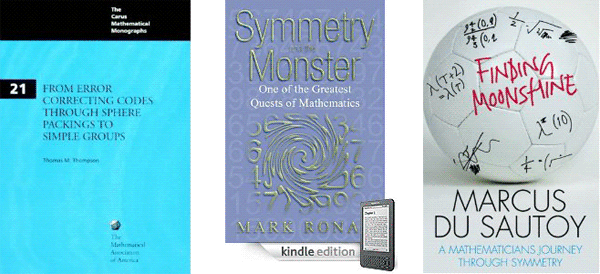
The story comes from Mark Ronan’s book Symmetry and the Monster on page 178.

Let’s remind ourselves how we got here. A few years earlier, Fischer has created his ‘transposition’ groups Fi22, Fi23, and Fi24. He had called them M(22), M(23), and M(24), because they were related to Mathieu’s groups M22,M23, and M24, and since he used Fi22 to create his new group of mirror symmetries, he tentatively called it M^{22}.
It seemed to appear as a cross-section in something even bigger, and as this larger group was clearly associated with Fi24, he labeled it M^{24}. Was there something in between that could be called M^{23}?
Fischer visited Cambridge to talk on his new work, and Conway named these three potential groups the Baby Monster, the Middle Monster, and the Super Monster. When it became clear that the Middle Monster didn’t exist, Conway settled on the names Baby Monster and Monster, and this became the standard terminology.

Marcus du Sautoy’s account in Finding Moonshine is slightly different. He tells on page 322 that the Super Monster didn’t exist. Anyone knowing the factual story?

Some mathematical trickery later revealed that the Super Monster was going to be impossible to build: there were certain features that contradicted each other. It was just a mirage, which vanished under closer scrutiny. But the other two were still looking robust. The Middle Monster was rechristened simply the Monster.

And, the inclusion diagram of the sporadic simples tells yet another story.

Anyhow, this inclusion diagram is helpful in seeing the three generations of the Happy Family (as well as the Pariahs) of the sporadic groups, terminology invented by Robert Griess in his 100+p Inventiones paper on the construction of the Monster (which he liked to call, for obvious reasons, the Friendly Giant denoted by FG). The happy family appears in Table 1.1. of the introduction.

It was this picture that made me propose the trinity on the left below in the previous post. I now like to add another trinity on the right, and, the connection between the two is clear.

\xymatrix{& Conway \ar@{-}[rd] & \\ Mathieu \ar@{-}[ru] \ar@{-}[rr] & & Monster} constructed using \xymatrix{& Leech \ar@{-}[rd] & \\ Golay \ar@{-}[ru] \ar@{-}[rr] & & Griess}

Here Golay denotes the extended binary Golay code of which the Mathieu group M_{24} is the automorphism group. Leech is of course the 24-dimensional Leech lattice of which the automorphism group is a double cover of the Conway group Co_1. Griess is the Griess algebra which is a nonassociative 196884-dimensional algebra of which the automorphism group is the Monster.

I am aware of a construction of the Leech lattice involving the quaternions (the icosian construction of chapter 8, section 2.2 of SPLAG). Does anyone know of a construction of the Griess algebra involving octonions???

Arnold’s trinities

Tuesday, June 17th, 2008

Referring to the triple of exceptional Galois groups L_2(5),L_2(7),L_2(11) and its connection to the Platonic solids I wrote : “It sure seems that surprises often come in triples…”. Briefly I considered replacing triples by trinities, but then, I didnt want to sound too mystic…

David Corfield of the n-category cafe and a dialogue on infinity (and perhaps other blogs I’m unaware of) pointed me to the paper Symplectization, complexification and mathematical trinities by Vladimir I. Arnold. (Update : here is a PDF-conversion of the paper)

The paper is a write-up of the second in a series of three lectures Arnold gave in june 1997 at the meeting in the Fields Institute dedicated to his 60th birthday. The goal of that lecture was to explain some mathematical dreams he had.

The next dream I want to present is an even more fantastic set of theorems and conjectures. Here I also have no theory and actually the ideas form a kind of religion rather than mathematics.
The key observation is that in mathematics one encounters many trinities. I shall present a list of examples. The main dream (or conjecture) is that all these trinities are united by some rectangular “commutative diagrams”.
I mean the existence of some “functorial” constructions connecting different trinities. The knowledge of the existence of these diagrams provides some new conjectures which might turn to be true theorems.

Follows a list of 12 trinities, many taken from Arnold’s field of expertise being differential geometry. I’ll restrict to the more algebraically inclined ones.

1 : “The first trinity everyone knows is”

\xymatrix{& \mathbb{C} \ar@{-}[rd] & \\ \mathbb{R} \ar@{-}[ru] \ar@{-}[rr] & & \mathbb{H}} but I would like to alter it into \xymatrix{& \mathbb{H} \ar@{-}[rd] & \\ \mathbb{C} \ar@{-}[ru] \ar@{-}[rr] & & \mathbb{O}}

where \mathbb{H} are the Hamiltonian quaternions. The trinity on the left may be natural to differential geometers who see real and complex and hyper-Kaehler manifolds as distinct but related beasts, but I’m willing to bet that most algebraists would settle for the trinity on the right where \mathbb{O} are the octonians.

2 : The next trinity is that of the exceptional Lie algebras E6, E7 and E8.

\xymatrix{& E_7 \ar@{-}[rd] & \\ E_6 \ar@{-}[ru] \ar@{-}[rr] & & E_8}

with corresponding Dynkin-Coxeter diagrams

Arnold has this to say about the apparent ubiquity of Dynkin diagrams in mathematics.

Manin told me once that the reason why we always encounter this list in many different mathematical classifications is its presence in the hardware of our brain (which is thus unable to discover a more complicated scheme).
I still hope there exists a better reason that once should be discovered.

Amen to that. I’m quite hopeful human evolution will overcome the limitations of Manin’s brain…

3 : Next comes the Platonic trinity of the tetrahedron, cube and dodecahedron

\xymatrix{& Cube \ar@{-}[rd] & \\ Tetra \ar@{-}[ru] \ar@{-}[rr] & & Dode}

Clearly one can argue against this trinity as follows : a tetrahedron is a bunch of triangles such that there are exactly 3 of them meeting in each vertex, a cube is a bunch of squares, again 3 meeting in every vertex, a dodecahedron is a bunch of pentagons 3 meeting in every vertex… and we can continue the pattern. What should be a bunch a hexagons such that in each vertex exactly 3 of them meet? Well, only one possibility : it must be the hexagonal tiling (on the left below). And in normal Euclidian space we cannot have a bunch of septagons such that three of them meet in every vertex, but in hyperbolic geometry this is still possible and leads to the Klein quartic (on the right). Check out this wonderful post by John Baez for more on this.

4 : The trinity of the rotation symmetry groups of the three Platonics

\xymatrix{& S_4 \ar@{-}[rd] & \\ A_4 \ar@{-}[ru] \ar@{-}[rr] & & A_5}

where A_n is the alternating group on n letters and S_n is the