Posts Tagged ‘representations’


Klein’s dessins d’enfant and the buckyball

Monday, June 30th, 2008

We saw that the icosahedron can be constructed from the alternating group A_5 by considering the elements of a conjugacy class of order 5 elements as the vertices and edges between two vertices if their product is still in the conjugacy class.

This description is so nice that one would like to have a similar construction for the buckyball. But, the buckyball has 60 vertices, so they surely cannot correspond to the elements of a conjugacy class of A_5. But, perhaps there is a larger group, somewhat naturally containing A_5, having a conjugacy class of 60 elements?

This is precisely the statement contained in Galois’ last letter. He showed that 11 is the largest prime p such that the group L_2(p)=PSL_2(\mathbb{F}_p) has a (transitive) permutation presentation on p elements. For, p=11 the group L_2(11) is of order 660, so it permuting 11 elements means that this set must be of the form X=L_2(11)/A with A \subset L_2(11) a subgroup of 60 elements… and it turns out that A \simeq A_5

Actually there are TWO conjugacy classes of subgroups isomorphic to A_5 in L_2(11) and we have already seen one description of these using the biplane geometry (one class is the stabilizer subgroup of a ‘line’, the other the stabilizer subgroup of a point).

Here, we will give yet another description of these two classes of A_5 in L_2(11), showing among other things that the theory of dessins d’enfant predates Grothendieck by 100 years.

In the very same paper containing the first depiction of the Dedekind tessellation, Klein found that there should be a degree 11 cover \mathbb{P}^1_{\mathbb{C}} \rightarrow \mathbb{P}^1_{\mathbb{C}} with monodromy group L_2(11), ramified only in the three points \{ 0,1,\infty \} such that there is just one point lying over \infty, seven over 1 of which four points where two sheets come together and finally 5 points lying over 0 of which three where three sheets come together. In 1879 he wanted to determine this cover explicitly in the paper “Ueber die Transformationen elfter Ordnung der elliptischen Funktionen” (Math. Annalen) by describing all Riemann surfaces with this ramification data and pick out those with the correct monodromy group.

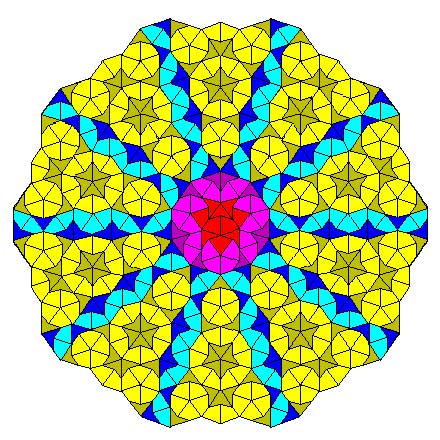
He manages to do so by associating to all these covers their ‘dessins d’enfants’ (which he calls Linienzuges), that is the pre-image of the interval [0,1] in which he marks the preimages of 0 by a bullet and those of 1 by a +, such as in the innermost darker graph on the right above. He even has these two wonderful pictures explaining how the dessin determines how the 11 sheets fit together. (More examples of dessins and the correspondences of sheets were drawn in the 1878 paper.)

The ramification data translates to the following statements about the Linienzuge : (a) it must be a tree (\infty has one preimage), (b) there are exactly 11 (half)edges (the degree of the cover), (c) there are 7 +-vertices and 5 o-vertices (preimages of 0 and 1) and (d) there are 3 trivalent o-vertices and 4 bivalent +-vertices (the sheet-information).

Klein finds that there are exactly 10 such dessins and lists them in his Fig. 2 (left). Then, he claims that one the two dessins of type I give the correct monodromy group. Recall that the monodromy group is found by giving each of the half-edges a number from 1 to 11 and looking at the permutation \tau of order two pairing the half-edges adjacent to a +-vertex and the order three permutation \sigma listing the half-edges by cycling counter-clockwise around a o-vertex. The monodromy group is the group generated by these two elements.

Fpr example, if we label the type V-dessin by the numbers of the white regions bordering the half-edges (as in the picture Fig. 3 on the right above) we get \sigma = (7,10,9)(5,11,6)(1,4,2) and \tau=(8,9)(7,11)(1,5)(3,4).

Nowadays, it is a matter of a few seconds to determine the monodromy group using GAP and we verify that this group is A_{11}.

Of course, Klein didn’t have GAP at his disposal, so he had to rule out all these cases by hand.

gap> g:=Group((7,10,9)(5,11,6)(1,4,2),(8,9)(7,11)(1,5)(3,4));
Group([ (1,4,2)(5,11,6)(7,10,9), (1,5)(3,4)(7,11)(8,9) ])
gap> Size(g);
19958400
gap> IsSimpleGroup(g);
true

Klein used the fact that L_2(7) only has elements of orders 1,2,3,5,6 and 11. So, in each of the remaining cases he had to find an element of a different order. For example, in type V he verified that the element \tau.(\sigma.\tau)^3 is equal to the permutation (1,8)(2,10,11,9,6,4,5)(3,7) and consequently is of order 14.

Perhaps Klein knew this but GAP tells us that the monodromy group of all the remaining 8 cases is isomorphic to the alternating group A_{11} and in the two type I cases is indeed L_2(11). Anyway, the two dessins of type I correspond to the two conjugacy classes of subgroups A_5 in the group L_2(11).

But, back to the buckyball! The upshot of all this is that we have the group L_2(11) containing two classes of subgroups isomorphic to A_5 and the larger group L_2(11) does indeed have two conjugacy classes of order 11 elements containing exactly 60 elements (compare this to the two conjugacy classes of order 5 elements in A_5 in the icosahedral construction). Can we construct the buckyball out of such a conjugacy class?

To start, we can identify the 12 pentagons of the buckyball from a conjugacy class C of order 11 elements. If x \in C, then so do x^3,x^4,x^5 and x^9, whereas the powers \{ x^2,x^6,x^7,x^8,x^{10} \} belong to the other conjugacy class. Hence, we can divide our 60 elements in 12 subsets of 5 elements and taking an element x in each of these, the vertices of a pentagon correspond (in order) to ~(x,x^3,x^9,x^5,x^4).

Group-theoretically this follows from the fact that the factorgroup of the normalizer of x modulo the centralizer of x is cyclic of order 5 and this group acts naturally on the conjugacy class of x with orbits of size 5.

Finding out how these pentagons fit together using hexagons is a lot subtler… and in The graph of the truncated icosahedron and the last letter of Galois Bertram Kostant shows how to do this.

Fix a subgroup isomorphic to A_5 and let D be the set of all its order 2 elements (recall that they form a full conjugacy class in this A_5 and that there are precisely 15 of them). Now, the startling observation made by Kostant is that for our order 11 element x in C there is a unique element a \in D such that the commutator~b=[x,a]=x^{-1}a^{-1}xa belongs again to D. The unique hexagonal side having vertex x connects it to the element b.xwhich belongs again to C as b.x=(ax)^{-1}.x.(ax).

Concluding, if C is a conjugacy class of order 11 elements in L_2(11), then its 60 elements can be viewed as corresponding to the vertices of the buckyball. Any element x \in C is connected by two pentagonal sides to the elements x^{3} and x^4 and one hexagonal side connecting it to \tau x = b.x.

Galois’ last letter

Thursday, June 12th, 2008
“Ne pleure pas, Alfred ! J’ai besoin de tout mon courage pour mourir à vingt ans!”

We all remember the last words of Evariste Galois to his brother Alfred. Lesser known are the mathematical results contained in his last letter, written to his friend Auguste Chevalier, on the eve of his fatal duel. Here the final sentences :

Tu prieras publiquement Jacobi ou Gauss de donner leur avis non sur la verite, mais sur l’importance des theoremes.
Apres cela il se trouvera, j’espere, des gens qui trouvent leur profis a dechiffrer tout ce gachis.
Je t’embrasse avec effusion. E. Galois, le 29 Mai 1832

A major result contained in this letter concerns the groups L_2(p)=PSL_2(\mathbb{F}_p), that is the group of 2 \times 2 matrices with determinant equal to one over the finite field \mathbb{F}_p modulo its center. L_2(p) is known to be simple whenever p \geq 5. Galois writes that L_2(p) cannot have a non-trivial permutation representation on fewer than p+1 symbols whenever p > 11 and indicates the transitive permutation representation on exactly p symbols in the three ‘exceptional’ cases p=5,7,11.

Let \alpha = \begin{bmatrix} 1 & 1 \\ 0 & 1 \end{bmatrix} and consider for p=5,7,11 the involutions on \mathbb{P}^1_{\mathbb{F}_p} = \mathbb{F}_p \cup \{ \infty \} (on which L_2(p) acts via Moebius transformations)

\pi_5 = (0,\infty)(1,4)(2,3) \quad \pi_7=(0,\infty)(1,3)(2,6)(4,5) \quad \pi_{11}=(0,\infty)(1,6)(3,7)(9,10)(5,8)(4,2)

(in fact, Galois uses the involution ~(0,\infty)(1,2)(3,6)(4,8)(5,10)(9,7) for p=11), then L_2(p) leaves invariant the set consisting of the p involutions \Pi = \{ \alpha^{-i} \pi_p \alpha^i~:~1 \leq i \leq p \}. After mentioning these involutions Galois merely writes :

Ainsi pour le cas de p=5,7,11, l’equation modulaire s’abaisse au degre p.
En toute rigueur, cette reduction n’est pas possible dans les cas plus eleves.

Alternatively, one can deduce these permutation representation representations from group isomorphisms. As L_2(5) \simeq A_5, the alternating group on 5 symbols, L_2(5) clearly acts transitively on 5 symbols.

Similarly, for p=7 we have L_2(7) \simeq L_3(2) and so the group acts as automorphisms on the projective plane over the field on two elements \mathbb{P}^2_{\mathbb{F}_2} aka the Fano plane, as depicted on the left.

This finite projective plane has 7 points and 7 lines and L_3(2) acts transitively on them.

For p=11 the geometrical object is a bit more involved. The set of non-squares in \mathbb{F}_{11} is

\{ 1,3,4,5,9 \}

and if we translate this set using the additive structure in \mathbb{F}_{11} one obtains the following 11 five-element sets

\{ 1,3,4,5,9 \}, \{ 2,4,5,6,10 \}, \{ 3,5,6,7,11 \}, \{ 1,4,6,7,8 \}, \{ 2,5,7,8,9 \}, \{ 3,6,8,9,10 \},

 \{ 4,7,9,10,11 \}, \{ 1,5,8,10,11 \}, \{ 1,2,6,9,11 \}, \{ 1,2,3,7,10 \}, \{ 2,3,4,8,11 \}

and if we regard these sets as ‘lines’ we see that two distinct lines intersect in exactly 2 points and that any two distinct points lie on exactly two ‘lines’. That is, intersection sets up a bijection between the 55-element set of all pairs of distinct points and the 55-element set of all pairs of distinct ‘lines’. This is called the biplane geometry.

The subgroup of S_{11} (acting on the eleven elements of \mathbb{F}_{11}) stabilizing this set of 11 5-element sets is precisely the group L_2(11) giving the permutation representation on 11 objects.

An alternative statement of Galois’ result is that for p > 11 there is no subgroup of L_2(p) complementary to the cyclic subgroup

C_p = \{ \begin{bmatrix} 1 & x \\ 0 & 1 \end{bmatrix}~:~x \in \mathbb{F}_p \}

That is, there is no subgroup such that set-theoretically L_2(p) = F \times C_p (note this is of courese not a group-product, all it says is that any element can be written as g=f.c with f \in F, c \in C_p.

However, in the three exceptional cases we do have complementary subgroups. In fact, set-theoretically we have

L_2(5) = A_4 \times C_5 \qquad L_2(7) = S_4 \times C_7 \qquad L_2(11) = A_5 \times C_{11}

and it is a truly amazing fact that the three groups appearing are precisely the three Platonic groups!

Recall that here are 5 Platonic (or Scottish) solids coming in three sorts when it comes to rotation-automorphism groups : the tetrahedron (group A_4), the cube and octahedron (group S_4) and the dodecahedron and icosahedron (group A_5). The “4″ in the cube are the four body diagonals and the “5″ in the dodecahedron are the five inscribed cubes.

That is, our three ‘exceptional’ Galois-groups correspond to the three Platonic groups, which in turn correspond to the three exceptional Lie algebras E_6,E_7,E_8 via McKay correspondence (wrt. their 2-fold covers). Maybe I’ll detail this latter connection another time. It sure seems that surprises often come in triples…

Finally, it is well known that L_2(5) \simeq A_5 is the automorphism group of the icosahedron (or dodecahedron) and that L_2(7) is the automorphism group of the Klein quartic.

So, one might ask : is there also a nice curve connected with the third group L_2(11)? Rumour has it that this is indeed the case and that the curve in question has genus 70… (to be continued).

Reference

Bertram Kostant, “The graph of the truncated icosahedron and the last letter of Galois”

the McKay-Thompson series

Saturday, March 22nd, 2008

Monstrous moonshine was born (sometime in 1978) the moment John McKay realized that the linear term in the j-function

j(q) = \frac{1}{q} + 744 + 196884 q + 21493760 q^2 + 864229970 q^3 + \hdots

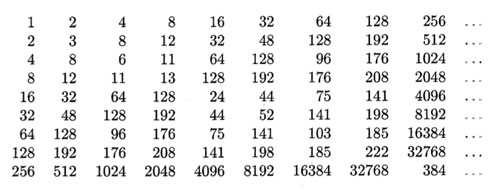
is surprisingly close to the dimension of the smallest non-trivial irreducible representation of the monster group, which is 196883. Note that at that time, the Monster hasn’t been constructed yet, and, the only traces of its possible existence were kept as semi-secret information in a huge ledger (costing 80 pounds…) kept in the Atlas-office at Cambridge. Included were 8 huge pages describing the character table of the monster, the top left fragment, describing the lower dimensional irreducibles and their characters at small order elements, reproduced below

If you look at the dimensions of the smallest irreducible representations (the first column) : 196883, 21296876, 842609326, … you will see that the first, second and third of them are extremely close to the linear, quadratic and cubic coefficient of the j-function. In fact, more is true : one can obtain these actual j-coefficients as simple linear combination of the dimensions of the irrducibles :

\begin{cases} 196884 &= 1 + 196883 \\
21493760 &= 1 + 196883 + 21296876 \\
864229970 &= 2 \times 1 + 2 \times 196883 + 21296876 + 842609326
\end{cases}

Often, only the first relation is attributed to McKay, whereas the second and third were supposedly discovered by John Thompson after MKay showed him the first. Marcus du Sautoy tells a somewhat different sory in Finding Moonshine :

McKay has also gone on to find these extra equations, but is was Thompson who first published them. McKay admits that “I was a bit peeved really, I don’t think Thompson quite knew how much I knew.”

By the work of Richard Borcherds we now know the (partial according to some) explanation behind these numerical facts : there is a graded representation V = \oplus_i V_i of the Monster-group (actually, it has a lot of extra structure such as being a vertex algebra) such that the dimension of the i-th factor V_i equals the coefficient f q^i in the j-function. The homogeneous components V_i being finite dimensional representations of the monster, they decompose into the 194 irreducibles X_j. For the first three components we have the decompositions

\begin{cases} V_1 &= X_1 \oplus X_2 \\
V_2 &= X_1 \oplus X_2 \oplus X_3 \\
V_3 &= X_1^{\oplus 2 } \oplus X_2^{\oplus 2} \oplus X_3 \oplus X_4
\end{cases}

Calculating the dimensions on both sides give the above equations. However, being isomorphisms of monster-representations we are not restricted to just computing the dimensions. We might as well compute the character of any monster-element on both sides (observe that the dimension is just the character of the identity element). Characters are the traces of the matrices describing the action of a monster-element on the representation and these numbers fill the different columns of the character-table above.

Hence, the same integral combinations of the character values of any monster-element give another q-series and these are called the McKay-Thompson series. John Conway discovered them to be classical modular functions known as Hauptmoduln.

In most papers and online material on this only the first few coefficients of these series are documented, which may be just too little information to make new discoveries!

Fortunately, David Madore has compiled the first 3200 coefficients of all the 172 monster-series which are available in a huge 8Mb file. And, if you really need to have more coefficients, you can always use and modify his moonshine python program.

In order to reduce bandwidth, here a list containing the first 100 coefficients of the j-function

jfunct=[196884, 21493760, 864299970, 20245856256, 333202640600, 4252023300096, 44656994071935, 401490886656000, 3176440229784420, 22567393309593600, 146211911499519294, 874313719685775360, 4872010111798142520, 25497827389410525184, 126142916465781843075, 593121772421445058560, 2662842413150775245160, 11459912788444786513920, 47438786801234168813250, 189449976248893390028800, 731811377318137519245696, 2740630712513624654929920, 9971041659937182693533820, 35307453186561427099877376, 121883284330422510433351500, 410789960190307909157638144, 1353563541518646878675077500, 4365689224858876634610401280, 13798375834642999925542288376, 42780782244213262567058227200, 130233693825770295128044873221, 389608006170995911894300098560, 1146329398900810637779611090240, 3319627709139267167263679606784, 9468166135702260431646263438600, 26614365825753796268872151875584, 73773169969725069760801792854360, 201768789947228738648580043776000, 544763881751616630123165410477688, 1452689254439362169794355429376000, 3827767751739363485065598331130120, 9970416600217443268739409968824320, 25683334706395406994774011866319670, 65452367731499268312170283695144960, 165078821568186174782496283155142200, 412189630805216773489544457234333696, 1019253515891576791938652011091437835, 2496774105950716692603315123199672320, 6060574415413720999542378222812650932, 14581598453215019997540391326153984000, 34782974253512490652111111930326416268, 82282309236048637946346570669250805760, 193075525467822574167329529658775261720, 449497224123337477155078537760754122752, 1038483010587949794068925153685932435825, 2381407585309922413499951812839633584128, 5421449889876564723000378957979772088000, 12255365475040820661535516233050165760000, 27513411092859486460692553086168714659374, 61354289505303613617069338272284858777600, 135925092428365503809701809166616289474168, 299210983800076883665074958854523331870720, 654553043491650303064385476041569995365270, 1423197635972716062310802114654243653681152, 3076095473477196763039615540128479523917200, 6610091773782871627445909215080641586954240, 14123583372861184908287080245891873213544410, 30010041497911129625894110839466234009518080, 63419842535335416307760114920603619461313664, 133312625293210235328551896736236879235481600, 278775024890624328476718493296348769305198947, 579989466306862709777897124287027028934656000, 1200647685924154079965706763561795395948173320, 2473342981183106509136265613239678864092991488, 5070711930898997080570078906280842196519646750, 10346906640850426356226316839259822574115946496, 21015945810275143250691058902482079910086459520, 42493520024686459968969327541404178941239869440, 85539981818424975894053769448098796349808643878, 171444843023856632323050507966626554304633241600, 342155525555189176731983869123583942011978493364, 679986843667214052171954098018582522609944965120, 1345823847068981684952596216882155845897900827370, 2652886321384703560252232129659440092172381585408, 5208621342520253933693153488396012720448385783600, 10186635497140956830216811207229975611480797601792, 19845946857715387241695878080425504863628738882125, 38518943830283497365369391336243138882250145792000, 74484518929289017811719989832768142076931259410120, 143507172467283453885515222342782991192353207603200, 275501042616789153749080617893836796951133929783496, 527036058053281764188089220041629201191975505756160, 1004730453440939042843898965365412981690307145827840, 1908864098321310302488604739098618405938938477379584, 3614432179304462681879676809120464684975130836205250, 6821306832689380776546629825653465084003418476904448, 12831568450930566237049157191017104861217433634289960, 24060143444937604997591586090380473418086401696839680, 44972195698011806740150818275177754986409472910549646, 83798831110707476912751950384757452703801918339072000]

This information will come in handy when we will organize our Monstrous Easter Egg Race, starting tomorrow at 6 am (GMT)…

Farey symbols of sporadic groups

Thursday, March 20th, 2008

John Conway once wrote :

There are almost as many different constructions of M_{24} as there have been mathematicians interested in that most remarkable of all finite groups.

In the inguanodon post Ive added yet another construction of the Mathieu groups M_{12} and M_{24} starting from (half of) the Farey sequences and the associated cuboid tree diagram obtained by demanding that all edges are odd. In this way the Mathieu groups turned out to be part of a (conjecturally) infinite sequence of simple groups, starting as follows :

L_2(7),M_{12},A_{16},M_{24},A_{28},A_{40},A_{48},A_{60},A_{68},A_{88},A_{96},A_{120},A_{132},A_{148},A_{164},A_{196},\hdots

It is quite easy to show that none of the other sporadics will appear in this sequence via their known permutation representations. Still, several of the sporadic simple groups are generated by an element of order two and one of order three, so they are determined by a finite dimensional permutation representation of the modular group PSL_2(\mathbb{Z}) and hence are hiding in a special polygonal region of the Dedekind’s tessellation

Let us try to figure out where the sporadic with the next simplest permutation representation is hiding : the second Janko group J_2, via its 100-dimensional permutation representation. The Atlas tells us that the order two and three generators act as

e:= (1,84)(2,20)(3,48)(4,56)(5,82)(6,67)(7,55)(8,41)(9,35)(10,40)(11,78)(12, 100)(13,49)(14,37)(15,94)(16,76)(17,19)(18,44)(21,34)(22,85)(23,92)(24, 57)(25,75)(26,28)(27,64)(29,90)(30,97)(31,38)(32,68)(33,69)(36,53)(39,61) (42,73)(43,91)(45,86)(46,81)(47,89)(50,93)(51,96)(52,72)(54,74)(58,99) (59,95)(60,63)(62,83)(65,70)(66,88)(71,87)(77,98)(79,80);

v:= (1,80,22)(2,9,11)(3,53,87)(4,23,78)(5,51,18)(6,37,24)(8,27,60)(10,62,47) (12,65,31)(13,64,19)(14,61,52)(15,98,25)(16,73,32)(17,39,33)(20,97,58) (21,96,67)(26,93,99)(28,57,35)(29,71,55)(30,69,45)(34,86,82)(38,59,94) (40,43,91)(42,68,44)(46,85,89)(48,76,90)(49,92,77)(50,66,88)(54,95,56) (63,74,72)(70,81,75)(79,100,83);

But as the kfarey.sage package written by Chris Kurth calculates the Farey symbol using the L-R generators, we use GAP to find those

L = e*v^-1  and  R=e*v^-2 so

L=(1,84,22,46,70,12,79)(2,58,93,88,50,26,35)(3,90,55,7,71,53,36)(4,95,38,65,75,98,92)(5,86,69,39,14,6,96)(8,41,60,72,61,17, 64)(9,57,37,52,74,56,78)(10,91,40,47,85,80,83)(11,23,49,19,33,30,20)(13,77,15,59,54,63,27)(16,48,87,29,76,32,42)(18,68, 73,44,51,21,82)(24,28,99,97,45,34,67)(25,81,89,62,100,31,94)

R=(1,84,80,100,65,81,85)(2,97,69,17,13,92,78)(3,76,73,68,16,90,71)(4,54,72,14,24,35,11)(5,34,96,18,42,32,44)(6,21,86,30,58, 26,57)(7,29,48,53,36,87,55)(8,41,27,19,39,52,63)(9,28,93,66,50,99,20)(10,43,40,62,79,22,89)(12,83,47,46,75,15,38)(23,77, 25,70,31,59,56)(33,45,82,51,67,37,61)(49,64,60,74,95,94,98)

Defining these permutations in sage and using kfarey, this gives us the Farey-symbol of the associated permutation representation

L=SymmetricGroup(Integer(100))("(1,84,22,46,70,12,79)(2,58,93,88,50,26,35)(3,90,55,7,71,53,36)(4,95,38,65,75,98,92)(5,86,69,39,14,6,96)(8,41,60,72,61,17, 64)(9,57,37,52,74,56,78)(10,91,40,47,85,80,83)(11,23,49,19,33,30,20)(13,77,15,59,54,63,27)(16,48,87,29,76,32,42)(18,68, 73,44,51,21,82)(24,28,99,97,45,34,67)(25,81,89,62,100,31,94)")

R=SymmetricGroup(Integer(100))("(1,84,80,100,65,81,85)(2,97,69,17,13,92,78)(3,76,73,68,16,90,71)(4,54,72,14,24,35,11)(5,34,96,18,42,32,44)(6,21,86,30,58, 26,57)(7,29,48,53,36,87,55)(8,41,27,19,39,52,63)(9,28,93,66,50,99,20)(10,43,40,62,79,22,89)(12,83,47,46,75,15,38)(23,77, 25,70,31,59,56)(33,45,82,51,67,37,61)(49,64,60,74,95,94,98)")

sage: FareySymbol("Perm",[L,R])

[[0, 1, 4, 3, 2, 5, 18, 13, 21, 71, 121, 413, 292, 463, 171, 50, 29, 8, 27, 46, 65, 19, 30, 11, 3, 10, 37, 64, 27, 17, 7, 4, 5], [1, 1, 3, 2, 1, 2, 7, 5, 8, 27, 46, 157, 111, 176, 65, 19, 11, 3, 10, 17, 24, 7, 11, 4, 1, 3, 11, 19, 8, 5, 2, 1, 1], [-3, 1, 4, 4, 2, 3, 6, -3, 7, 13, 14, 15, -3, -3, 15, 14, 11, 8, 8, 10, 12, 12, 10, 9, 5, 5, 9, 11, 13, 7, 6, 3, 2, 1]]

Here, the first string gives the numerators of the cusps, the second the denominators and the third gives the pairing information (where [tex[-2[/tex] denotes an even edge and -3 an odd edge. Fortunately, kfarey also allows us to draw the special polygonal region determined by a Farey-symbol. So, here it is (without the pairing data) :

the hiding place of J_2

It would be nice to have (a) other Farey-symbols associated to the second Janko group, hopefully showing a pattern that one can extend into an infinite family as in the inguanodon series and (b) to determine Farey-symbols of more sporadic groups.

KMS, Gibbs & zeta function

Thursday, February 21st, 2008

Time to wrap up this series on the Bost-Connes algebra. Here’s what we have learned so far : the convolution product on double cosets

\begin{bmatrix} 1 & \mathbb{Z} \\ 0 & 1 \end{bmatrix} \backslash \begin{bmatrix} 1 & \mathbb{Q} \\ 0 & \mathbb{Q}_{> 0} \end{bmatrix} / \begin{bmatrix} 1 & \mathbb{Z} \\ 0 & 1 \end{bmatrix}

is a noncommutative algebra, the Bost-Connes Hecke algebra \mathcal{H}, which is a bi-chrystalline graded algebra (somewhat weaker than ’strongly graded’) with part of degree one the group-algebra \mathbb{Q}[\mathbb{Q}/\mathbb{Z}]. Further, \mathcal{H} has a natural one-parameter family of algebra automorphisms \sigma_t defined by \sigma_t(X_n) = n^{it}X_n and \sigma_t(Y_{\lambda})=Y_{\lambda}.

For any algebra A together with a one-parameter family of automorphisms \sigma_t one is interested in KMS-states or Kubo-Martin-Schwinger states with parameter \beta, KMS_{\beta} (this parameter is often called the ‘invers temperature’ of the system) as these are suitable equilibria states. Recall that a state is a special linear functional \phi on A (in particular it must have norm one) and it belongs to KMS_{\beta} if the following commutation relation holds for all elements a,b \in A

\phi(a \sigma_{i\beta}(b)) = \phi(b a)

Let us work out the special case when A is the matrix-algebra M_n(\mathbb{C}). To begin, all algebra-automorphisms are inner in this case, so any one-parameter family of automorphisms is of the form

\sigma_t(a) = e^{itH} a e^{-itH}

where e^{itH} is the matrix-exponential of the nxn matrix H. For any parameter \beta we claim that the linear functional

\phi(a) = \frac{1}{tr(e^{-\beta H})} tr(a e^{-\beta H})

is a KMS-state.Indeed, we have for all matrices a,b \in M_n(\mathbb{C}) that

\phi(a \sigma_{i \beta}(b)) = \frac{1}{tr(e^{-\beta H})} tr(a e^{- \beta H} b e^{\beta H} e^{- \beta H})

= \frac{1}{tr(e^{-\beta H})} tr(a e^{-\beta H} b) = \frac{1}{tr(e^{-\betaH})} tr(ba e^{-\beta H}) = \phi(ba)

(the next to last equality follows from cyclic-invariance of the trace map). These states are usually called Gibbs states and the normalization factor \frac{1}{tr(e^{-\beta H})} (needed because a state must have norm one) is called the partition function of the system. Gibbs states have arisen from the study of ideal gases and the place to read up on all of this are the first two chapters of the second volume of “Operator algebras and quantum statistical mechanics” by Ola Bratelli and Derek Robinson.

This gives us a method to construct KMS-states for an arbitrary algebra A with one-parameter automorphisms \sigma_t : take a simple n-dimensional representation \pi~:~A \mapsto M_n(\mathbb{C}), find the matrix H determining the image of the automorphisms \pi(\sigma_t) and take the Gibbs states as defined before.

Let us return now to the Bost-Connes algebra \mathcal{H}. We don’t know any finite dimensional simple representations of \mathcal{H} but, sure enough, have plenty of graded simple representations. By the usual strongly-graded-yoga they should correspond to simple finite dimensional representations of the part of degree one \mathbb{Q}[\mathbb{Q}/\mathbb{Z}] (all of them being one-dimensional and corresponding to characters of \mathbb{Q}/\mathbb{Z}).

Hence, for any u \in \mathcal{G} = \prod_p \hat{\mathbb{Z}}_p^{\ast} ( details) we have a graded simple \mathcal{H}-representation S_u = \oplus_{n \in \mathbb{N}_+} \mathbb{C} e_n with action defined by

\begin{cases} \pi_u(X_n)(e_m) = e_{nm} \\ \pi_u(Y_{\lambda})(e_m) = e^{2\pi i n u . \lambda} e_m \end{cases}

Here, u.\lambda is computed using the ‘chinese-remainder-identification’ \mathcal{A}/\mathcal{R} = \mathbb{Q}/\mathbb{Z} ( details).

Even when the representations S_u are not finite dimensional, we can mimic the above strategy : we should find a linear operator H determining the images of the automorphisms \pi_u(\sigma_t). We claim that the operator is defined by H(e_n) = log(n) e_n for all n \in \mathbb{N}_+. That is, we claim that for elements a \in \mahcal{H} we have

\pi_u(\sigma_t(a)) = e^{itH} \pi_u(a) e^{-itH}

So let us compute the action of both sides on e_m when a=X_n. The left hand side gives \pi_u(n^{it}X_n)(e_m) = n^{it} e_{mn} whereas the right-hand side becomes

e^{itH}\pi_u(X_n) e^{-itH}(e_m) = e^{itH} \pi_u(X_n) m^{-it} e_m =

e^{itH} m^{-it} e_{mn} = (mn)^{it} m^{-it} e_{mn} = n^{it} e_{mn}

proving the claim. For any parameter \beta this then gives us a KMS-state for the Bost-Connes algebra by

\phi_u(a) = \frac{1}{Tr(e^{-\beta H})} Tr(\pi_u(a) e^{-\beta H})

Finally, let us calculate the normalization factor (or partition function) \frac{1}{Tr(e^{-\beta H})}. Because e^{-\beta H}(e_n) = n^{-\beta} e_n we have for that the trace

Tr(e^{-\beta H}) = \sum_{n \in \mathbb{N}_+} \frac{1}{n^{\beta}} = \zeta(\beta)

is equal to the Riemann zeta-value \zeta(\beta) (at least when \beta > 1 ).

Summarizing, we started with the definition of the Bost-Connes algebra \mathcal{H}, found a canonical one-parameter subgroup of algebra automorphisms \sigma_t and computed that the natural equilibria states with respect to this ‘time evolution’ have as their partition function the Riemann zeta-function. Voila!