No kidding, this is the final sentence of Le spectre d’Atacama, the second novel by Alain Connes (written with Danye Chéreau (IRL Mrs. AC) and his former Ph.D. advisor Jacques Dixmier).
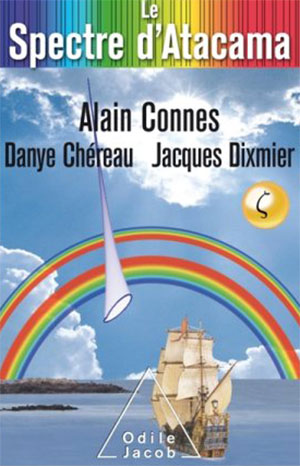
The book has a promising start. Armand Lafforet (IRL AC) is summoned by his friend Rodrigo to the Chilean observatory Alma in the Altacama desert. They have observed a mysterious spectrum, and need his advice.
Armand drops everything and on the flight he lectures the lady sitting next to him on proofs by induction (breaking up chocolate bars), and recalls a recent stay at the La Trappe Abbey, where he had an encounter with (the ghost of) Alexander Grothendieck, who urged him to ‘Follow the motif!’.
“Comment était-il arrivé là? Il possédait surement quelques clés. Pourquoi pas celles des songes?” (How did he get
there? Surely he owned some keys, why not those of our dreams?)
A few pages further there’s this on the notion of topos (my attempt to translate):
“The notion of space plays a central role in mathematics. Traditionally we represent it as a set of points, together with a notion of neighborhood that we call a ‘topology’. The universe of these new spaces, ‘toposes’, unveiled by Grothendieck, is marvellous, not only for the infinite wealth of examples (it contains, apart from the ordinary topological spaces, also numerous instances of a more combinatorial nature) but because of the totally original way to perceive space: instead of appearing on the main stage from the start, it hides backstage and manifests itself as a ‘deus ex machina’, introducing a variability in the theory of sets.”
So far, so good.
We have a mystery, tidbits of mathematics, and allusions left there to put a smile on any Grothendieck-aficionado’s face.
But then, upon arrival, the story drops dead.
Rodrigo has been taken to hospital, and will remain incommunicado until well in the final quarter of the book.
As the remaining astronomers show little interest in Alain’s (sorry, Armand’s) first lecture, he decides to skip the second, and departs on a hike to the ocean. There, he takes a genuine sailing ship in true Jules Verne style to the lighthouse at he end of the world.
All this drags on for at least half a year in time, and two thirds of the book’s length. We are left in complete suspense when it comes to the mysterious Atacama spectrum.
Perhaps the three authors deliberately want to break with existing conventions of story telling?
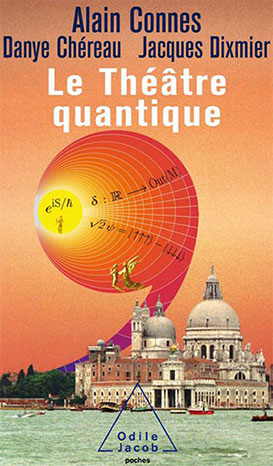
I had a similar feeling when reading their first novel Le Theatre Quantique. Here they spend some effort to flesh out their heroine, Charlotte, in the first part of the book. But then, all of a sudden, their main character is replaced by a detective, and next by a computer.
Anyway, when Armand finally reappears at the IHES the story picks up pace.
The trio (Armand, his would-be-lover Charlotte, and Ali Ravi, Cern’s computer guru) convince CERN to sell its main computer to an American billionaire with the (fake) promise of developing a quantum computer. Incidentally, they somehow manage to do this using Charlotte’s history with that computer (for this, you have to read ‘Le Theatre Quantique’).
By their quantum-computing power (Shor and quantum-encryption pass the revue) they are able to decipher the Atacame spectrum (something to do with primes and zeroes of the zeta function), send coded messages using quantum entanglement, end up in the Oval Office and convince the president to send a message to the ‘Riemann sphere’ (another fun pun), and so on, and on.
The book ends with a twist of the classic tale of the mathematician willing to sell his soul to the devil for a (dis)proof of the Riemann hypothesis:
After spending some time in purgatory, the mathematician gets a meeting with God and asks her the question “Is the Riemann hypothesis true?”.
“Of course”, God says.
“But how can you know that all non-trivial zeroes of the zeta function have real part 1/2?”, Armand asks.
And God replies:
“Simple enough, I can see them all at once. But then, don’t forget I’m God. I can see the disappointment in your face, yes I can read in your heart that you are frustrated, that you desire an explanation…
Well, we’re going to fix this. I will call archangel Gabriel, the angel of geometry, he will make you a topos!”
If you feel like running to the nearest Kindle store to buy “Le spectre d’Atacama”, make sure to opt for a package deal. It is impossible to make heads or tails of the story without reading “Le theatre quantique” first.
But then, there are worse ways to spend an idle week than by binge reading Connes…
Edit (February 28th). A short video of Alain Connes explaining ‘Le spectre d’Atacama’ (in French)