Posts Tagged ‘permutation representation’


what does the monster see?

Wednesday, July 16th, 2008

The Monster is the largest of the 26 sporadic simple groups and has order

808 017 424 794 512 875 886 459 904 961 710 757 005 754 368 000 000 000

= 2^46 3^20 5^9 7^6 11^2 13^3 17 19 23 29 31 41 47 59 71.

It is not so much the size of its order that makes it hard to do actual calculations in the monster, but rather the dimensions of its smallest non-trivial irreducible representations (196 883 for the smallest, 21 296 876 for the next one, and so on).

In characteristic two there is an irreducible representation of one dimension less (196 882) which appears to be of great use to obtain information. For example, Robert Wilson used it to prove that The Monster is a Hurwitz group. This means that the Monster is generated by two elements g and h satisfying the relations

g^2 = h^3 = (gh)^7 = 1

Geometrically, this implies that the Monster is the automorphism group of a Riemann surface of genus g satisfying the Hurwitz bound 84(g-1)=#Monster. That is,

g=9619255057077534236743570297163223297687552000000001=42151199 * 293998543 * 776222682603828537142813968452830193

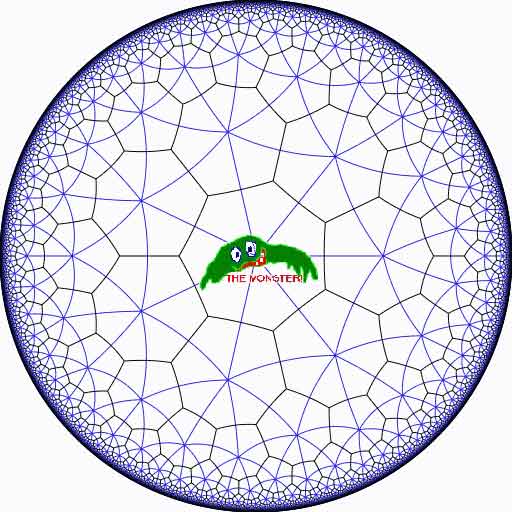
Or, in analogy with the Klein quartic which can be constructed from 24 heptagons in the tiling of the hyperbolic plane, there is a finite region of the hyperbolic plane, tiled with heptagons, from which we can construct this monster curve by gluing the boundary is a specific way so that we get a Riemann surface with exactly 9619255057077534236743570297163223297687552000000001 holes. This finite part of the hyperbolic tiling (consisting of #Monster/7 heptagons) we’ll call the empire of the monster and we’d love to describe it in more detail.

Look at the half-edges of all the heptagons in the empire (the picture above learns that every edge in cut in two by a blue geodesic). They are exactly #Monster such half-edges and they form a dessin d’enfant for the monster-curve.

If we label these half-edges by the elements of the Monster, then multiplication by g in the monster interchanges the two half-edges making up a heptagonal edge in the empire and multiplication by h in the monster takes a half-edge to the one encountered first by going counter-clockwise in the vertex of the heptagonal tiling. Because g and h generated the Monster, the dessin of the empire is just a concrete realization of the monster.

Because g is of order two and h is of order three, the two permutations they determine on the dessin, gives a group epimorphism C_2 \ast C</em>3 = PSL_2(\mathbb{Z}) \rightarrow \mathbb{M} from the modular group PSL</em>2(\mathbb{Z}) onto the Monster-group.

In noncommutative geometry, the group-algebra of the modular group \mathbb{C} PSL_2 can be interpreted as the coordinate ring of a noncommutative manifold (because it is formally smooth in the sense of Kontsevich-Rosenberg or Cuntz-Quillen) and the group-algebra of the Monster \mathbb{C} \mathbb{M} itself corresponds in this picture to a finite collection of ‘points’ on the manifold. Using this geometric viewpoint we can now ask the question What does the Monster see of the modular group?

To make sense of this question, let us first consider the commutative equivalent : what does a point P see of a commutative variety X?

Evaluation of polynomial functions in P gives us an algebra epimorphism \mathbb{C}[X] \rightarrow \mathbb{C} from the coordinate ring of the variety \mathbb{C}[X] onto \mathbb{C} and the kernel of this map is the maximal ideal \mathfrak{m}_P of \mathbb{C}[X] consisting of all functions vanishing in P.

Equivalently, we can view the point P= \wis{spec}~\mathbb{C}[X]/\mathfrak{m}_P as the scheme corresponding to the quotient \mathbb{C}[X]/\mathfrak{m}</em>P. Call this the 0-th formal neighborhood of the point P.

This sounds pretty useless, but let us now consider higher-order formal neighborhoods. Call the affine scheme \wis{spec}~\C[X]/\mathfrak{m}_P^{n+1} the n-th forml neighborhood of P, then the first neighborhood, that is with coordinate ring \mathbb{C}[X]/\mathfrak{m}</em>P^2 gives us tangent-information. Alternatively, it gives the best linear approximation of functions near P. The second neighborhood \mathbb{C}[X]/\mathfrak{m}_P^3 gives us the best quadratic approximation of function near P, etc. etc.

These successive quotients by powers of the maximal ideal \mathfrak{m}_P form a system of algebra epimorphisms

\hdots \frac{\mathbb{C}[X]}{\mathfrak{m}_P^{n+1}} \rightarrow \frac{\mathbb{C}[X]}{\mathfrak{m}</em>P^{n}} \rightarrow \hdots \hdots \rightarrow \frac{\mathbb{C}[X]}{\mathfrak{m}_P^{2}} \rightarrow \frac{\mathbb{C}[X]}{\mathfrak{m}</em>P} = \mathbb{C}

and its inverse limit \underset{\leftarrow}{lim}~\frac{\mathbb{C}[X]}{\mathfrak{m}_P^{n}} = \hat{\mathcal{O}}</em>{X,P} is the completion of the local ring in P and contains all the infinitesimal information (to any order) of the variety X in a neighborhood of P. That is, this completion \hat{\mathcal{O}}_{X,P} contains all information that P can see of the variety X.

In case P is a smooth point of X, then X is a manifold in a neighborhood of P and then this completion \hat{\mathcal{O}}_{X,P} is isomorphic to the algebra of formal power series \mathbb{C}[[ x</em>1,x_2,\hdots,x</em>d ]] where the x_i form a local system of coordinates for the manifold X near P.

Right, after this lengthy recollection, back to our question what does the monster see of the modular group? Well, we have an algebra epimorphism

\pi~:~\C PSL_2(\mathbb{Z}) \rightarrow \C \mathbb{M}

and in analogy with the commutative case, all information the Monster can gain from the modular group is contained in the \mathfrak{m}-adic completion

\widehat{\C PSL_2(\mathbb{Z})}</em>{\mathfrak{m}} = \underset{\leftarrow}{lim}~\frac{\mathbb{C} PSL_2(\mathbb{Z})}{\mathfrak{m}^n}

where \mathfrak{m} is the kernel of the epimorphism \pi sending the two free generators of the modular group PSL_2(\mathbb{Z}) = C</em>2 \ast C_3 to the permutations g and h determined by the dessin of the pentagonal tiling of the Monster’s empire.

As it is a hopeless task to determine the Monster-empire explicitly, it seems even more hopeless to determine the kernel \mathfrak{m} let alone the completed algebra… But, (surprise) we can compute \widehat{\C PSL_2(\mathbb{Z})}</em>{\mathfrak{m}} as explicitly as in the commutative case we have \hat{\mathcal{O}}_{X,P} \simeq \mathbb{C}[[ x</em>1,x_2,\hdots,x</em>d ]] for a point P on a manifold X.

Here the details : the quotient \mathfrak{m}/\mathfrak{m}^2 has a natural structure of \mathbb{C} \mathbb{M}-bimodule. The group-algebra of the monster is a semi-simple algebra, that is, a direct sum of full matrix-algebras of sizes corresponding to the dimensions of the irreducible monster-representations. That is,

\mathbb{C} \mathbb{M} \simeq \mathbb{C} \oplus M_{196883}(\mathbb{C}) \oplus M</em>{21296876}(\mathbb{C}) \oplus \hdots \hdots \oplus M_{258823477531055064045234375}(\mathbb{C})

with exactly 194 components (the number of irreducible Monster-representations). For any \mathbb{C} \mathbb{M}-bimodule M one can form the tensor-algebra

T_{\mathbb{C} \mathbb{M}}(M) = \mathbb{C} \mathbb{M} \oplus M \oplus (M \otimes</em>{\mathbb{C} \mathbb{M}} M) \oplus (M \otimes_{\mathbb{C} \mathbb{M}} M \otimes</em>{\mathbb{C} \mathbb{M}} M) \oplus \hdots \hdots

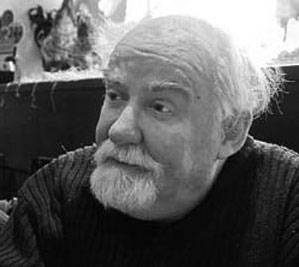
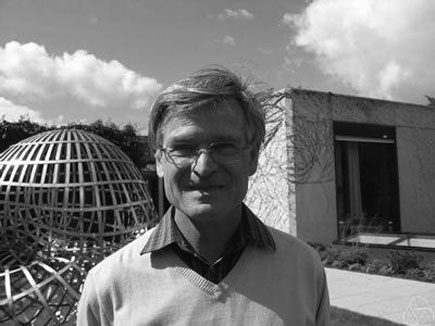
and applying the formal neighborhood theorem for formally smooth algebras (such as \mathbb{C} PSL_2(\mathbb{Z})) due to Joachim Cuntz (left) and Daniel Quillen (right) we have an isomorphism of algebras

\widehat{\C PSL_2(\mathbb{Z})}</em>{\mathfrak{m}} \simeq \widehat{T_{\mathbb{C} \mathbb{M}}(\mathfrak{m}/\mathfrac{m}^2)}

where the right-hand side is the completion of the tensor-algebra (at the unique graded maximal ideal) of the \mathbb{C} \mathbb{M}-bimodule \mathfrak{m}/\mathfrak{m}^2, so we’d better describe this bimodule explicitly.

Okay, so what’s a bimodule over a semisimple algebra of the form S=M_{n</em>1}(\mathbb{C}) \oplus \hdots \oplus M_{n</em>k}(\mathbb{C})? Well, a simple S-bimodule must be either (1) a factor M_{n</em>i}(\mathbb{C}) with all other factors acting trivially or (2) the full space of rectangular matrices M_{n</em>i \times n_j}(\mathbb{C}) with the factor M</em>{n_i}(\mathbb{C}) acting on the left, M</em>{n_j}(\mathbb{C}) acting on the right and all other factors acting trivially.

That is, any S-bimodule can be represented by a quiver (that is a directed graph) on k vertices (the number of matrix components) with a loop in vertex i corresponding to each simple factor of type (1) and a directed arrow from i to j corresponding to every simple factor of type (2).

That is, for the Monster, the bimodule \mathfrak{m}/\mathfrak{m}^2 is represented by a quiver on 194 vertices and now we only have to determine how many loops and arrows there are at or between vertices.

Using Morita equivalences and standard representation theory of quivers it isn’t exactly rocket science to determine that the number of arrows between the vertices corresponding to the irreducible Monster-representations S_i and S</em>j is equal to

dim_{\mathbb{C}}~Ext^1</em>{\mathbb{C} PSL_2(\mathbb{Z})}(S</em>i,S_j)-\delta</em>{ij}

Now, I’ve been wasting a lot of time already here explaining what representations of the modular group have to do with quivers (see for example here or some other posts in the same series) and for quiver-representations we all know how to compute Ext-dimensions in terms of the Euler-form applied to the dimension vectors.

Right, so for every Monster-irreducible S_i we have to determine the corresponding dimension-vector ~(a</em>1,a_2;b</em>1,b_2,b</em>3) for the quiver

\xymatrix{ & & & &
\vtx{b_1} \\ \vtx{a</em>1} \ar[rrrru]^(.3){B_{11}} \ar[rrrrd]^(.3){B</em>{21}}
\ar[rrrrddd]_(.2){B</em>{31}} & & & & \\ & & & & \vtx{b_2} \\ \vtx{a</em>2}
\ar[rrrruuu]_(.7){B</em>{12}} \ar[rrrru]_(.7){B</em>{22}}
\ar[rrrrd]_(.7){B</em>{23}} & & & & \\ & & & & \vtx{b_3}}

Now the dimensions a_i are the dimensions of the +/-1 eigenspaces for the order 2 element g in the representation and the b</em>i are the dimensions of the eigenspaces for the order 3 element h. So, we have to determine to which conjugacy classes g and h belong, and from Wilson’s paper mentioned above these are classes 2B and 3B in standard Atlas notation.

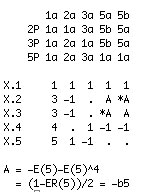
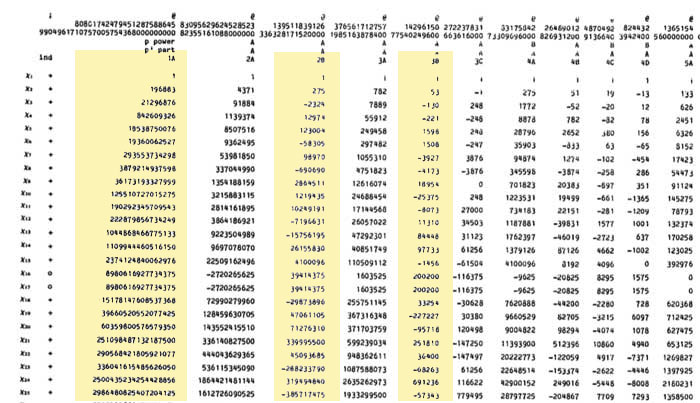
So, for each of the 194 irreducible Monster-representations we look up the character values at 2B and 3B (see below for the first batch of those) and these together with the dimensions determine the dimension vector ~(a_1,a</em>2;b_1,b</em>2,b_3).

For example take the 196883-dimensional irreducible. Its 2B-character is 275 and the 3B-character is 53. So we are looking for a dimension vector such that a_1+a</em>2=196883, a_1-275=a</em>2 and b_1+b</em>2+b_3=196883, b</em>1-53=b_2=b</em>3 giving us for that representation the dimension vector of the quiver above ~(98579,98304,65663,65610,65610).

Okay, so for each of the 194 irreducibles S_i we have determined a dimension vector ~(a</em>1(i),a_2(i);b</em>1(i),b_2(i),b</em>3(i)), then standard quiver-representation theory asserts that the number of loops in the vertex corresponding to S_i is equal to

dim(S_i)^2 + 1 - a</em>1(i)^2-a_2(i)^2-b</em>1(i)^2-b_2(i)^2-b</em>3(i)^2

and that the number of arrows from vertex S_i to vertex S</em>j is equal to

dim(S_i)dim(S</em>j) - a_1(i)a</em>1(j)-a_2(i)a</em>2(j)-b_1(i)b</em>1(j)-b_2(i)b</em>2(j)-b_3(i)b</em>3(j)

This data then determines completely the \mathbb{C} \mathbb{M}-bimodule \mathfrak{m}/\mathfrak{m}^2 and hence the structure of the completion \widehat{\mathbb{C} PSL_2}</em>{\mathfrak{m}} containing all information the Monster can gain from the modular group.

But then, one doesn’t have to go for the full regular representation of the Monster. Any faithful permutation representation will do, so we might as well go for the one of minimal dimension.

That one is known to correspond to the largest maximal subgroup of the Monster which is known to be a two-fold extension 2.\mathbb{B} of the Baby-Monster. The corresponding permutation representation is of dimension 97239461142009186000 and decomposes into Monster-irreducibles

S_1 \oplus S</em>2 \oplus S_4 \oplus S</em>5 \oplus S_9 \oplus S</em>{14} \oplus S_{21} \oplus S</em>{34} \oplus S_{35}

(in standard Atlas-ordering) and hence repeating the arguments above we get a quiver on just 9 vertices! The actual numbers of loops and arrows (I forgot to mention this, but the quivers obtained are actually symmetric) obtained were found after laborious computations mentioned in this post and the details I’ll make avalable here.

Anyone who can spot a relation between the numbers obtained and any other part of mathematics will obtain quantities of genuine (ie. non-Inbev) Belgian beer…

Galois’ last letter

Thursday, June 12th, 2008
“Ne pleure pas, Alfred ! J’ai besoin de tout mon courage pour mourir à vingt ans!”

We all remember the last words of Evariste Galois to his brother Alfred. Lesser known are the mathematical results contained in his last letter, written to his friend Auguste Chevalier, on the eve of his fatal duel. Here the final sentences :

Tu prieras publiquement Jacobi ou Gauss de donner leur avis non sur la verite, mais sur l’importance des theoremes.
Apres cela il se trouvera, j’espere, des gens qui trouvent leur profis a dechiffrer tout ce gachis.
Je t’embrasse avec effusion. E. Galois, le 29 Mai 1832

A major result contained in this letter concerns the groups L_2(p)=PSL</em>2(\mathbb{F}_p), that is the group of 2 \times 2 matrices with determinant equal to one over the finite field \mathbb{F}</em>p modulo its center. L_2(p) is known to be simple whenever p \geq 5. Galois writes that L</em>2(p) cannot have a non-trivial permutation representation on fewer than p+1 symbols whenever p > 11 and indicates the transitive permutation representation on exactly p symbols in the three ‘exceptional’ cases p=5,7,11.

Let \alpha = \begin{bmatrix} 1 & 1 \\ 0 & 1 \end{bmatrix} and consider for p=5,7,11 the involutions on \mathbb{P}^1_{\mathbb{F}</em>p} = \mathbb{F}_p \cup \{ \infty \} (on which L</em>2(p) acts via Moebius transformations)

\pi_5 = (0,\infty)(1,4)(2,3) \quad \pi</em>7=(0,\infty)(1,3)(2,6)(4,5) \quad \pi_{11}=(0,\infty)(1,6)(3,7)(9,10)(5,8)(4,2)

(in fact, Galois uses the involution ~(0,\infty)(1,2)(3,6)(4,8)(5,10)(9,7) for p=11), then L_2(p) leaves invariant the set consisting of the p involutions \Pi = \{ \alpha^{-i} \pi</em>p \alpha^i~:~1 \leq i \leq p \}. After mentioning these involutions Galois merely writes :

Ainsi pour le cas de p=5,7,11, l’equation modulaire s’abaisse au degre p.
En toute rigueur, cette reduction n’est pas possible dans les cas plus eleves.

Alternatively, one can deduce these permutation representation representations from group isomorphisms. As L_2(5) \simeq A</em>5, the alternating group on 5 symbols, L_2(5) clearly acts transitively on 5 symbols.

Similarly, for p=7 we have L_2(7) \simeq L</em>3(2) and so the group acts as automorphisms on the projective plane over the field on two elements \mathbb{P}^2_{\mathbb{F}</em>2} aka the Fano plane, as depicted on the left.

This finite projective plane has 7 points and 7 lines and L_3(2) acts transitively on them.

For p=11 the geometrical object is a bit more involved. The set of non-squares in \mathbb{F}_{11} is

\{ 1,3,4,5,9 \}

and if we translate this set using the additive structure in \mathbb{F}_{11} one obtains the following 11 five-element sets

\{ 1,3,4,5,9 \}, \{ 2,4,5,6,10 \}, \{ 3,5,6,7,11 \}, \{ 1,4,6,7,8 \}, \{ 2,5,7,8,9 \}, \{ 3,6,8,9,10 \},

 \{ 4,7,9,10,11 \}, \{ 1,5,8,10,11 \}, \{ 1,2,6,9,11 \}, \{ 1,2,3,7,10 \}, \{ 2,3,4,8,11 \}

and if we regard these sets as ‘lines’ we see that two distinct lines intersect in exactly 2 points and that any two distinct points lie on exactly two ‘lines’. That is, intersection sets up a bijection between the 55-element set of all pairs of distinct points and the 55-element set of all pairs of distinct ‘lines’. This is called the biplane geometry.

The subgroup of S_{11} (acting on the eleven elements of \mathbb{F}</em>{11}) stabilizing this set of 11 5-element sets is precisely the group L_2(11) giving the permutation representation on 11 objects.

An alternative statement of Galois’ result is that for p > 11 there is no subgroup of L_2(p) complementary to the cyclic subgroup

C_p = \{ \begin{bmatrix} 1 & x \\ 0 & 1 \end{bmatrix}~:~x \in \mathbb{F}</em>p \}

That is, there is no subgroup such that set-theoretically L_2(p) = F \times C</em>p (note this is of courese not a group-product, all it says is that any element can be written as g=f.c with f \in F, c \in C_p.

However, in the three exceptional cases we do have complementary subgroups. In fact, set-theoretically we have

L_2(5) = A</em>4 \times C_5 \qquad L</em>2(7) = S_4 \times C</em>7 \qquad L_2(11) = A</em>5 \times C_{11}

and it is a truly amazing fact that the three groups appearing are precisely the three Platonic groups!

Recall that here are 5 Platonic (or Scottish) solids coming in three sorts when it comes to rotation-automorphism groups : the tetrahedron (group A_4), the cube and octahedron (group S</em>4) and the dodecahedron and icosahedron (group A_5). The “4″ in the cube are the four body diagonals and the “5″ in the dodecahedron are the five inscribed cubes.

That is, our three ‘exceptional’ Galois-groups correspond to the three Platonic groups, which in turn correspond to the three exceptional Lie algebras E_6,E</em>7,E_8 via McKay correspondence (wrt. their 2-fold covers). Maybe I’ll detail this latter connection another time. It sure seems that surprises often come in triples…

Finally, it is well known that L_2(5) \simeq A</em>5 is the automorphism group of the icosahedron (or dodecahedron) and that L_2(7) is the automorphism group of the Klein quartic.

So, one might ask : is there also a nice curve connected with the third group L_2(11)? Rumour has it that this is indeed the case and that the curve in question has genus 70… (to be continued).

Reference

Bertram Kostant, “The graph of the truncated icosahedron and the last letter of Galois”

Farey symbols of sporadic groups

Thursday, March 20th, 2008

John Conway once wrote :

There are almost as many different constructions of M_{24} as there have been mathematicians interested in that most remarkable of all finite groups.

In the inguanodon post Ive added yet another construction of the Mathieu groups M_{12} and M</em>{24} starting from (half of) the Farey sequences and the associated cuboid tree diagram obtained by demanding that all edges are odd. In this way the Mathieu groups turned out to be part of a (conjecturally) infinite sequence of simple groups, starting as follows :

L_2(7),M</em>{12},A_{16},M</em>{24},A_{28},A</em>{40},A_{48},A</em>{60},A_{68},A</em>{88},A_{96},A</em>{120},A_{132},A</em>{148},A_{164},A</em>{196},\hdots

It is quite easy to show that none of the other sporadics will appear in this sequence via their known permutation representations. Still, several of the sporadic simple groups are generated by an element of order two and one of order three, so they are determined by a finite dimensional permutation representation of the modular group PSL_2(\mathbb{Z}) and hence are hiding in a special polygonal region of the Dedekind’s tessellation

Let us try to figure out where the sporadic with the next simplest permutation representation is hiding : the second Janko group J_2, via its 100-dimensional permutation representation. The Atlas tells us that the order two and three generators act as

e:= (1,84)(2,20)(3,48)(4,56)(5,82)(6,67)(7,55)(8,41)(9,35)(10,40)(11,78)(12, 100)(13,49)(14,37)(15,94)(16,76)(17,19)(18,44)(21,34)(22,85)(23,92)(24, 57)(25,75)(26,28)(27,64)(29,90)(30,97)(31,38)(32,68)(33,69)(36,53)(39,61) (42,73)(43,91)(45,86)(46,81)(47,89)(50,93)(51,96)(52,72)(54,74)(58,99) (59,95)(60,63)(62,83)(65,70)(66,88)(71,87)(77,98)(79,80);

v:= (1,80,22)(2,9,11)(3,53,87)(4,23,78)(5,51,18)(6,37,24)(8,27,60)(10,62,47) (12,65,31)(13,64,19)(14,61,52)(15,98,25)(16,73,32)(17,39,33)(20,97,58) (21,96,67)(26,93,99)(28,57,35)(29,71,55)(30,69,45)(34,86,82)(38,59,94) (40,43,91)(42,68,44)(46,85,89)(48,76,90)(49,92,77)(50,66,88)(54,95,56) (63,74,72)(70,81,75)(79,100,83);

But as the kfarey.sage package written by Chris Kurth calculates the Farey symbol using the L-R generators, we use GAP to find those

L = e*v^-1  and  R=e*v^-2 so

L=(1,84,22,46,70,12,79)(2,58,93,88,50,26,35)(3,90,55,7,71,53,36)(4,95,38,65,75,98,92)(5,86,69,39,14,6,96)(8,41,60,72,61,17, 64)(9,57,37,52,74,56,78)(10,91,40,47,85,80,83)(11,23,49,19,33,30,20)(13,77,15,59,54,63,27)(16,48,87,29,76,32,42)(18,68, 73,44,51,21,82)(24,28,99,97,45,34,67)(25,81,89,62,100,31,94)

R=(1,84,80,100,65,81,85)(2,97,69,17,13,92,78)(3,76,73,68,16,90,71)(4,54,72,14,24,35,11)(5,34,96,18,42,32,44)(6,21,86,30,58, 26,57)(7,29,48,53,36,87,55)(8,41,27,19,39,52,63)(9,28,93,66,50,99,20)(10,43,40,62,79,22,89)(12,83,47,46,75,15,38)(23,77, 25,70,31,59,56)(33,45,82,51,67,37,61)(49,64,60,74,95,94,98)

Defining these permutations in sage and using kfarey, this gives us the Farey-symbol of the associated permutation representation

L=SymmetricGroup(Integer(100))("(1,84,22,46,70,12,79)(2,58,93,88,50,26,35)(3,90,55,7,71,53,36)(4,95,38,65,75,98,92)(5,86,69,39,14,6,96)(8,41,60,72,61,17, 64)(9,57,37,52,74,56,78)(10,91,40,47,85,80,83)(11,23,49,19,33,30,20)(13,77,15,59,54,63,27)(16,48,87,29,76,32,42)(18,68, 73,44,51,21,82)(24,28,99,97,45,34,67)(25,81,89,62,100,31,94)")

R=SymmetricGroup(Integer(100))("(1,84,80,100,65,81,85)(2,97,69,17,13,92,78)(3,76,73,68,16,90,71)(4,54,72,14,24,35,11)(5,34,96,18,42,32,44)(6,21,86,30,58, 26,57)(7,29,48,53,36,87,55)(8,41,27,19,39,52,63)(9,28,93,66,50,99,20)(10,43,40,62,79,22,89)(12,83,47,46,75,15,38)(23,77, 25,70,31,59,56)(33,45,82,51,67,37,61)(49,64,60,74,95,94,98)")

sage: FareySymbol("Perm",[L,R])

[[0, 1, 4, 3, 2, 5, 18, 13, 21, 71, 121, 413, 292, 463, 171, 50, 29, 8, 27, 46, 65, 19, 30, 11, 3, 10, 37, 64, 27, 17, 7, 4, 5], [1, 1, 3, 2, 1, 2, 7, 5, 8, 27, 46, 157, 111, 176, 65, 19, 11, 3, 10, 17, 24, 7, 11, 4, 1, 3, 11, 19, 8, 5, 2, 1, 1], [-3, 1, 4, 4, 2, 3, 6, -3, 7, 13, 14, 15, -3, -3, 15, 14, 11, 8, 8, 10, 12, 12, 10, 9, 5, 5, 9, 11, 13, 7, 6, 3, 2, 1]]

Here, the first string gives the numerators of the cusps, the second the denominators and the third gives the pairing information (where [tex[-2[/tex] denotes an even edge and -3 an odd edge. Fortunately, kfarey also allows us to draw the special polygonal region determined by a Farey-symbol. So, here it is (without the pairing data) :

the hiding place of J_2

It would be nice to have (a) other Farey-symbols associated to the second Janko group, hopefully showing a pattern that one can extend into an infinite family as in the inguanodon series and (b) to determine Farey-symbols of more sporadic groups.

Quiver-superpotentials

Monday, January 14th, 2008

It’s been a while, so let’s include a recap : a (transitive) permutation representation of the modular group \Gamma = PSL_2(\mathbb{Z}) is determined by the conjugacy class of a cofinite subgroup \Lambda \subset \Gamma, or equivalently, to a dessin d’enfant. We have introduced a quiver (aka an oriented graph) which comes from a triangulation of the compactification of \mathbb{H} / \Lambda where \mathbb{H} is the hyperbolic upper half-plane. This quiver is independent of the chosen embedding of the dessin in the Dedeking tessellation. (For more on these terms and constructions, please consult the series Modular subgroups and Dessins d’enfants).

Why are quivers useful? To start, any quiver Q defines a noncommutative algebra, the path algebra \mathbb{C} Q, which has as a \mathbb{C}-basis all oriented paths in the quiver and multiplication is induced by concatenation of paths (when possible, or zero otherwise). Usually, it is quite hard to make actual computations in noncommutative algebras, but in the case of path algebras you can just see what happens.

Moreover, we can also see the finite dimensional representations of this algebra \mathbb{C} Q. Up to isomorphism they are all of the following form : at each vertex v_i of the quiver one places a finite dimensional vectorspace \mathbb{C}^{d</em>i} and any arrow in the quiver \xymatrix{\vtx{v_i} \ar[r]^a & \vtx{v</em>j}} determines a linear map between these vertex spaces, that is, to a corresponds a matrix in M_{d</em>j \times d_i}(\mathbb{C}). These matrices determine how the paths of length one act on the representation, longer paths act via multiplcation of matrices along the oriented path.

A necklace in the quiver is a closed oriented path in the quiver up to cyclic permutation of the arrows making up the cycle. That is, we are free to choose the start (and end) point of the cycle. For example, in the one-cycle quiver

\xymatrix{\vtx{} \ar[rr]^a & & \vtx{} \ar[ld]^b \\ & \vtx{} \ar[lu]^c &}

the basic necklace can be represented as abc or bca or cab. How does a necklace act on a representation? Well, the matrix-multiplication of the matrices corresponding to the arrows gives a square matrix in each of the vertices in the cycle. Though the dimensions of this matrix may vary from vertex to vertex, what does not change (and hence is a property of the necklace rather than of the particular choice of cycle) is the trace of this matrix. That is, necklaces give complex-valued functions on representations of \mathbb{C} Q and by a result of Artin and Procesi there are enough of them to distinguish isoclasses of (semi)simple representations! That is, linear combinations a necklaces (aka super-potentials) can be viewed, after taking traces, as complex-valued functions on all representations (similar to character-functions).

In physics, one views these functions as potentials and it then interested in the points (representations) where this function is extremal (minimal) : the vacua. Clearly, this does not make much sense in the complex-case but is relevant when we look at the real-case (where we look at skew-Hermitian matrices rather than all matrices). A motivating example (the Yang-Mills potential) is given in Example 2.3.2 of Victor Ginzburg’s paper Calabi-Yau algebras.

Let \Phi be a super-potential (again, a linear combination of necklaces) then our commutative intuition tells us that extrema correspond to zeroes of all partial differentials \frac{\partial \Phi}{\partial a} where a runs over all coordinates (in our case, the arrows of the quiver). One can make sense of differentials of necklaces (and super-potentials) as follows : the partial differential with respect to an arrow a occurring in a term of \Phi is defined to be the path in the quiver one obtains by removing all 1-occurrences of a in the necklaces (defining \Phi) and rearranging terms to get a maximal broken necklace (using the cyclic property of necklaces). An example, for the cyclic quiver above let us take as super-potential abcabc (2 cyclic turns), then for example

\frac{\partial \Phi}{\partial b} = cabca+cabca = 2 cabca

(the first term corresponds to the first occurrence of b, the second to the second). Okay, but then the vacua-representations will be the representations of the quotient-algebra (which I like to call the vacualgebra)

\mathcal{U}(Q,\Phi) = \frac{\mathbb{C} Q}{(\partial \Phi/\partial a, \forall a)}

which in ‘physical relevant settings’ (whatever that means…) turn out to be Calabi-Yau algebras.

But, let us return to the case of subgroups of the modular group and their quivers. Do we have a natural super-potential in this case? Well yes, the quiver encoded a triangulation of the compactification of \mathbb{H}/\Lambda and if we choose an orientation it turns out that all ‘black’ triangles (with respect to the Dedekind tessellation) have their arrow-sides defining a necklace, whereas for the ‘white’ triangles the reverse orientation makes the arrow-sides into a necklace. Hence, it makes sense to look at the cubic superpotential \Phi being the sum over all triangle-sides-necklaces with a +1-coefficient for the black triangles and a -1-coefficient for the white ones. Let’s consider an index three example from a previous post

\xymatrix{& & \rho \ar[lld]_d \ar[ld]^f \ar[rd]^e & \\
i \ar[rrd]</em>a & i+1 \ar[rd]^b & & \omega \ar[ld]^c \\
& & 0 \ar[uu]^h \ar@/^/[uu]^g \ar@/_/[uu]</em>i &}

In this case the super-potential coming from the triangulation is

\Phi = -aid+agd-cge+che-bhf+bif

and therefore we have a noncommutative algebra \mathcal{U}(Q,\Phi) associated to this index 3 subgroup. Contrary to what I believed at the start of this series, the algebras one obtains in this way from dessins d’enfants are far from being Calabi-Yau (in whatever definition). For example, using a GAP-program written by Raf Bocklandt Ive checked that the growth rate of the above algebra is similar to that of \mathbb{C}[x], so in this case \mathcal{U}(Q,\Phi) can be viewed as a noncommutative curve (with singularities).

However, this is not the case for all such algebras. For example, the vacualgebra associated to the second index three subgroup (whose fundamental domain and quiver were depicted at the end of this post) has growth rate similar to that of \mathbb{C} \langle x,y \rangle

I have an outlandish conjecture about the growth-behavior of all algebras \mathcal{U}(Q,\Phi) coming from dessins d’enfants : the algebra sees what the monodromy representation of the dessin sees of the modular group (or of the third braid group). I can make this more precise, but perhaps it is wiser to calculate one or two further examples…

quivers versus quilts

Wednesday, January 2nd, 2008

We have associated to a subgroup of the modular group PSL_2(\mathbb{Z}) a quiver (that is, an oriented graph). For example, one verifies that the fundamental domain of the subgroup \Gamma</em>0(2) (an index 3 subgroup) is depicted on the right by the region between the thick lines with the identification of edges as indicated. The associated quiver is then

\xymatrix{i \ar[rr]^a \ar[dd]^b & & 1 \ar@/^/[ld]^h \ar@/_/[ld]</em>i \\
& \rho \ar@/^/[lu]^d \ar@/_/[lu]</em>e \ar[rd]^f & \\
0 \ar[ru]^g & & i+1 \ar[uu]^c}

The corresponding “dessin d’enfant” are the green edges in the picture. But, the red dot on the left boundary is identied with the red dot on the lower circular boundary, so the dessin of the modular subgroup \Gamma_0(2) is

\xymatrix{| \ar@{-}[r] & \bullet \ar@{-}@/^8ex/[r] \ar@{-}@/_8ex/[r] & -}

Here, the three red dots (all of them even points in the Dedekind tessellation) give (after the identification) the two points indicated by a