lieven le bruyn's blog
Posts tagged M-geometry
Quiver-superpotentials
Jan 14th
superpotentials
It’s been a while, so let’s include a recap : a (transitive) permutation representation of the modular group
is determined by the conjugacy class of a cofinite subgroup
, or equivalently, to a dessin d’enfant. We have introduced a quiver (aka an oriented graph) which comes from a triangulation of the compactification of
where
is the hyperbolic upper half-plane. This quiver is independent of the chosen embedding of the dessin in the Dedeking tessellation. (For more on these terms and constructions, please consult the series Modular subgroups and Dessins d’enfants).
Why are quivers useful? To start, any quiver
defines a noncommutative algebra, the path algebra
, which has as a
-basis all oriented paths in the quiver and multiplication is induced by concatenation of paths (when possible, or zero otherwise). Usually, it is quite hard to make actual computations in noncommutative algebras, but in the case of path algebras you can just see what happens.
Moreover, we can also see the finite dimensional representations of this algebra
. Up to isomorphism they are all of the following form : at each vertex
of the quiver one places a finite dimensional vectorspace
and any arrow in the quiver
determines a linear map between these vertex spaces, that is, to
corresponds a matrix in
. These matrices determine how the paths of length one act on the representation, longer paths act via multiplcation of matrices along the oriented path.
A necklace in the quiver is a closed oriented path in the quiver up to cyclic permutation of the arrows making up the cycle. That is, we are free to choose the start (and end) point of the cycle. For example, in the one-cycle quiver
![\xymatrix{\vtx{} \ar[rr]^a & & \vtx{} \ar[ld]^b \\ & \vtx{} \ar[lu]^c &} \xymatrix{\vtx{} \ar[rr]^a & & \vtx{} \ar[ld]^b \\ & \vtx{} \ar[lu]^c &}](/latexrender/pictures/35440701b59e55eed3f49ecc53aa8325.gif)
the basic necklace can be represented as
or
or
. How does a necklace act on a representation? Well, the matrix-multiplication of the matrices corresponding to the arrows gives a square matrix in each of the vertices in the cycle. Though the dimensions of this matrix may vary from vertex to vertex, what does not change (and hence is a property of the necklace rather than of the particular choice of cycle) is the trace of this matrix. That is, necklaces give complex-valued functions on representations of
and by a result of Artin and Procesi there are enough of them to distinguish isoclasses of (semi)simple representations! That is, linear combinations a necklaces (aka super-potentials) can be viewed, after taking traces, as complex-valued functions on all representations (similar to character-functions).
In physics, one views these functions as potentials and it then interested in the points (representations) where this function is extremal (minimal) : the vacua. Clearly, this does not make much sense in the complex-case but is relevant when we look at the real-case (where we look at skew-Hermitian matrices rather than all matrices). A motivating example (the Yang-Mills potential) is given in Example 2.3.2 of Victor Ginzburg’s paper Calabi-Yau algebras.
Let
be a super-potential (again, a linear combination of necklaces) then our commutative intuition tells us that extrema correspond to zeroes of all partial differentials
where
runs over all coordinates (in our case, the arrows of the quiver). One can make sense of differentials of necklaces (and super-potentials) as follows : the partial differential with respect to an arrow
occurring in a term of
is defined to be the path in the quiver one obtains by removing all 1-occurrences of
in the necklaces (defining
) and rearranging terms to get a maximal broken necklace (using the cyclic property of necklaces). An example, for the cyclic quiver above let us take as super-potential
(2 cyclic turns), then for example

(the first term corresponds to the first occurrence of
, the second to the second). Okay, but then the vacua-representations will be the representations of the quotient-algebra (which I like to call the vacualgebra)

which in ‘physical relevant settings’ (whatever that means…) turn out to be Calabi-Yau algebras.
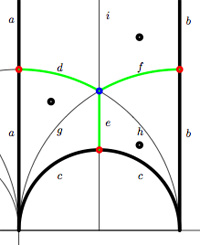
But, let us return to the case of subgroups of the modular group and their quivers. Do we have a natural super-potential in this case? Well yes, the quiver encoded a triangulation of the compactification of
and if we choose an orientation it turns out that all ‘black’ triangles (with respect to the Dedekind tessellation) have their arrow-sides defining a necklace, whereas for the ‘white’ triangles the reverse orientation makes the arrow-sides into a necklace. Hence, it makes sense to look at the cubic superpotential
being the sum over all triangle-sides-necklaces with a +1-coefficient for the black triangles and a -1-coefficient for the white ones. Let’s consider an index three example from a previous post
![\xymatrix{& & \rho \ar[lld]_d \ar[ld]^f \ar[rd]^e & \\
i \ar[rrd]_a & i+1 \ar[rd]^b & & \omega \ar[ld]^c \\
& & 0 \ar[uu]^h \ar@/^/[uu]^g \ar@/_/[uu]_i &} \xymatrix{& & \rho \ar[lld]_d \ar[ld]^f \ar[rd]^e & \\
i \ar[rrd]_a & i+1 \ar[rd]^b & & \omega \ar[ld]^c \\
& & 0 \ar[uu]^h \ar@/^/[uu]^g \ar@/_/[uu]_i &}](/latexrender/pictures/aab36d16da83218af03225c806a3d999.gif)
In this case the super-potential coming from the triangulation is

and therefore we have a noncommutative algebra
associated to this index 3 subgroup. Contrary to what I believed at the start of this series, the algebras one obtains in this way from dessins d’enfants are far from being Calabi-Yau (in whatever definition). For example, using a GAP-program written by Raf Bocklandt Ive checked that the growth rate of the above algebra is similar to that of
, so in this case
can be viewed as a noncommutative curve (with singularities).
However, this is not the case for all such algebras. For example, the vacualgebra associated to the second index three subgroup (whose fundamental domain and quiver were depicted at the end of this post) has growth rate similar to that of
…
I have an outlandish conjecture about the growth-behavior of all algebras
coming from dessins d’enfants : the algebra sees what the monodromy representation of the dessin sees of the modular group (or of the third braid group).
I can make this more precise, but perhaps it is wiser to calculate one or two further examples…
Anabelian & Noncommutative Geometry 2
Dec 19th
Anabelian vs. Noncommutative
- Anabelian vs. Noncommutative Geometry
- profinite groups survival guide
- Anabelian & Noncommutative Geometry 2
Last time (possibly with help from the survival guide) we have seen that the universal map from the modular group
to its profinite completion
(limit over all finite index normal subgroups
) gives an embedding of the sets of (continuous) simple finite dimensional representations

and based on the example
we would like the above embedding to be dense in some kind of noncommutative analogon of the Zariski topology on
.
We use the Zariski topology on
as in these two M-geometry posts1. So, what’s this idea in this special case? Let
be the vectorspace with basis the conjugacy classes of elements of
(that is, the space of class functions). As explained here it is a consequence of the Artin-Procesi theorem that the linear functions
separate finite dimensional (semi)simple representations of
. That is we have an embedding

and we can define closed subsets of
as subsets of simple representations on which a set of class-functions vanish. With this definition of Zariski topology it is immediately clear that the image of
is dense. For, suppose it would be contained in a proper closed subset then there would be a class-function vanishing on all simples of
so, in particular, there should be a bound on the number of simples of finite quotients
which clearly is not the case (just look at the quotients
).
But then, the same holds if we replace ‘simples of
‘ by ‘simple components of permutation representations of
‘. This is the importance of Farey symbols to the representation problem of the modular group. They give us a manageable subset of simples which is nevertheless dense in the whole space. To utilize this a natural idea might be to ask what such a permutation representation can see of the modular group, or in geometric terms, what the tangent space is to
in a permutation representation2. We will call this the modular content of the permutation representation and to understand it we will have to compute the tangent quiver
.
M-geometry (3)
Sep 18th
For any finite dimensional A-representation S we defined before a character
which is an linear functional on the noncommutative functions
and defined via
for all 
We would like to have enough such characters to separate simples, that is we would like to have an embedding

from the set of all finite dimensional simple A-representations
into the linear dual of
. This is a consequence of the celebrated Artin-Procesi theorem.
Michael Artin was the first person to approach representation theory via algebraic geometry and geometric invariant theory. In his 1969 classical paper “On Azumaya algebras and finite dimensional representations of rings” he introduced the affine scheme
of all n-dimensional representations of A on which the group
acts via basechange, the orbits of which are exactly the isomorphism classes of representations. He went on to use the Hilbert criterium in invariant theory to prove that the closed orbits for this action are exactly the isomorphism classes of semi-simple -dimensional representations. Invariant theory tells us that there are enough invariant polynomials to separate closed orbits, so we would be done if the caracters would generate the ring of invariant polynmials, a statement first conjectured in this paper.
Claudio Procesi was able to prove this conjecture in his 1976 paper “The invariant theory of
matrices” in which he reformulated the fundamental theorems on
-invariants to show that the ring of invariant polynomials of m
matrices under simultaneous conjugation is generated by traces of words in the matrices (and even managed to limit the number of letters in the words required to
). Using the properties of the Reynolds operator in invariant theory it then follows that the same applies to the
-action on the representation schemes
.
So, let us reformulate their result a bit. Assume the affine
-algebra A is generated by the elements
then we define a necklace to be an equivalence class of words in the
, where two words are equivalent iff they are the same upto cyclic permutation of letters. For example
and
determine the same necklace. Remark that traces of different words corresponding to the same necklace have the same value and that the noncommutative functions
are spanned by necklaces.
The Artin-Procesi theorem then asserts that if S and T are non-isomorphic simple A-representations, then
as elements of
and even that they differ on a necklace in the generators of A of length at most
. Phrased differently, the array of characters of simples evaluated at necklaces is a substitute for the clasical character-table in finite group theory.
M-geometry (2)
Sep 17th
Last time we introduced the tangent quiver
of an affine algebra A to be a quiver on the isoclasses of simple finite dimensional representations. When
is the coordinate ring of an affine variety, these vertices are just the points of the variety
and this set has the extra structure of being endowed with the Zariski topology. For a general, possibly noncommutative algebra, we would like to equip the vertices of
also with a topology.
In the commutative case, the Zariski topology has as its closed sets the common zeroes of a set of polynomials on
, so we need to generalize the notion of ‘functions’ the the noncommutative world. The NC-mantra states that we should view the algebra A as the ring of functions on a (usually virtual) noncommutative space. And, face it, for a commutative variety
the algebra
does indeed do the job. Still, this is a red herring.
Let’s consider the easiest noncommutative case, that of the group algebra
of a finite group
. In this case, the vertices of the tangent quiver
are the irreducible representations of
and no sane person would consider the full group algebra to be the algebra of functions on this set. However, we do have a good alternative in this case : characters which allow us to separate the irreducibles and are a lot more manageable than the full group algebra. For example, if
is the monster group then the group algebra has dimension approx
whereas there are just 194 characters to consider…
But, can we extend characters to arbitrary noncommutative algebras? and, more important, are there enough of these to separate the simple representations? The first question is easy enough to answer, after all characters are just traces so we can define for every element
and any finite dimensional simple A-representation
the character

where
is the matrix describing the action of a on S. But, you might say, characters are then just linear functionals on the algebra A so it is natural to view A as the function algebra, right? Wrong! Traces have the nice property that
and so they vanish on all commutators
of A, so characters only carry information of the quotient space
![\mathfrak{g}_A = \frac{A}{[A,A]_{vect}} \mathfrak{g}_A = \frac{A}{[A,A]_{vect}}](/latexrender/pictures/4eb5d8bdfc4d737e80569afc182a7e2e.gif)
where
is the vectorspace spanned by all commutators (and not the ideal…). If one is too focussed on commutative geometry one misses this essential simplification as clearly for
being a commutative algebra,
and therefore in this case ![\mathfrak{g}_{\C[X]} = \C[X] \mathfrak{g}_{\C[X]} = \C[X]](/latexrender/pictures/c7c00b1eb37b4ba5815bca25703e8a5a.gif)
Ok, but are there enough characters (that is, linear functionals on
, that is elements of the dual space
) to separate the simple representations? And, why do I (ab)use Lie-algebra notation
to denote the vectorspace
???
M-geometry (1)
Sep 15th
Take an affine
-algebra A (not necessarily commutative). We will assign to it a strange object called the tangent-quiver
, compute it in a few examples and later show how it connects with existing theory and how it can be used. This series of posts can be seen as the promised notes of my talks at the GAMAP-workshop but in reverse order… If some of the LaTeX-pictures are not in the desired spots, please size and resize your browser-window and they will find their intended positions.
A vertex
of
corresponds to the isomorphism class of a finite dimensional simple A-representations
and between any two such vertices, say
and
, the number of directed arrows from
to
is given by the dimension of the Ext-space

Recall that this Ext-space counts the equivalence classes of short exact sequences of A-representations
![\xymatrix{0 \ar[r] & S_w \ar[r] & V \ar[r] & S_v \ar[r] & 0} \xymatrix{0 \ar[r] & S_w \ar[r] & V \ar[r] & S_v \ar[r] & 0}](/latexrender/pictures/79295bdb9289c15e0389919ccdcfde3e.gif)
where two such sequences (say with middle terms V resp. W) are equivalent if there is an A-isomorphism
making the diagram below commutative
![\xymatrix{0 \ar[r] & S_w \ar[r] \ar[d]^{id_{S_w}} & V \ar[r] \ar[d]^{\phi} & S_v \ar[r] \ar[d]^{id_{S_v}} & 0 \\\
0 \ar[r] & S_w \ar[r] & W \ar[r] & S_v \ar[r] & 0} \xymatrix{0 \ar[r] & S_w \ar[r] \ar[d]^{id_{S_w}} & V \ar[r] \ar[d]^{\phi} & S_v \ar[r] \ar[d]^{id_{S_v}} & 0 \\\
0 \ar[r] & S_w \ar[r] & W \ar[r] & S_v \ar[r] & 0}](/latexrender/pictures/db75113e87fc6b4cc9024e320164e5b7.gif)
The Ext-space measures how many non-split extensions there are between the two simples and is always a finite dimensional vectorspace. So the tangent quiver
has the property that in all vertices there are at most finitely many loops and between any two vertices there are a finite number of directed arrows, but in principle a vertex may be the origin of arrows connecting it to infinitely many other vertices.
Right, now let us at least motivate the terminology. Let
be a (commutative) affine variety with coordinate ring
then what is
in this case? To begin, as
is commutative, all its finite dimensional simple representations are one-dimensional and there is one such for every point
. Therefore, the vertices of
correspond to the points of the affine variety
. The simple A-representation
corresponding to a point
is just evaluating polynomials in
. Moreover, if
then there are no non-split extensions between
and
(a commutative semi-local algebra splits as a direct sum of locals), therefore in
there can only be loops and no genuine arrows between different vertices. Finally, the number of loops in the vertex corresponding to the point
can be computed using the fact that the self-extensions can be identified with the tangent space at
, that is
![dim_{\C}~Ext^1_{\C[X]}(S_x,S_x) = dim_{\C}~T_x~X dim_{\C}~Ext^1_{\C[X]}(S_x,S_x) = dim_{\C}~T_x~X](/latexrender/pictures/1ee42834fa98fe925db931cc0ecf526f.gif)
That is, if
is the coordinate ring of an affine variety
, then the quiver
is the set of points of
having in each point
as many loops as the dimension of the tangent space
. So, in this case, the quiver
contains all information about tangent spaces to the variety and that’s why we call it the tangent quiver.
Let’s go into the noncommutative wilderness. A first, quite trivial, example is the group algebra
of a finite group
, then the simple A-representations are just the irreducible G-representations and as the group algebra is semi-simple every short exact sequence splits so all Ext-spaces are zero. That is, in this case the tangent quiver
in just a finite set of vertices (as many as there are irreducible G-representations) and no arrows nor loops.
Now you may ask whether there are examples of tangent quivers having arrows apart from loops. So, take another easy finite dimensional example : the path algebra
of a finite quiver
without oriented cycles. Recall that the path algebra is the vectorspace having as basis all vertices and all oriented paths in the quiver Q (and as there are no cycles, this basis is finite) and multiplication is induced by concatenation of paths. Here an easy example. Suppose the quiver Q looks like
![\xymatrix{\vtx{} \ar[r] & \vtx{} \ar[r] & \vtx{}} \xymatrix{\vtx{} \ar[r] & \vtx{} \ar[r] & \vtx{}}](/latexrender/pictures/e396315d4f3cf8c5deb4147af9b7699b.gif)
then the path algebra is 6 dimensional as there are 3 vertices, 2 paths of length one (the arrows) and one path of length two (going from the leftmost to the rightmost vertex). The concatenation rule shows that the three vertices will give three idempotents in A and one easily verifies that the path algebra can be identified with upper-triangular
matrices

where the diagonal components correspond to the vertices, the first offdiagonal components to the two arrows and the corner component corresponds to the unique path of length two. Right, for a general finite quiver without oriented cycles is the quite easy to see that all finite dimensional simples are one-dimensional and correspond to the vertex-idempotents, that is every simple is of the form
where
is the vertex idempotent. No doubt, you can guess what the tangent quiver
will be, can’t you?