lieven le bruyn's blog
Posts tagged Lenstra
Lambda-rings for formula-phobics
Feb 5th
In 1956, Alexander Grothendieck (middle) introduced
-rings in an algebraic-geometric context to be commutative rings A equipped with a bunch of operations
(for all numbers
) satisfying a list of rather obscure identities. From the easier ones, such as

to those expressing
and
via specific universal polynomials. An attempt to capture the essence of
-rings without formulas?
Lenstra’s elegant construction of the 1-power series rings
requires only one identity to remember
.
Still, one can use it to show the existence of ringmorphisms
, for all numbers
. Consider the formal ‘logarithmic derivative’

where
is the usual formal derivative of a power series. As this derivative satisfies the chain rule, we have

and so all the maps
are additive. To show that they are also multiplicative, it suffices by functoriality to verify this on the special 1-series
for all
. But,

That is,
and Lenstra’s identity implies that
is indeed multiplicative! A first attempt :
hassle-free definition 1 : a commutative ring
is a
-ring if and only if there is a ringmorphism
splitting
, that is, such that
.
In particular, a
-ring comes equipped with a multiplicative set of ring-endomorphisms
satisfying
. One can then define a
-ringmorphism to be a ringmorphism commuting with these endo-morphisms.
The motivation being that
-rings are known to form a subcategory of commutative rings for which the 1-power series functor is the right adjoint to the functor forgetting the
-structure. In particular, if
is a
-ring, we have a ringmorphism
corresponding to the identity morphism.
But then, what is the connection to the usual one involving all the operations
? Well, one ought to recover those from
.
For
to be a ringmorphism will require identities among the
. I hope an expert will correct me on this one, but I’d guess we won’t yet obtain all identities required. By the very definition of an adjoint we must have that
is a morphism of
-rings, and, this would require defining a
-ring structure on
, that is a ringmorphism
, the so called Artin-Hasse exponential, to which I’d like to return later.
For now, we can define a multiplicative set of ring-endomorphisms
from requiring that
for all
. Another try?
hassle-free definition 2 :
is a
-ring if and only if there is splitting
to
satisfying the compatibility relations
.
But even then, checking that a map
is a ringmorphism is as hard as verifying the lists of identities among the
. Fortunately, we get such a ringmorphism for free in the important case when A is of ‘characteristic zero’, that is, has no additive torsion. Then, a ringmorphism
exists whenever we have a multiplicative set of ring endomorphisms
for all
such that for every prime number
the morphism
is a lift of the Frobenius, that is,
.
Perhaps this captures the essence of
-rings best (without the risk of getting an headache) : in characteristic zero, they are the (commutative) rings having a multiplicative set of endomorphisms, generated by lifts of the Frobenius maps.
big Witt vectors for everyone (1/2)
Feb 2nd
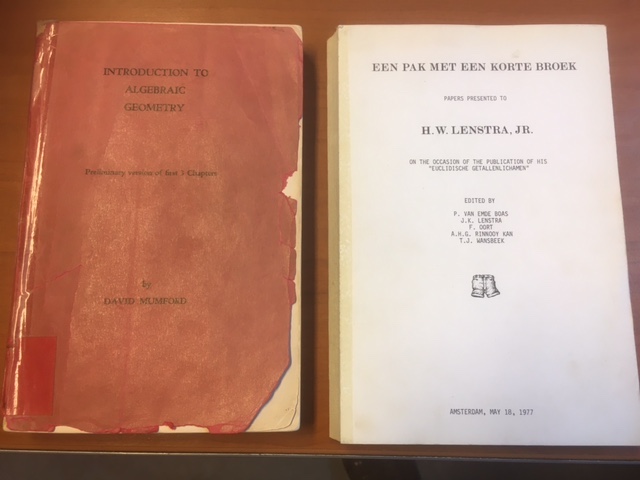
Next time you visit your math-library, please have a look whether these books are still on the shelves : Michiel Hazewinkel‘s Formal groups and applications, William Fulton’s and Serge Lange’s Riemann-Roch algebra and Donald Knutson’s lambda-rings and the representation theory of the symmetric group.
I wouldn’t be surprised if one or more of these books are borrowed out, probably all of them to the same person. I’m afraid I’m that person in Antwerp…
Lately, there’s been a renewed interest in
-rings and the endo-functor W assigning to a commutative algebra its ring of big Witt vectors, following Borger’s new proposal for a geometry over the absolute point.
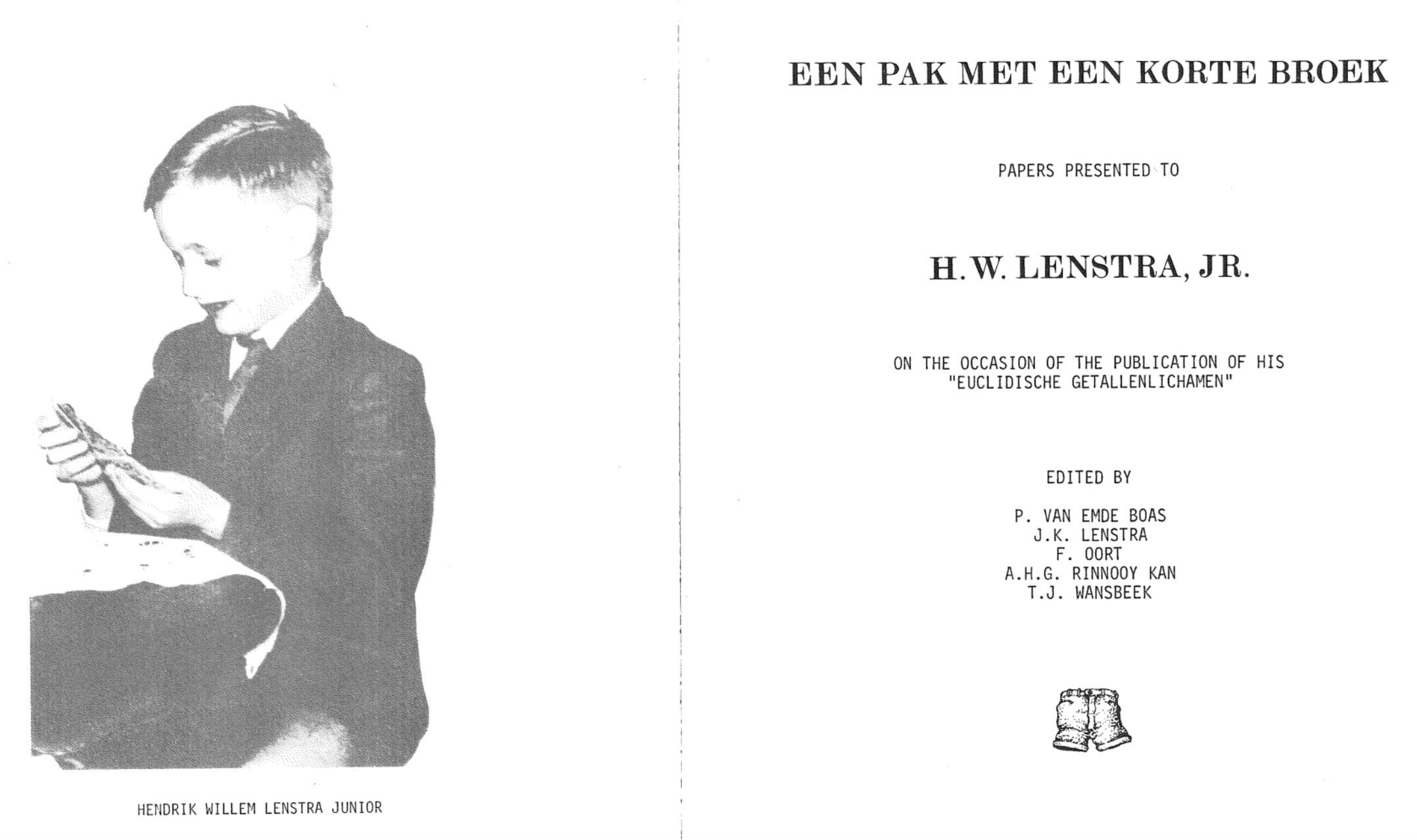
However, as Hendrik Lenstra writes in his 2002 course-notes on the subject Construction of the ring of Witt vectors : “The literature on the functor W is in a somewhat unsatisfactory state: nobody seems to have any interest in Witt vectors beyond applying them for a purpose, and they are often treated in appendices to papers devoting to something else; also, the construction usually depends on a set of implicit or unintelligible formulae. Apparently, anybody who wishes to understand Witt vectors needs to construct them personally. That is what is now happening to myself.”
Before doing a series on Borger’s paper, we’d better run through Lenstra’s elegant construction in a couple of posts. Let A be a commutative ring and consider the multiplicative group of all ‘one-power series’ over it
. Our aim is to define a commutative ring structure on
taking as its ADDITION the MULTIPLICATION of power series.
That is, if
, then we define our addition
. This may be slightly confusing as the ZERO-element in
will then turn be the constant power series 1…
We are now going to define a multiplication
on
which is distributively with respect to
and turns
into a commutative ring with ONE-element the series
.
We will do this inductively, so consider
the (classes of) one-power series truncated at term n, that is, the kernel of the natural augmentation map between the multiplicative group-units
.
Again, taking multiplication in
as a new addition rule
, we see that
is an Abelian group, whence a
-module.
For all elements
we have a scaling operator
(sending
) which is an A-ring endomorphism of
, in particular multiplicative wrt.
. But then,
is an additive endomorphism of
, so is an element of the endomorphism-RING
. Because composition (being the multiplication in this endomorphism ring) of scaling operators is clearly commutative (
) we can define a commutative RING
being the subring of
generated by the operators
.
The action turns
into an E-module and we define an E-module morphism
by
.
All of this looks pretty harmless, but the upshot is that we have now equipped the image of this E-module morphism, say
(which is the additive subgroup of
generated by the elements
) with a commutative multiplication
induced by the rule
.
Explicitly,
is the set of one-truncated polynomials
with coefficients in
such that one can find elements
such that
. We multiply
with another such truncated one-polynomial
(taking elements
) via

and using distributivity and the multiplication rule this gives the element
.
Being a ring-qutient of
we have that
is a commutative ring, and, from the construction it is clear that
behaves functorially.
For rings
such that
we are done, but in general
may be strictly smaller. The idea is to use functoriality and do the relevant calculations in a larger ring
where we can multiply the two truncated one-polynomials and observe that the resulting truncated polynomial still has all its coefficients in
.
Here’s how we would do this over
: take two irreducible one-polynomials u(t) and v(t) of degrees r resp. s smaller or equal to n. Then over the complex numbers we have
and
. Then, over the field
we have that
and hence we can compute their product
as before to be
. But then, all coefficients of this truncated K-polynomial are invariant under all permutations of the roots
and the roots
and so is invariant under all elements of the Galois group. But then, these coefficients are algebraic numbers in
whence integers. That is,
. It should already be clear from this that the rings
contain a lot of arithmetic information!
For a general commutative ring
we will copy this argument by considering a free overring
(with 1 as one of the base elements) by formally adjoining roots. At level 1, consider
to be the set of all non-constant one-polynomials over
and consider the ring
![A^{(1)} = \bigotimes_{f \in M_0} A[X]/(f) = A[X_f, f \in M_0]/(f(X_f) , f \in M_0) A^{(1)} = \bigotimes_{f \in M_0} A[X]/(f) = A[X_f, f \in M_0]/(f(X_f) , f \in M_0)](/latexrender/pictures/c6e929599a48704975bfa805ec79901d.gif)
The idea being that every one-polynomial
now has one root, namely
in
. Further,
is a free A-module with basis elements all
with
.
Good! We now have at least one root, but we can continue this process. At level 2,
will be the set of all non-constant one-polynomials over
and we use them to construct the free overring
(which now has the property that every
has at least two roots in
). And, again, we repeat this process and obtain in succession the rings
. Finally, we define
having the property that every one-polynomial over A splits entirely in linear factors over
.
But then, for all
we can compute
. Remains to show that the resulting truncated one-polynomial has all its entries in A. The ring
contains two copies of
namely
and
and the intersection of these two rings in exactly
(here we use the freeness property and the additional fact that 1 is one of the base elements). But then, by functoriality of
, the element
lies in the intersection
. Done!
Hence, we have endo-functors
in the category of all commutative rings, for every number n. Reviewing the construction of
one observes that there are natural transformations
and therefore also natural transformations
. Taking the inverse limits
we therefore have the ‘one-power series’ endo-functor
which is ‘almost’ the functor W of big Witt vectors. Next time we’ll take you through the identification using ‘ghost variables’ and how the functor
can be used to define the category of
-rings.