Archive for the ‘groups’ tag
What is the knot associated to a prime?
Sometimes a MathOverflow question gets deleted before I can post a reply…
Yesterday (New-Year) PD1&2 were visiting, so I merely bookmarked the What is the knot associated to a prime?-topic, promising myself to reply to it this morning, only to find out that the page no longer exists.
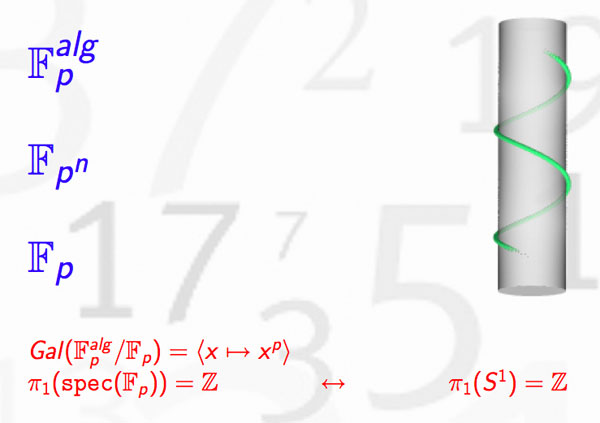
From what I recall, the OP interpreted one of my slides of the April 1st-Alumni talk

as indicating that there might be a procedure to assign to a prime number a specific knot. Here’s the little I know about this :
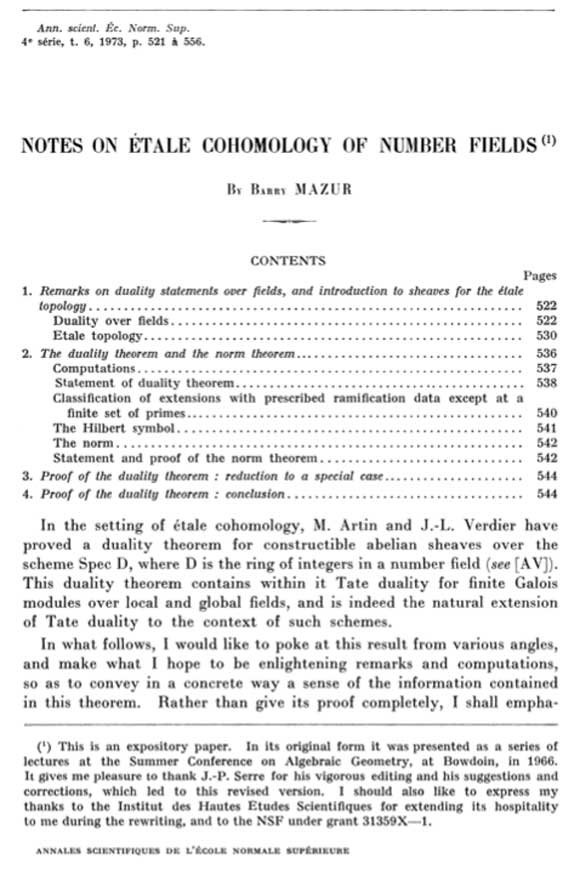
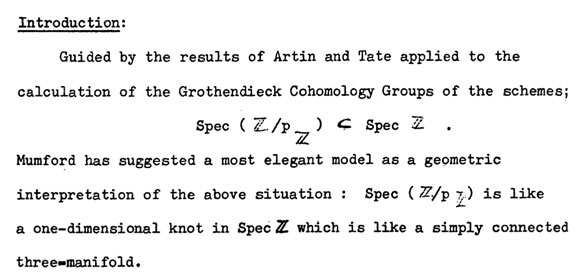
Artin-Verdier duality in etale cohomology suggests that $Spec(\mathbb{Z}) $ is a 3-dimensional manifold, as Barry Mazur pointed out in this paper

The theory of discriminants shows that there are no non-trivial global etale extensions of $Spec(\mathbb{Z}) $, whence its (algebraic) fundamental group should be trivial. By Poincare-Perelman this then implies that one should view $Spec(\mathbb{Z}) $ as the three-sphere $S^3 $. Note that there is no ambiguity in this direction. However, as there are other rings of integers in number fields having trivial fundamental group, the correspondence is not perfect.
Okay, but then primes should correspond to certain submanifolds of $S^3 $ and as the algebraic fundamental group of $Spec(\mathbb{F}_p) $ is the profinite completion of $\mathbb{Z} $, the first option that comes to mind are circles

Hence, primes might be viewed as circles embedded in $S^3 $, that is, as knots! But which knots? Well, as far as I know, nobody has a procedure to assign a knot to a prime number, let alone one having p crossings. What is known, however, is that different primes must correspond to different knots

because the algebraic fundamental groups of $Spec(\mathbb{Z})- { p } $ differ for distinct primes. This was the statement I wanted to illustrate in the first slide.
But, the story goes a lot further. Knots may be linked and one can detect this by calculating the link-number, which is symmetric in the two knots. In number theory, the Legendre symbol, plays a similar role thanks to quadratic reciprocity

and hence we can view the Legendre symbol as indicating whether the knots corresponding to different primes are linked or not. Whereas it is natural in knot theory to investigate whether collections of 3, 4 or 27 knots are intricately linked (or not), few people would consider the problem whether one collection of 27 primes differs from another set of 27 primes worthy of investigation.
There’s one noteworthy exception, the Redei symbol which we can now view as giving information about the link-behavior of the knots associated to three different primes. For example, one can hunt for prime-triples whose knots link as the Borromean rings

(note that the knots corresponding to the three primes are not the unknot but more complicated). Here’s where the story gets interesting : in number-theory one would like to discover ‘higher reciprocity laws’ (for collections of n prime numbers) by imitating higher-link invariants in knot-theory. This should be done by trying to correspond filtrations on the fundamental group of the knot-complement to that of the algebraic fundamental group of $Spec(\mathbb{Z})-{ p } $ This project is called arithmetic topology

Perhaps I should make a pod- or vod-cast of that 20 minute talk, one day…
Lists 2010 : MathOverflow bookmarks
A few MathOverflow threads I bookmarked in 2010 for various reasons.
- Honest answer : Applications of algebraic geometry over a field with one element. James Borger’s answer : “I’m confident that the answer to the original question is no. There are hardly any theorems at all in the subject, much less ones with external applications! In other words, if no further progress is ever made in any of the directions people have pursued, everything will likely be forgotten”
- Unknown result (at least to me) : Irreducibility of polynomials in two variables. Graham Leuschke’s “all-time leading candidate for Most Preposterous Theorem Ever”, proved using the classification of the finite simple groups.
- Should know example (but don’t) : Algebra A with Spec(A) reduced and Rep_n(A) non-reduced. Algebras being commutative here and even the existence of an example with Spec(A) is smooth is open. Peter Samuelson : ” My guess would be yes for both, but I’m not sure how to find one for either one.”
- Great list : The Frobenius morphism. David Ben-Zvi’s “outdated collection of intuitive ways to think about raising to the p-th power”.
- Overrated answer : who fixed the topology on ideles?. John Tate’s answer “When I wrote my thesis I used what seemed to me to be the obvious topology without going into the history of the matter.” got 73 votes…
- Langlands for dummies : What is the L-function version of quadratic reciprocity?. Sometimes working through the easiest non-trivial example gives more insight than several survey papers.
So, who did discover the Leech lattice?

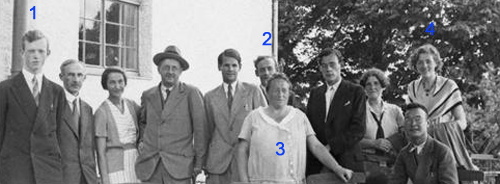
For the better part of the 30ties, Ernst Witt (1) did hang out with the rest of the ‘Noetherknaben’, the group of young mathematicians around Emmy Noether (3) in Gottingen.
In 1934 Witt became Helmut Hasse‘s assistent in Gottingen, where he qualified as a university lecturer in 1936. By 1938 he has made enough of a name for himself to be offered a lecturer position in Hamburg and soon became an associate professor, the down-graded position held by Emil Artin (2) until he was forced to emigrate in 1937.
A former fellow student of him in Gottingen, Erna Bannow (4), had gone earlier to Hamburg to work with Artin. She continued her studies with Witt and finished her Ph.D. in 1939. In 1940 Erna Bannow and Witt married.
So, life was smiling on Ernst Witt that sunday january 28th 1940, both professionally and personally. There was just one cloud on the horizon, and a rather menacing one. He was called up by the Wehrmacht and knew he had to enter service in february. For all he knew, he was spending the last week-end with his future wife… (later in february 1940, Blaschke helped him to defer his military service by one year).
Still, he desperately wanted to finish his paper before entering the army, so he spend most of that week-end going through the final version and submitted it on monday, as the published paper shows.

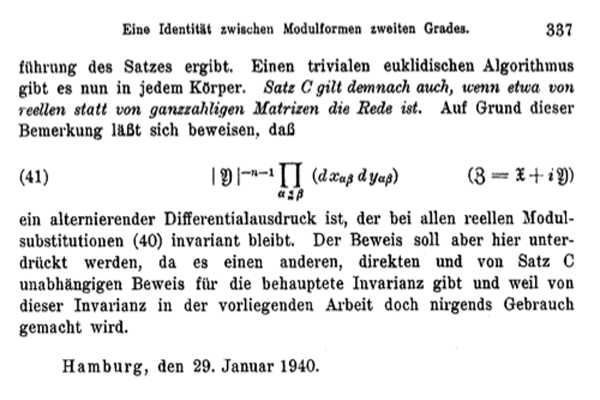
In the 70ties, Witt suddenly claimed he did discover the Leech lattice $ {\Lambda} $ that sunday. Last time we have seen that the only written evidence for Witt’s claim is one sentence in his 1941-paper Eine Identität zwischen Modulformen zweiten Grades. “Bei dem Versuch, eine Form aus einer solchen Klassen wirklich anzugeben, fand ich mehr als 10 verschiedene Klassen in $ {\Gamma_{24}} $.”
But then, why didn’t Witt include more details of this sensational lattice in his paper?
Ina Kersten recalls on page 328 of Witt’s collected papers : “In his colloquium talk “Gitter und Mathieu-Gruppen” in Hamburg on January 27, 1970, Witt said that in 1938, he had found nine lattices in $ {\Gamma_{24}} $ and that later on January 28, 1940, while studying the Steiner system $ {S(5,8,24)} $, he had found two additional lattices $ {M} $ and $ {\Lambda} $ in $ {\Gamma_{24}} $. He continued saying that he had then given up the tedious investigation of $ {\Gamma_{24}} $ because of the surprisingly low contribution
$ \displaystyle | Aut(\Lambda) |^{-1} < 10^{-18} $
to the Minkowski density and that he had consented himself with a short note on page 324 in his 1941 paper.”
In the last sentence he refers to the fact that the sum of the inverse orders of the automorphism groups of all even unimodular lattices of a given dimension is a fixed rational number, the Minkowski-Siegel mass constant. In dimension 24 this constant is
$ \displaystyle \sum_{L} \frac{1}{| Aut(L) |} = \frac {1027637932586061520960267}{129477933340026851560636148613120000000} \approx 7.937 \times 10^{-15} $
That is, Witt was disappointed by the low contribution of the Leech lattice to the total constant and concluded that there might be thousands of new even 24-dimensional unimodular lattices out there, and dropped the problem.
If true, the story gets even better : not only claims Witt to have found the lattices $ {A_1^{24}=M} $ and $ {\Lambda} $, but also enough information on the Leech lattice in order to compute the order of its automorphism group $ {Aut(\Lambda)} $, aka the Conway group $ {Co_0 = .0} $ the dotto-group!
Is this possible? Well fortunately, the difficulties one encounters when trying to compute the order of the automorphism group of the Leech lattice from scratch, is one of the better documented mathematical stories around.

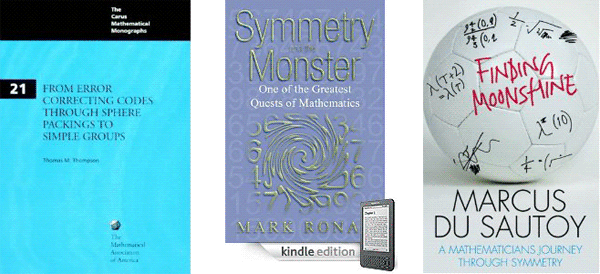
The books From Error-Correcting Codes through Sphere Packings to Simple Groups by Thomas Thompson, Symmetry and the monster by Mark Ronan, and Finding moonshine by Marcus du Sautoy tell the story in minute detail.
It took John Conway 12 hours on a 1968 saturday in Cambridge to compute the order of the dotto group, using the knowledge of Leech and McKay on the properties of the Leech lattice and with considerable help offered by John Thompson via telephone.
But then, John Conway is one of the fastest mathematicians the world has known. The prologue of his book On numbers and games begins with : “Just over a quarter of a century ago, for seven consecutive days I sat down and typed from 8:30 am until midnight, with just an hour for lunch, and ever since have described this book as “having been written in a week”.”
Conway may have written a book in one week, Ernst Witt did complete his entire Ph.D. in just one week! In a letter of August 1933, his sister told her parents : “He did not have a thesis topic until July 1, and the thesis was to be submitted by July 7. He did not want to have a topic assigned to him, and when he finally had the idea, he started working day and night, and eventually managed to finish in time.”
So, if someone might have beaten John Conway in fast-computing the dottos order, it may very well have been Witt. Sadly enough, there is a lot of circumstantial evidence to make Witt’s claim highly unlikely.
For starters, psychology. Would you spend your last week-end together with your wife to be before going to war performing an horrendous calculation?
Secondly, mathematical breakthroughs often arise from newly found insight. At that time, Witt was also working on his paper on root lattices “Spiegelungsgrupen and Aufzähling halbeinfacher Liescher Ringe” which he eventually submitted in january 1941. Contained in that paper is what we know as Witt’s lemma which tells us that for any integral lattice the sublattice generated by vectors of norms 1 and 2 is a direct sum of root lattices.
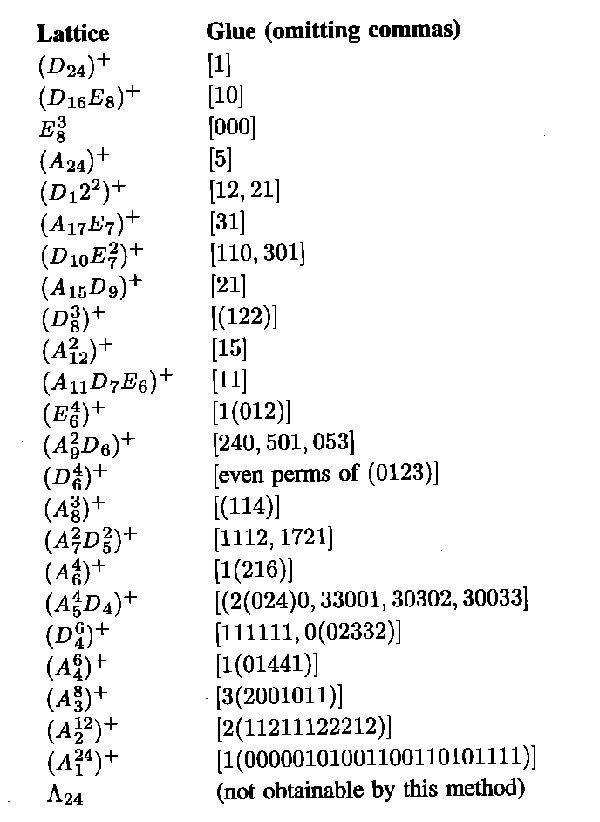
This leads to the trick of trying to construct unimodular lattices by starting with a direct sum of root lattices and ‘adding glue’. Although this gluing-method was introduced by Kneser as late as 1967, Witt must have been aware of it as his 16-dimensional lattice $ {D_{16}^+} $ is constructed this way.
If Witt wanted to construct new 24-dimensional even unimodular lattices in 1940, it would be natural for him to start off with direct sums of root lattices and trying to add vectors to them until he got what he was after. Now, all of the Niemeier-lattices are constructed this way, except for the Leech lattice!

I’m far from an expert on the Niemeier lattices but I would say that Witt definitely knew of the existence of $ {D_{24}^+} $, $ {E_8^3} $ and $ {A_{24}^+} $ and that it is quite likely he also constructed $ {(D_{16}E_8)^+, (D_{12}^2)^+, (A_{12}^2)^+, (D_8^3)^+} $ and possibly $ {(A_{17}E_7)^+} $ and $ {(A_{15}D_9)^+} $. I’d rate it far more likely Witt constructed another two such lattices on sunday january 28th 1940, rather than discovering the Leech lattice.
Finally, wouldn’t it be natural for him to include a remark, in his 1941 paper on root lattices, that not every even unimodular lattices can be obtained from sums of root lattices by adding glue, the Leech lattice being the minimal counter-example?
If it is true he was playing around with the Steiner systems that sunday, it would still be a pretty good story he discovered the lattices $ {(A_2^{12})^+} $ and $ {(A_1^{24})^+} $, for this would mean he discovered the Golay codes in the process!
Which brings us to our next question : who discovered the Golay code?
Books Ngram for your upcoming parties
No christmas- or new-years family party without heated discussions. Often on quite silly topics.
For example, which late 19th-century bookcharacter turned out to be most influential in the 20th century? Dracula, from the 1897 novel by Irish author Bram Stoker or Sir Arthur Conan Doyle’s Sherlock Holmes who made his first appearance in 1887?
Well, this year you can spice up such futile discussions by going over to Google Labs Books Ngram Viewer, specify the time period of interest to you and the relevant search terms and in no time it spits back a graph comparing the number of books mentioning these terms.
Here’s the 20th-century graph for ‘Dracula’ (blue), compared to ‘Sherlock Holmes’ (red).

The verdict being that Sherlock was the more popular of the two for the better part of the century, but in the end the vampire bit the detective. Such graphs lead to lots of new questions, such as : why was Holmes so popular in the early 30ties? and in WW2? why did Dracula become popular in the late 90ties? etc. etc.
Clearly, once you’ve used Books Ngram it’s a dangerous time-waster. Below, the graphs in the time-frame 1980-2008 for Alain Connes (blue), noncommutative geometry (red), Hopf algebras (green) and quantum groups (yellow).

It illustrates the simultaneous rise and fall of both quantum groups and Hopf algebras, whereas the noncommutative geometry-graph follows that of Alain Connes with a delay of about 2 years. I’m sure you’ll find a good use for this splendid tool…
Who discovered the Leech lattice?
The Leech lattice was, according to wikipedia, ‘originally discovered by Ernst Witt in 1940, but he did not publish his discovery’ and it ‘was later re-discovered in 1965 by John Leech’. However, there is very little evidence to support this claim.
The facts
What is certain is that John Leech discovered in 1965 an amazingly dense 24-dimensional lattice $ {\Lambda} $ having the property that unit balls around the lattice points touch, each one of them having exactly 196560 neighbors. The paper ‘Notes on sphere packings’ appeared in 1967 in the Canad. J. Math. 19, 251-267.
Compare this to the optimal method to place pennies on a table, leading to the hexagonal tiling, each penny touching exactly 6 others. Similarly, in dimension 8 the densest packing is the E8 lattice in which every unit ball has exactly 240 neighbors.
The Leech lattice $ {\Lambda} $ can be characterized as the unique unimodular positive definite even lattice such that the length of any non-zero vector is at least two.
The list of all positive definite even unimodular lattices, $ {\Gamma_{24}} $, in dimension 24 was classified later by Hans-Volker Niemeier and are now known as the 24 Niemeier lattices.

For the chronology below it is perhaps useful to note that, whereas Niemeier’s paper did appear in 1973, it was submitted april 5th 1971 and is just a minor rewrite of Niemeier’s Ph.D. “Definite quadratische Formen der Dimension 24 und Diskriminante 1″ obtained in 1968 from the University of Göttingen with advisor Martin Kneser.
The claim
On page 328 of Ernst Witt’s Collected Papers Ina Kersten recalls that Witt gave a colloquium talk on January 27, 1970 in Hamburg entitled “Gitter und Mathieu-Gruppen” (Lattices and Mathieu-groups). In this talk Witt claimed to have found nine lattices in $ {\Gamma_{24}} $ as far back as 1938 and that on January 28, 1940 he found two additional lattices $ {M} $ and $ {\Lambda} $ while studying the Steiner system $ {S(5,8,24)} $.
On page 329 of the collected papers is a scan of the abstract Witt wrote in the colloquium book in Bielefeld where he gave a talk “Uber einige unimodularen Gitter” (On certain unimodular lattices) on January 28, 1972

Here, Witt claims that he found three new lattices in $ {\Gamma_{24}} $ on January 28, 1940 as the lattices $ {M} $, $ {M’} $ and $ {\Lambda} $ ‘feiern heute ihren 32sten Gebursttag!’ (celebrate today their 32nd birthday).
He goes on telling that the lattices $ {M} $ and $ {\Lambda} $ were number 10 and 11 in his list of lattices in $ {\Gamma_{24}} $ in his paper “Eine Identität zwischen Modulformen zweiten Grades” in the Abh. Math. Sem. Univ. Hamburg 14 (1941) 323-337 and he refers in particular to page 324 of that paper.
He further claims that he computed the orders of their automorphism groups and writes that $ {\Lambda} $ ‘wurde 1967 von Leech wieder-entdeckt’ (was re-discovered by Leech in 1967) and that its automorphism group $ {G(\Lambda)} $ was studied by John Conway. Recall that Conway’s investigations of the automorphism group of the Leech lattice led to the discovery of three new sporadic groups, the Conway groups $ {Co_1,Co_2} $ and $ {Co_3} $.
However, Witt’s 1941-paper does not contain a numbered list of 24-dimensional lattices. In fact, apart from $ {E_8+E_8+E_8} $ is does not contain a single lattice in $ {\Gamma_{24}} $. The only relevant paragraph is indeed on page 324

He observes that Mordell already proved that there is just one lattice in $ {\Gamma_8} $ (the $ {E_8} $-lattice) and that the main result of his paper is to prove that there are precisely two even unimodular 16-dimensional lattices : $ {E_8+E_8} $ and another lattice, now usually called the 16-dimensional Witt-lattice.
He then goes on to observe that Schoeneberg knew that $ {\# \Gamma_{24} > 1} $ and so there must be more lattices than $ {E_8+E_8+E_8} $ in $ {\Gamma_{24}} $. Witt concludes with : “In my attempt to find such a lattice, I discovered more than 10 lattices in $ {\Gamma_{24}} $. The determination of $ {\# \Gamma_{24}} $ does not seem to be entirely trivial.”
Hence, it is fair to assume that by 1940 Ernst Witt had discovered at least 11 of the 24 Niemeier lattices. Whether the Leech lattice was indeed lattice 11 on the list is anybody’s guess.
Next time we will look more closely into the historical context of Witt’s 1941 paper.