Posts Tagged ‘Ginzburg’


Quiver-superpotentials

Monday, January 14th, 2008

It’s been a while, so let’s include a recap : a (transitive) permutation representation of the modular group \Gamma = PSL_2(\mathbb{Z}) is determined by the conjugacy class of a cofinite subgroup \Lambda \subset \Gamma, or equivalently, to a dessin d’enfant. We have introduced a quiver (aka an oriented graph) which comes from a triangulation of the compactification of \mathbb{H} / \Lambda where \mathbb{H} is the hyperbolic upper half-plane. This quiver is independent of the chosen embedding of the dessin in the Dedeking tessellation. (For more on these terms and constructions, please consult the series Modular subgroups and Dessins d’enfants).

Why are quivers useful? To start, any quiver Q defines a noncommutative algebra, the path algebra \mathbb{C} Q, which has as a \mathbb{C}-basis all oriented paths in the quiver and multiplication is induced by concatenation of paths (when possible, or zero otherwise). Usually, it is quite hard to make actual computations in noncommutative algebras, but in the case of path algebras you can just see what happens.

Moreover, we can also see the finite dimensional representations of this algebra \mathbb{C} Q. Up to isomorphism they are all of the following form : at each vertex v_i of the quiver one places a finite dimensional vectorspace \mathbb{C}^{d_i} and any arrow in the quiver \xymatrix{\vtx{v_i} \ar[r]^a & \vtx{v_j}} determines a linear map between these vertex spaces, that is, to a corresponds a matrix in M_{d_j \times d_i}(\mathbb{C}). These matrices determine how the paths of length one act on the representation, longer paths act via multiplcation of matrices along the oriented path.

A necklace in the quiver is a closed oriented path in the quiver up to cyclic permutation of the arrows making up the cycle. That is, we are free to choose the start (and end) point of the cycle. For example, in the one-cycle quiver

\xymatrix{\vtx{} \ar[rr]^a & & \vtx{} \ar[ld]^b \\ & \vtx{} \ar[lu]^c &}

the basic necklace can be represented as abc or bca or cab. How does a necklace act on a representation? Well, the matrix-multiplication of the matrices corresponding to the arrows gives a square matrix in each of the vertices in the cycle. Though the dimensions of this matrix may vary from vertex to vertex, what does not change (and hence is a property of the necklace rather than of the particular choice of cycle) is the trace of this matrix. That is, necklaces give complex-valued functions on representations of \mathbb{C} Q and by a result of Artin and Procesi there are enough of them to distinguish isoclasses of (semi)simple representations! That is, linear combinations a necklaces (aka super-potentials) can be viewed, after taking traces, as complex-valued functions on all representations (similar to character-functions).

In physics, one views these functions as potentials and it then interested in the points (representations) where this function is extremal (minimal) : the vacua. Clearly, this does not make much sense in the complex-case but is relevant when we look at the real-case (where we look at skew-Hermitian matrices rather than all matrices). A motivating example (the Yang-Mills potential) is given in Example 2.3.2 of Victor Ginzburg’s paper Calabi-Yau algebras.

Let \Phi be a super-potential (again, a linear combination of necklaces) then our commutative intuition tells us that extrema correspond to zeroes of all partial differentials \frac{\partial \Phi}{\partial a} where a runs over all coordinates (in our case, the arrows of the quiver). One can make sense of differentials of necklaces (and super-potentials) as follows : the partial differential with respect to an arrow a occurring in a term of \Phi is defined to be the path in the quiver one obtains by removing all 1-occurrences of a in the necklaces (defining \Phi) and rearranging terms to get a maximal broken necklace (using the cyclic property of necklaces). An example, for the cyclic quiver above let us take as super-potential abcabc (2 cyclic turns), then for example

\frac{\partial \Phi}{\partial b} = cabca+cabca = 2 cabca

(the first term corresponds to the first occurrence of b, the second to the second). Okay, but then the vacua-representations will be the representations of the quotient-algebra (which I like to call the vacualgebra)

\mathcal{U}(Q,\Phi) = \frac{\mathbb{C} Q}{(\partial \Phi/\partial a, \forall a)}

which in ‘physical relevant settings’ (whatever that means…) turn out to be Calabi-Yau algebras.

But, let us return to the case of subgroups of the modular group and their quivers. Do we have a natural super-potential in this case? Well yes, the quiver encoded a triangulation of the compactification of \mathbb{H}/\Lambda and if we choose an orientation it turns out that all ‘black’ triangles (with respect to the Dedekind tessellation) have their arrow-sides defining a necklace, whereas for the ‘white’ triangles the reverse orientation makes the arrow-sides into a necklace. Hence, it makes sense to look at the cubic superpotential \Phi being the sum over all triangle-sides-necklaces with a +1-coefficient for the black triangles and a -1-coefficient for the white ones. Let’s consider an index three example from a previous post
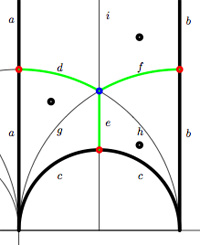
\xymatrix{& & \rho \ar[lld]_d \ar[ld]^f \ar[rd]^e & \\
i \ar[rrd]_a & i+1 \ar[rd]^b & & \omega \ar[ld]^c \\
& & 0 \ar[uu]^h \ar@/^/[uu]^g \ar@/_/[uu]_i &}

In this case the super-potential coming from the triangulation is

\Phi = -aid+agd-cge+che-bhf+bif

and therefore we have a noncommutative algebra \mathcal{U}(Q,\Phi) associated to this index 3 subgroup. Contrary to what I believed at the start of this series, the algebras one obtains in this way from dessins d’enfants are far from being Calabi-Yau (in whatever definition). For example, using a GAP-program written by Raf Bocklandt Ive checked that the growth rate of the above algebra is similar to that of \mathbb{C}[x], so in this case \mathcal{U}(Q,\Phi) can be viewed as a noncommutative curve (with singularities).

However, this is not the case for all such algebras. For example, the vacualgebra associated to the second index three subgroup (whose fundamental domain and quiver were depicted at the end of this post) has growth rate similar to that of \mathbb{C} \langle x,y \rangle

I have an outlandish conjecture about the growth-behavior of all algebras \mathcal{U}(Q,\Phi) coming from dessins d’enfants : the algebra sees what the monodromy representation of the dessin sees of the modular group (or of the third braid group). I can make this more precise, but perhaps it is wiser to calculate one or two further examples…

non-geometry

Friday, June 16th, 2006

Here’s an appeal to the few people working in Cuntz-Quillen-Kontsevich-whoever noncommutative geometry (the one where smooth affine varieties correspond to quasi-free or formally smooth algebras) : let’s rename our topic and call it non-geometry. I didn’t come up with this term, I heard in from Maxim Kontsevich in a talk he gave a couple of years ago in Antwerp. There are some good reasons for this name change.

The term non-commutative geometry is already taken by much more popular subjects such as Connes-style noncommutative differential geometry and Artin-style noncommutative algebraic geometry. Renaming our topic we no longer have to include footnotes (such as the one in the recent Kontsevich-Soibelman paper) :

We use “formal” non-commutative geometry in tensor categories, which is different from the non-commutative geometry in the sense of Alain Connes.

or to make a distinction between noncommutative geometry in the small (which is Artin-style) and noncommutative geometry in the large (which in non-geometry) as in the Ginzburg notes.

Besides, the stress in non-commutative geometry (both in Connes- and Artin-style) in on commutative. Connes-style might also be called ‘K-theory of $C^*$-algebras’ and they use the topological information of K-theoretic terms in the commutative case as guidance to speak about geometrical terms in the nocommutative case. Similarly, Artin-style might be called ‘graded homological algebra’ and they use Serre’s homological interpretation of commutative geometry to define similar concepts for noncommutative algebras. Hence, non-commutative geometry is that sort of non-geometry which is almost commutative…

But the main point of naming our subject non-geometry is to remind us not to rely too heavily on our (commutative) geometric intuition. For example, we would expect a manifold to have a fixed dimension. One way to define the dimension is as the trancendence degree of the functionfield. However, from the work of Paul Cohn (I learned about it through Aidan Schofield) we know that quasi-free algebras usually do’nt have a specific function ring of fractions, rather they have infinitely many good candidates for it and these candidates may look pretty unrelated. So, at best we can define a local dimension of a noncommutative manifold at a point, say given by a simple representation. It follows from the Cunz-Quillen tubular neighborhood result that the local ring in such a point is of the form

M_n(\mathbb{C} \langle \langle z_1,\hdots,z_m \rangle
\rangle)

(this s a noncommutative version of the classical fact than the local ring in a point of a d-dimensional manifold is formal power series \mathbb{C} [[ z_1,\hdots,z_d ]]) but in non-geometry both m (the _local dimension) and n (the dimension of the simple representation) vary from point to point. Still, one can attach to the quasi-free algebra A a finite amount of data (in fact, a finite quiver and dimension vector) containing enough information to compute the (n,m) couples for all simple points (follows from the one quiver to rule them all paper or see this for more details).

In fact, one can even extend this to points corresponding to semi-simple representations in which case one has to replace the matrix-ring above by a ring Morita equivalent to the completion of the path algebra of a finite quiver, the local quiver at the point (which can also be computer from the one-quiver of A. The local coalgebras of distributions at such points of Kontsevich&Soibelman are just the dual coalgebras of these local algebras (in math.RA/0606241 they merely deal with the n=1 case but no doubt the general case will appear in the second part of their paper).

The case of the semi-simple point illustrates another major difference between commutative geometry and non-geometry, whereas commutative simples only have self-extensions (so the distribution coalgebra is just the direct sum of all the local distributions) noncommutative simples usually have plenty of non-isomorphic simples with which they have extensions, so to get at the global distribution coalgebra of A one cannot simply add the locals but have to embed them in more involved coalgebras.

The way to do it is somewhat concealed in the third version of my neverending book (the version that most people found incomprehensible). Here is the idea : construct a huge uncountable quiver by taking as its vertices the isomorphism classes of all simple A-representations and with as many arrows between the simple vertices S and T as the dimension of the ext-group between these simples (and again, these dimensions follow from the knowledge of the one-quiver of A). Then, the global coalgebra of distributions of A is the limit over all cotensor coalgebras corresponding to finite subquivers). Maybe I’ll revamp this old material in connection with the Kontsevich&Soibelman paper(s) for the mini-course I’m supposed to give in september.

necklaces (again)

Wednesday, March 23rd, 2005

I have been posting before on the necklace Lie algebra : on Travis Schedler's extension of the Lie algebra structure to a Lie bialgebra and its deformation and more recently in connection with Michel Van den Bergh's double Poisson paper.
Yesterday, Victor Ginzburg and Travis Schedler posted their paper Moyal quantization of necklace Lie algebras on the arXiv in which they give a Moyal-type construction of the Hopf algebra deformation of the necklace Lie bialgebra found by Schedler last year.
It would be nice if someone worked out a few examples of these constructions in full detail. But as often in the case of (wild) quiver situation it is not clear what an 'interesting' example might be. For the finite and tame case we have a full classification by (extended) Dynkin diagrams so a natural class of examples but it isn't clear how to find gems in the complement.
One natural source of double quiver situations seems to come from what I called the One Quiver of a formally smooth algebra. This one quiver of group algebras of some interesting arithemetical groups such as the modular group PSL_2(\mathbb{Z}) and SL_2(\mathbb{Z}) were calculated before and turned out to be consisting of one (resp. two) components which are the double of the tame quiver \tilde{A}_5.
To obtain the double of a wild quiver situation loook at the group GL_2(\mathbb{Z}) = D_4
\bigstar_{D_2} D_6. In a previous post I thought to have calculated it, but lately I found that this was incorrect. Even the version I computed last week still had some mistakes as Raf Bocklandt discovered. But as of yesterday we are pretty certain that the one quiver for GL_2(\mathbb{Z}) consists of two components. One of these is the double quiver of an interesting wild quiver

\xymatrix{& \vtx{} \ar@{=}[rr] \ar@{=}[dd] & & \vtx{} \ar@{=}[dd]
\\ \vtx{} \ar@{=}[ur] \ar@{=}[rr] \ar@{=}[dd] & & \vtx{} \ar@{.}[ur]
\ar@{.}[dd] \ar@{=}[dr] \\ & \vtx{} \ar@{.}[rr] \ar@{=}[dr] & & \vtx{}
\\ \vtx{} \ar@{=}[rr] \ar@{.}[ur] & & \vtx{} \ar@{=}[ur]}

where each double line indicates that there is an arrow in each direction between the vertices. So, it is an interwoven pattern of one big cycle of length 6 (reminiscent of the modular group case) with 4 cycles of length 5. Perhaps the associated necklace Lie (bi)algebra and its deformation might be interesting to work out.
However, the second component of the one quiver for GL_2(\mathbb{Z}) is not symmetric.Maybe I will come back to the calculation of these quivers later.

cotangent bundles

Thursday, September 9th, 2004

The previous post in this sequence was moduli spaces. Why did we spend time explaining the connection of the quiver
Q~:~\xymatrix{\vtx{} \ar[rr]^a & & \vtx{} \ar@(ur,dr)^x}
to moduli spaces of vectorbundles on curves and moduli spaces of linear control systems? At the start I said we would concentrate on its double quiver \tilde{Q}~:~\xymatrix{\vtx{} \ar@/^/[rr]^a && \vtx{}
\ar@(u,ur)^x \ar@(d,dr)_{x^_} \ar@/^/[ll]^{a^_}} Clearly, this already gives away the answer : if the path algebra $C Q$ determines a (non-commutative) manifold $M$, then the path algebra $C \tilde{Q}$ determines the cotangent bundle of $M$. Recall that for a commutative manifold $M$, the cotangent bundle is the vectorbundle having at the point $p \in M$ as fiber the linear dual $(Tp M)^$ of the tangent space. So, why do we claim that $C \tilde{Q}$ corresponds to the cotangent bundle of $C Q$? Fix a dimension vector $\alpha = (m,n)$ then the representation space
$\mathbf{rep}{\alpha}~Q = M{n \times m}(C) \oplus Mn(C)$ is just an affine space so in its point the tangent space is the representation space itself. To define its linear dual use the non-degeneracy of the _trace pairings $M{n \times m}(C) \times M{m \times n}(C) \rightarrow C~:~(A,B) \mapsto tr(AB)$ $Mn(C) \times Mn(C) \rightarrow C~:~(C,D) \mapsto tr(CD)$ and therefore the linear dual $\mathbf{rep}_{\alpha}~Q^
= M{m \times n}(C) \oplus Mn(C)$ which is the representation space $\mathbf{rep}{\alpha}~Q^s$ of the quiver
Q^s~:~\xymatrix{\vtx{} & & \vtx{} \ar[ll] \ar@(ur,dr)}
and therefore we have that the cotangent bundle to the representation space $\mathbf{rep}
{\alpha}~Q$ $T^* \mathbf{rep}{\alpha}~Q = \mathbf{rep}{\alpha}~\tilde{Q}$ Important for us will be that any cotangent bundle has a natural symplectic structure. For a good introduction to this see the course notes “Symplectic geometry and quivers” by Geert Van de Weyer. As a consequence $C \tilde{Q}$ can be viewed as a non-commutative symplectic manifold with the symplectic structure determined by the non-commutative 2-form
$\omega = da^* da + dx^* dx$ but before we can define all this we will have to recall some facts on non-commutative differential forms. Maybe next time. For the impatient : have a look at the paper by Victor Ginzburg Non-commutative Symplectic Geometry, Quiver varieties, and Operads or my paper with Raf Bocklandt Necklace Lie algebras and noncommutative symplectic geometry. Now that we have a cotangent bundle of $C Q$ is there also a tangent bundle and does it again correspond to a new quiver? Well yes, here it is
\xymatrix{\vtx{} \ar@/^/[rr]^{a+da} \ar@/_/[rr]_{a-da} & & \vtx{}
\ar@(u,ur)^{x+dx} \ar@(d,dr)_{x-dx}} and the labeling of the arrows may help you to work through some sections of the Cuntz-Quillen paper…

nog course outline

Thursday, September 2nd, 2004

Now that the preparation for my undergraduate courses in the first semester is more or less finished, I can begin to think about the courses I’ll give this year in the master class non-commutative geometry. For a change I’d like to introduce the main ideas and concepts by a very concrete example : Ginzburg’s coadjoint-orbit result for the Calogero-Moser space and its relation to the classification of one-sided ideals in the first Weyl algebra. Not only will this example give me the opportunity to say things about formally smooth algebras, non-commutative differential forms and even non-commutative symplectic geometry, but it also involves what some people prefer to call non-commutative algebraic geometry (that is the study of graded Noetherian rings having excellent homological properties) via the projective space associated to the homogenized Weyl algebra. Besides, I have some affinity with this example.

A long time ago I introduced the moduli spaces for one-sided ideals in the Weyl algebra in Moduli spaces for right ideals of the Weyl algebra and when I was printing a very preliminary version of Ginzburg’s paper Non-commutative Symplectic Geometry, Quiver varieties, and Operads (probably because he send a preview to Yuri Berest and I was in contact with him at the time about the moduli spaces) the idea hit me at the printer that the right way to look at the propblem was to consider the quiver

\xymatrix{\vtx{} \ar@/^/[rr]^a & &  \vtx{} \ar@(u,ur)^x \ar@(d,dr)_y \ar@/^/[ll]^b}

which eventually led to my paper together with Raf Bocklandt Necklace Lie algebras and noncommutative symplectic geometry. Apart from this papers I would like to explain the following papers by illustrating them on the above example : Michail Kapranov Noncommutative geometry based on commutator expansions Maxim Kontsevich and Alex Rosenberg Noncommutative smooth spaces Yuri Berest and George Wilson Automorphisms and Ideals of the Weyl Algebra Yuri Berest and George Wilson Ideal Classes of the Weyl Algebra and Noncommutative Projective Geometry Travis Schedler A Hopf algebra quantizing a necklace Lie algebra canonically associated to a quiver and of course the seminal paper by Joachim Cuntz and Daniel Quillen on quasi-free algebras and their non-commutative differential forms which, unfortunately, in not available online. I plan to write a series of posts here on all this material but I will be very happy to get side-tracked by any comments you might have. So please, if you are interested in any of this and want to have more information or explanation do not hesitate to post a comment (only your name and email is required to do so, you do not have to register and you can even put some latex-code in your post but such a posting will first have to viewed by me to avoid cluttering of nonsense GIFs in my directories).

AWSOM Powered