Posts Tagged ‘braid group’


F_un and braid groups

Sunday, June 15th, 2008

Recall that an n-braid consists of n strictly descending elastic strings connecting n inputs at the top (named 1,2,…,n) to n outputs at the bottom (labeled 1,2,…,n) upto isotopy (meaning that we may pull and rearrange the strings in any way possible within 3-dimensional space). We can always change the braid slightly such that we can divide the interval between in- and output in a number of subintervals such that in each of those there is at most one crossing.

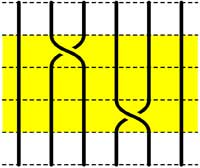
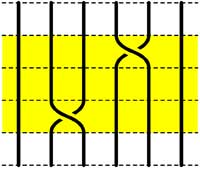
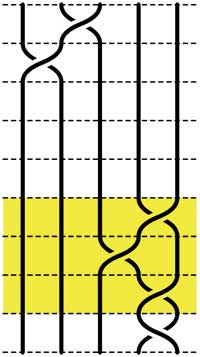
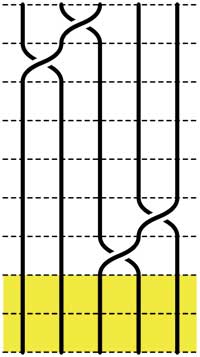
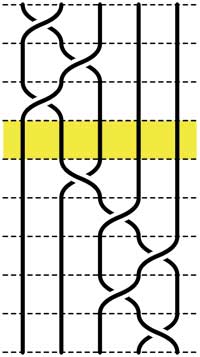
n-braids can be multiplied by putting them on top of each other and connecting the outputs of the first braid trivially to the inputs of the second. For example the 5-braid on the left can be written as B=B_1.B_2 with B_1 the braid on the top 3 subintervals and B_2 the braid on the lower 5 subintervals.

In this way (and using our claim that there can be at most 1 crossing in each subinterval) we can write any n-braid as a word in the generators \sigma_i (with 1 \leq i < n) being the overcrossing between inputs i and i+1. Observe that the undercrossing is then the inverse \sigma_i^{-1}. For example, the braid on the left corresponds to the word

\sigma_1^{-1}.\sigma_2^{-1}.\sigma_1^{-1}.\sigma_2.\sigma_3^{-1}.\sigma_4^{-1}.\sigma_3^{-1}.\sigma_4

Clearly there are relations among words in the generators. The easiest one we have already used implicitly namely that \sigma_i.\sigma_i^{-1} is the trivial braid. Emil Artin proved in the 1930-ies that all such relations are consequences of two sets of ‘obvious’ relations. The first being commutation relations between crossings when the strings are far enough from each other. That is we have

\sigma_i . \sigma_j = \sigma_j . \sigma_i whenever |i-j| \geq 2

=

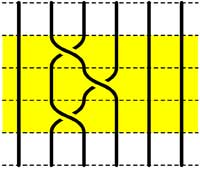
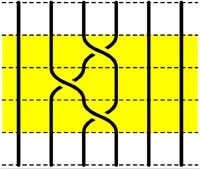
The second basic set of relations involves crossings using a common string

\sigma_i.\sigma_{i+1}.\sigma_i = \sigma_{i+1}.\sigma_i.\sigma_{i+1}

=

Starting with the 5-braid at the top, we can use these relations to reduce it to a simpler form. At each step we have outlined to region where the relations are applied
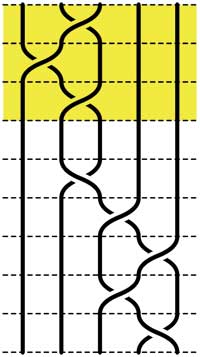
= = =
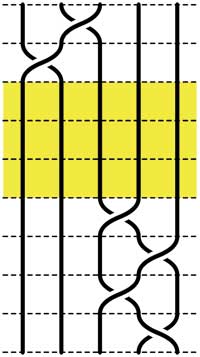
These beautiful braid-pictures were produced using the braid-metapost program written by Stijn Symens.

Tracing a string from an input to an output assigns to an n-braid a permutation on n letters. In the above example, the permutation is ~(1,2,4,5,3). As this permutation doesn’t change under applying basic reduction, this gives a group-morphism

\mathbb{B}_n \rightarrow S_n

from the braid group on n strings \mathbb{B}_n to the symmetric group. We have seen before that the symmetric group S_n has a F-un interpretation as the linear group GL_n(\mathbb{F}_1) over the field with one element. Hence, we can ask whether there is also a F-un interpretation of the n-string braid group and of the above group-morphism.

Kapranov and Smirnov suggest in their paper that the n-string braid group \mathbb{B}_n \simeq GL_n(\mathbb{F}_1[t]) is the general linear group over the polynomial ring \mathbb{F}_1[t] over the field with one element and that the evaluation morphism (setting t=0)

GL_n(\mathbb{F}_1[t]) \rightarrow GL_n(\mathbb{F}1) gives the groupmorphism \mathbb{B}_n \rightarrow S_n

The rationale behind this analogy is a theorem of Drinfeld’s saying that over a finite field \mathbb{F}_q, the profinite completion of GL_n(\mathbb{F}_q[t]) is embedded in the fundamental group of the space of q-polynomials of degree n in much the same way as the n-string braid group \mathbb{B}_n is the fundamental group of the space of complex polynomials of degree n without multiple roots.

And, now that we know the basics of absolute linear algebra, we can give an absolute braid-group representation

\mathbb{B}_n = GL_n(\mathbb{F}_1[t]) \rightarrow GL_n(\mathbb{F}_{1^n})

obtained by sending each generator \sigma_i to the matrix over \mathbb{F}_{1^n} (remember that \mathbb{F}_{1^n} = (\mu_n)^{\bullet} where \mu_n = \langle \epsilon_n \rangle are the n-th roots of unity)

\sigma_i \mapsto \begin{bmatrix}
1_{i-1} & & & \\
& 0 & \epsilon_n & \\
& \epsilon_n^{-1} & 0 & \\
& & & 1_{n-1-i} \end{bmatrix}

and it is easy to see that these matrices do indeed satisfy Artin’s defining relations for \mathbb{B}_n.

Absolute linear algebra

Tuesday, June 10th, 2008

Fun with F_un

  1. Looking for F_un
  2. The F_un folklore
  3. Absolute linear algebra
  4. F_un and braid groups

Today we will define some basic linear algebra over the absolute fields \mathbb{F}_{1^n} following the Kapranov-Smirnov document. Recall from last time that \mathbb{F}_{1^n} = \mu_n^{\bullet} and that a d-dimensional vectorspace over this field is a pointed set V^{\bullet} where V is a free \mu_n-set consisting of n.d elements. Note that in absolute linear algebra we are not allowed to have addition of vectors and have to define everything in terms of scalar multiplication (or if you want, the \mu_n-action). In the hope of keeping you awake, we will include an F-un interpretation of the power residue symbol.

Direct sums of vectorspaces are defined via V^{\bullet} \oplus W^{\bullet} = (V \bigsqcup W)^{\bullet}, that is, correspond to the disjoint union of free \mu_n-sets. Consequently we have that dim(V^{\bullet} \oplus W^{\bullet}) = dim(V^{\bullet}) + dim(W^{\bullet}).

For tensor-product we start with V^{\bullet} \times W^{\bullet} = (V \times W)^{\bullet} the vectorspace cooresponding to the Cartesian product of free \mu_n-sets. If the dimensions of V^{\bullet} and W^{\bullet} are respectively d and e, then V \times W consists of n.d.n.e elements, so is of dimension n.d.e. In order to have a sensible notion of tensor-products we have to eliminate the n-factor. We do this by identifying ~(x,y) with (\epsilon_n x, \epsilon^{-1} y) and call the corresponding vectorspace V^{\bullet} \otimes W^{\bullet}. If we denote the image of ~(x,y) by x \otimes w then the identification merely says we can pull the \mu_n-action through the tensor-sign, as we’d like to do. With this definition we do indeed have that dim(V^{\bullet} \otimes W^{\bullet}) = dim(V^{\bullet}) dim(W^{\bullet}).

Recall that any linear automorphism A of an \mathbb{F}_{1^n} vectorspace V^{\bullet} with basis \{ b_1,\hdots,b_d \} (representants of the different \mu_n-orbits) is of the form A(b_i) = \epsilon_n^{k_i} b_{\sigma(i)} for some powers of the primitive n-th root of unity \epsilon_n and some permutation \sigma \in S_d. We define the determinant det(A) = \prod_{i=1}^d \epsilon_n^{k_i}. One verifies that the determinant is multiplicative and independent of the choice of basis.

For example, scalar-multiplication by \epsilon_n gives an automorphism on any d-dimensional \mathbb{F}_{1^n}-vectorspace V^{\bullet} and the corresponding determinant clearly equals det = \epsilon_n^d. That is, the det-functor remembers the dimension modulo n. These mod-n features are a recurrent theme in absolute linear algebra. Another example, which will become relevant when we come to reciprocity laws :

Take n=2. Then, a \mathbb{F}_{1^2} vectorspace V^{\bullet} of dimension d is a set consisting of 2d elements V equipped with a free involution. Any linear automorphism A~:~V^{\bullet} \rightarrow V^{\bullet} is represented by a d \times d matrix having one nonzero entry in every row and column being equal to +1 or -1. Hence, the determinant det(A) \in \{ +1,-1 \}.
On the other hand, by definition, the linear automorphism A determines a permutation \sigma_A \in S_{2d} on the 2d non-zero elements of V^{\bullet}. The connection between these two interpretations is that det(A) = sgn(\sigma_A) the determinant gives the sign of the permutation!

For a prime power q=p^k with q \equiv 1~mod(n), we have seen that the roots of unity \mu_n \subset \mathbb{F}_q^_ and hence that \mathbb{F}_q is a vectorspace over \mathbb{F}_{1^n}. For any field-unit a \in \mathbb{F}_q^_ we have the power residue symbol

\begin{pmatrix} a \\ \mathbb{F}_q \end{pmatrix}_n = a^{\frac{q-1}{n}} \in \mu_n

On the other hand, multiplication by a is a linear automorphism on the \mathbb{F}_{1^n}-vectorspace \mathbb{F}_q and hence we can look at its F-un determinant det(a \times). The F-un interpretation of a classical lemma by Gauss asserts that the power residue symbol equals det(a \times).

An \mathbb{F}_{1^n}-subspace W^{\bullet} of a vectorspace V^{\bullet} is a subset W \subset V consisting of full \mu_n-orbits. Normally, in defining a quotient space we would say that two V-vectors are equivalent when their difference belongs to W and take equivalence classes. However, in absolute linear algebra we are not allowed to take linear combinations of vectors…

The only way out is to define ~(V/W)^{\bullet} to correspond to the free \mu_n-set ~(V/W) obtained by identifying all elements of W with the zero-element in V^{\bullet}. But… this will screw-up things if we want to interpret \mathbb{F}_q-vectorspaces as \mathbb{F}_{1^n}-spaces whenever q \equiv 1~mod(n).

For this reason, Kapranov and Smirnov invent the notion of an equivalence f~:~X^{\bullet} \rightarrow Y^{\bullet} between \mathbb{F}_{1^n}-spaces to be a linear map (note that this means a set-theoretic map X \rightarrow Y^{\bullet} such that the invers image of 0 consists of full \mu_n-orbits and is a \mu_n-map elsewhere) satisfying the properties that f^{-1}(0) = 0 and for every element y \in Y we have that the number of pre-images f^{-1}(y) is congruent to 1 modulo n. Observe that under an equivalence f~:~X^{\bullet} \rightarrow Y^{\bullet} we have that dim(X^{\bullet}) \equiv dim(Y^{\bullet})~mod(n).

This then allows us to define an exact sequence of \mathbb{F}_{1^n}-vectorspaces to be

\xymatrix{0 \ar[r] & V_1^{\bullet} \ar[r]^{\alpha} & V^{\bullet} \ar[r]^{\beta} & V_2^{\bullet} \ar[r] & 0}

with \alpha a set-theoretic inclusion, the composition \beta \circ \alpha to be the zero-map and with the additional assumption that the map induced by \beta

~(V/V_1)^{\bullet} \rightarrow V_2^{\bullet}

is an equivalence. For an exact sequence of spaces as above we have the congruence relation on their dimensions dim(V_1)+dim(V_2) \equiv dim(V)~mod(n).

More importantly, if as before q \equiv 1~mod(n) and we use the embedding \mu_n \subset \mathbb{F}_q^* to turn usual \mathbb{F}_q-vectorspaces into absolute \mathbb{F}_{1^n}-spaces, then an ordinary exact sequence of \mathbb{F}_q-vectorspaces remains exact in the above definition.

Quiver-superpotentials

Monday, January 14th, 2008

It’s been a while, so let’s include a recap : a (transitive) permutation representation of the modular group \Gamma = PSL_2(\mathbb{Z}) is determined by the conjugacy class of a cofinite subgroup \Lambda \subset \Gamma, or equivalently, to a dessin d’enfant. We have introduced a quiver (aka an oriented graph) which comes from a triangulation of the compactification of \mathbb{H} / \Lambda where \mathbb{H} is the hyperbolic upper half-plane. This quiver is independent of the chosen embedding of the dessin in the Dedeking tessellation. (For more on these terms and constructions, please consult the series Modular subgroups and Dessins d’enfants).

Why are quivers useful? To start, any quiver Q defines a noncommutative algebra, the path algebra \mathbb{C} Q, which has as a \mathbb{C}-basis all oriented paths in the quiver and multiplication is induced by concatenation of paths (when possible, or zero otherwise). Usually, it is quite hard to make actual computations in noncommutative algebras, but in the case of path algebras you can just see what happens.

Moreover, we can also see the finite dimensional representations of this algebra \mathbb{C} Q. Up to isomorphism they are all of the following form : at each vertex v_i of the quiver one places a finite dimensional vectorspace \mathbb{C}^{d_i} and any arrow in the quiver \xymatrix{\vtx{v_i} \ar[r]^a & \vtx{v_j}} determines a linear map between these vertex spaces, that is, to a corresponds a matrix in M_{d_j \times d_i}(\mathbb{C}). These matrices determine how the paths of length one act on the representation, longer paths act via multiplcation of matrices along the oriented path.

A necklace in the quiver is a closed oriented path in the quiver up to cyclic permutation of the arrows making up the cycle. That is, we are free to choose the start (and end) point of the cycle. For example, in the one-cycle quiver

\xymatrix{\vtx{} \ar[rr]^a & & \vtx{} \ar[ld]^b \\ & \vtx{} \ar[lu]^c &}

the basic necklace can be represented as abc or bca or cab. How does a necklace act on a representation? Well, the matrix-multiplication of the matrices corresponding to the arrows gives a square matrix in each of the vertices in the cycle. Though the dimensions of this matrix may vary from vertex to vertex, what does not change (and hence is a property of the necklace rather than of the particular choice of cycle) is the trace of this matrix. That is, necklaces give complex-valued functions on representations of \mathbb{C} Q and by a result of Artin and Procesi there are enough of them to distinguish isoclasses of (semi)simple representations! That is, linear combinations a necklaces (aka super-potentials) can be viewed, after taking traces, as complex-valued functions on all representations (similar to character-functions).

In physics, one views these functions as potentials and it then interested in the points (representations) where this function is extremal (minimal) : the vacua. Clearly, this does not make much sense in the complex-case but is relevant when we look at the real-case (where we look at skew-Hermitian matrices rather than all matrices). A motivating example (the Yang-Mills potential) is given in Example 2.3.2 of Victor Ginzburg’s paper Calabi-Yau algebras.

Let \Phi be a super-potential (again, a linear combination of necklaces) then our commutative intuition tells us that extrema correspond to zeroes of all partial differentials \frac{\partial \Phi}{\partial a} where a runs over all coordinates (in our case, the arrows of the quiver). One can make sense of differentials of necklaces (and super-potentials) as follows : the partial differential with respect to an arrow a occurring in a term of \Phi is defined to be the path in the quiver one obtains by removing all 1-occurrences of a in the necklaces (defining \Phi) and rearranging terms to get a maximal broken necklace (using the cyclic property of necklaces). An example, for the cyclic quiver above let us take as super-potential abcabc (2 cyclic turns), then for example

\frac{\partial \Phi}{\partial b} = cabca+cabca = 2 cabca

(the first term corresponds to the first occurrence of b, the second to the second). Okay, but then the vacua-representations will be the representations of the quotient-algebra (which I like to call the vacualgebra)

\mathcal{U}(Q,\Phi) = \frac{\mathbb{C} Q}{(\partial \Phi/\partial a, \forall a)}

which in ‘physical relevant settings’ (whatever that means…) turn out to be Calabi-Yau algebras.

But, let us return to the case of subgroups of the modular group and their quivers. Do we have a natural super-potential in this case? Well yes, the quiver encoded a triangulation of the compactification of \mathbb{H}/\Lambda and if we choose an orientation it turns out that all ‘black’ triangles (with respect to the Dedekind tessellation) have their arrow-sides defining a necklace, whereas for the ‘white’ triangles the reverse orientation makes the arrow-sides into a necklace. Hence, it makes sense to look at the cubic superpotential \Phi being the sum over all triangle-sides-necklaces with a +1-coefficient for the black triangles and a -1-coefficient for the white ones. Let’s consider an index three example from a previous post

\xymatrix{& & \rho \ar[lld]_d \ar[ld]^f \ar[rd]^e & \\
i \ar[rrd]_a & i+1 \ar[rd]^b & & \omega \ar[ld]^c \\
& & 0 \ar[uu]^h \ar@/^/[uu]^g \ar@/_/[uu]_i &}

In this case the super-potential coming from the triangulation is

\Phi = -aid+agd-cge+che-bhf+bif

and therefore we have a noncommutative algebra \mathcal{U}(Q,\Phi) associated to this index 3 subgroup. Contrary to what I believed at the start of this series, the algebras one obtains in this way from dessins d’enfants are far from being Calabi-Yau (in whatever definition). For example, using a GAP-program written by Raf Bocklandt Ive checked that the growth rate of the above algebra is similar to that of \mathbb{C}[x], so in this case \mathcal{U}(Q,\Phi) can be viewed as a noncommutative curve (with singularities).

However, this is not the case for all such algebras. For example, the vacualgebra associated to the second index three subgroup (whose fundamental domain and quiver were depicted at the end of this post) has growth rate similar to that of \mathbb{C} \langle x,y \rangle

I have an outlandish conjecture about the growth-behavior of all algebras \mathcal{U}(Q,\Phi) coming from dessins d’enfants : the algebra sees what the monodromy representation of the dessin sees of the modular group (or of the third braid group). I can make this more precise, but perhaps it is wiser to calculate one or two further examples…

quivers versus quilts

Wednesday, January 2nd, 2008

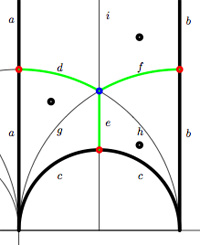
We have associated to a subgroup of the modular group PSL_2(\mathbb{Z}) a quiver (that is, an oriented graph). For example, one verifies that the fundamental domain of the subgroup \Gamma_0(2) (an index 3 subgroup) is depicted on the right by the region between the thick lines with the identification of edges as indicated. The associated quiver is then

\xymatrix{i \ar[rr]^a \ar[dd]^b & & 1 \ar@/^/[ld]^h \ar@/_/[ld]_i \\
& \rho \ar@/^/[lu]^d \ar@/_/[lu]_e \ar[rd]^f & \\
0 \ar[ru]^g & & i+1 \ar[uu]^c}

The corresponding “dessin d’enfant” are the green edges in the picture. But, the red dot on the left boundary is identied with the red dot on the lower circular boundary, so the dessin of the modular subgroup \Gamma_0(2) is

\xymatrix{| \ar@{-}[r] & \bullet \ar@{-}@/^8ex/[r] \ar@{-}@/_8ex/[r] & -}

Here, the three red dots (all of them even points in the Dedekind tessellation) give (after the identification) the two points indicated by a \mid whereas the blue dot (an odd point in the tessellation) is depicted by a \bullet. There is another ‘quiver-like’ picture associated to this dessin, a quilt of the modular subgroup \Gamma_0(2) as studied by John Conway and Tim Hsu.

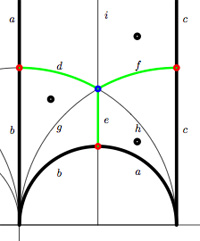
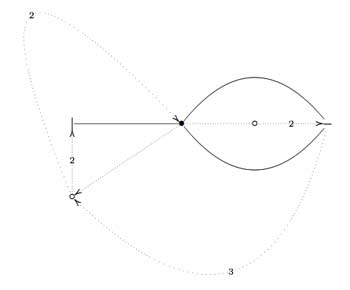
On the left, a quilt-diagram copied from Hsu’s book Quilts : central extensions, braid actions, and finite groups, exercise 3.3.9. This ‘quiver’ has also 5 vertices and 7 arrows as our quiver above, so is there a connection?
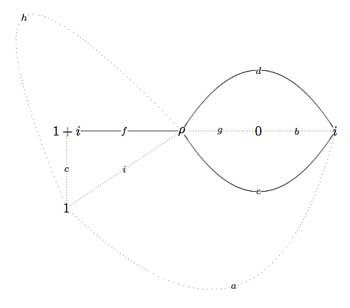
A quilt is a gadget to study transitive permutation representations of the braid group B_3 (rather than its quotient, the modular group PSL_2(\mathbb{Z}) = B_3/\langle Z \rangle where \langle Z \rangle is the cyclic center of B_3. The Z-stabilizer subgroup of all elements in a transitive permutation representation of B_3 is the same and hence of the form \langle Z^M \rangle where M is called the modulus of the representation. The arrow-data of a quilt, that is the direction of certain edges and their labeling with numbers from \mathbb{Z}/M \mathbb{Z} (which have to satisfy some requirements, the flow rules, but more about that another time) encode the Z-action on the permutation representation. The dimension of the representation is M \times k where k is the number of half-edges in the dessin. In the above example, the modulus is 5 and the dessin has 3 (half)edges, so it depicts a 15-dimensional permutation representation of B_3.

If we forget the Z-action (that is, the arrow information), we get a permutation representation of the modular group (that is a dessin). So, if we delete the labels and directions on the edges we get what Hsu calls a modular quilt, that is, a picture consisting of thick edges (the dessin) together with dotted edges which are called the seams of the modular quilt. The modular quilt is merely another way to depict a fundamental domain of the corresponding subgroup of the modular group. For the above example, we have the indicated correspondences between the fundamental domain of \Gamma_0(2) in the upper half-plane (on the left) and as a modular quilt (on the right)

That is, we can also get our quiver (or its opposite quiver) from the modular quilt by fixing the orientation of one 2-cell. For example, if we fix the orientation of the 2-cell \vec{fch} we get our quiver back from the modular quilt

\xymatrix{i \ar[rr]^a \ar[dd]^b & & 1 \ar@/^/[ld]^h \ar@/_/[ld]_i \\
& \rho \ar@/^/[lu]^d \ar@/_/[lu]_e \ar[rd]^f & \\
0 \ar[ru]^g & & i+1 \ar[uu]^c}

This shows that the quiver (or its opposite) associated to a (conjugacy class of a) subgroup of PSL_2(\mathbb{Z}) does not depend on the choice of embedding of the dessin (or associated cuboid tree diagram) in the upper half-plane. For, one can get the modular quilt from the dessin by adding one extra vertex for every connected component of the complement of the dessin (in the example, the two vertices corresponding to 0 and 1) and drawing a triangulation from them (the dotted lines or ’seams’).

mathematics for 2008 (and beyond)

Sunday, December 30th, 2007

Via the n-category cafe (and just now also the Arcadian functor ) I learned that Benjamin Mann of DARPA has constructed a list of 23 challenges for mathematics for this century.

DARPA is the “Defense Advanced Research Projects Agency” and is an agency of the United States Department of Defense ‘responsible for the development of new technology for use by the military’.

Bejamin Mann is someone in their subdivision DSO, that is, the “Defense Sciences Office” that ‘vigorously pursues the most promising technologies within a broad spectrum of the science and engineering research communities and develops those technologies into important, radically new military capabilities’.

I’m not the greatest fan of the US military, but the proposed list of 23 mathematical challenges is actually quite original and interesting.

What follows is my personal selection of what I consider the top 5 challenges from the list (please disagree) :

1. The Mathematics of Quantum Computing, Algorithms, and Entanglement (DARPA 15) : “In the last century we learned how quantum phenomena shape our world. In the coming century we need to develop the mathematics required to control the quantum world.”

2. Settle the Riemann Hypothesis (DARPA 19) : “The Holy Grail of number theory.”

3. Geometric Langlands and Quantum Physics (DARPA 17) : “How does the Langlands program, which originated in number theory and representation theory, explain the fundamental symmetries of physics? And vice versa?”

4. The Geometry of Genome Space (DARPA 15) : “What notion of distance is needed to incorporate biological utility?”

5. Algorithmic Origami and Biology (DARPA 10) : “Build a stronger mathematical theory for isometric and rigid embedding that can give insight into protein folding.”

All of this will have to wait a bit, for now

HAPPY & HEALTHY 2008

AWSOM Powered