Posts Tagged ‘arxiv’


Surreal numbers & chess

Tuesday, April 8th, 2008

Most chess programs are able to give a numerical evaluation of a position. For example, the position below is considered to be worth +8.7 with white to move, and, -0.7 with black to move (by a certain program). But, if one applies combinatorial game theory as in John Conway’s ONAG and the Berlekamp-Conway-Guy masterpiece Winning Ways for your Mathematical Plays it will turn out that the position can be proved to have an infinitesimal advantage for white…

So, what do we mean by this? First some basic rules of combinatorial game theory. To start, we evaluate a position without knowing which player has the move. A zero-game is by definition a position in which neither player has a good move, that is, any move by either player quickly leads to losing the game. Hence, a zero-game is a position in which the second player to move wins.

What is the chess-equivalent of a zero-position game? A position in which neither player has a good move is called a Mutual Zugzwang in chess literature. An example is given by the above position, if we restrict attention only to the 4 pieces in the upper right-hand corner and forget the rest. We don’t know who has the move, but, White cannot move at all and Black cannot move the King or Bishop without losing the Bishop and allowing White to promote the pawn and win quickly. In CGT-parlance, the upper-right position has value \{ \emptyset | \emptyset \} = 0 where the left options denote the White moves and the right options the Black moves.

All other values are determined by recursion. For example, consider a position in which White has just one move left before the sitution is again a Mutual Zugzwang, and, Black has no good move whatsoever. After white’s move, the position will again be a zero-position and Black has no options, so the value of this position would be denoted by \{ 0 | \emptyset \} and we call the value of this position to be +1. Similarly, if white has no options and black has one final move to make, the position would be considered to have value \{ \emptyset | 0 \}= -1.

Clearly, these are just the three easiest game-values to have and the real kick comes further down the road when one can prove by recursion that some games have non-integer values (such as \{ 0 | 1 \} = \frac{1}{2} for a position in which white has one move to get to a mutual zugzwang and black has a move leading to a position of value +1 (defined as before)), or non-number values such as \ast = \{ 0 | 0 \} where both white and black’s best move is to get to a mutal zugzwang. Game-values such as \ast are called fuzzy (or confused with zero) and are defined by the property that the first player to move wins.

Similarly, positive game-values are those positions where White wins, independent of who has the move and negatives are those that Black wins. There is a whole menagery of game-values and the WinningWays-booklets give an example based introduction to this fascinating theory.

Brief as this introduction was, it will allow us to determine the exact value of the position in the above diagram. We know already that we can forget about the right-hand upper corner (as this is a zero-position) and concentrate attention to the left-hand side of the board.

It is easy to see that neither Knight can move without loosing quickly, nor can the pawns on a5 and b7. That is, white has just 2 options : either c3-c4 (quickly loosing after d5xc4 2. d3xc4,d4-d3 3. Nc1xd3,Na1-b3) or, and this is the only valid option c3xd4 leading to the position on the left below. Black has only one valid move : d4xc3 leading to the position on the right below.

\{~ ~|~ ~\}

Clearly, the left-diagram has value 0 as it is a mutual Zugzwang. The position on the right takes a moment’s thought : White has one move left d3-d4 leading to a 0-position, whereas black has one move d5-d4 leading to a position of value -1 (as black still has one move left d6-d5, whereas white has none). That is, the CGT-value of the right-hand position is \{ 0 | -1 \} and therefore, the value of the starting position is precisely equal to

\{ 0 | \{ 0 | -1 \} \} = +_{1} (called tiny-one among ONAGers)

It can be shown that +_1 has a positive value (that is, White wins independently of who has the first move) but smaller than any positive number-valued games!

Noam Elkies has written a beautiful paper On numbers and endgames: Combinatorial game theory in chess endgames containing many interesting examples (the example above is an adaptation of his diagram9).

the King’s problem on MUBs

Thursday, February 28th, 2008

MUBs (for Mutually Unbiased Bases) are quite popular at the moment. Kea is running a mini-series Mutual Unbias as is Carl Brannen. Further, the Perimeter Institute has a good website for its seminars where they offer streaming video (I like their MacromediaFlash format giving video and slides/blackboard shots simultaneously, in distinct windows) including a talk on MUBs (as well as an old talk by Wootters).

So what are MUBs to mathematicians? Recall that a d-state quantum system is just the vectorspace \mathbb{C}^d equipped with the usual Hermitian inproduct \vec{v}.\vec{w} = \sum \overline{v_i} w_i. An observable E is a choice of orthonormal basis \{ \vec{e_i} \} consisting of eigenvectors of the self-adjoint matrix E. E together with another observable F (with orthonormal basis \{ \vec{f_j} \}) are said to be mutally unbiased if the norms of all inproducts \vec{f_j}.\vec{e_i} are equal to 1/\sqrt{d}. This definition extends to a collection of pairwise mutually unbiased observables. In a d-state quantum system there can be at most d+1 mutually unbiased bases and such a collection of observables is then called a MUB of the system. Using properties of finite fields one has shown that MUBs exists whenever d is a prime-power. On the other hand, existence of a MUB for d=6 still seems to be open…

The King’s Problem1 is the following : A physicist is trapped on an island ruled by a mean king who promises to set her free if she can give him the answer to the following puzzle. The physicist is asked to prepare a d−state quantum system in any state of her choosing and give it to the king, who measures one of several mutually unbiased observables on it. Following this, the physicist is allowed to make a control measurement on the system, as well as any other systems it may have been coupled to in the preparation phase. The king then reveals which observable he measured and the physicist is required to predict correctly all the eigenvalues he found.

The Solution to the King’s problem in prime power dimension by P. K. Aravind, say for d=p^k, consists in taking a system of k object qupits (when p=2l+1 one qupit is a spin l particle) which she will give to the King together with k ancilla qupits that she retains in her possession. These 2k qupits are diligently entangled and prepared is a well chosen state. The final step in finding a suitable state is the solution to a pure combinatorial problem :

She must use the numbers 1 to d to form d^2 ordered sets of d+1 numbers each, with repetitions of numbers within a set allowed, such that any two sets have exactly one identical number in the same place in both. Here’s an example of 16 such strings for d=4 :

11432, 12341, 13214, 14123, 21324, 22413, 23142, 24231, 31243, 32134, 33421, 34312, 41111, 42222, 43333, 44444

Here again, finite fields are used in the solution. When d=p^k, identify the elements of \mathbb{F}_{p^k} with the numbers from 1 to d in some fixed way. Then, the d^2 of number-strings are found as follows : let k_0,k_1 \in \mathbb{F}_{p^k} and take as the first 2 numbers the ones corresponding to these field-elements. The remaning d-2 numbers in the string are those corresponding to the field element k_m (with 2 \leq m \leq d) determined from k_0,k_1 by the equation

k_m = l_{m} * k_0+k_1

where l_i is the field-element corresponding to the integer i (l_1 corresponds to the zero element). It is easy to see that these d^2 strings satisfy the conditions of the combinatorial problem. Indeed, any two of its digits determine k_0,k_1 (and hence the whole string) as it follows from k_m = l_m k_0 + k_1 and k_r = l_r k_0 + k_1 that k_0 = \frac{k_m-k_r}{l_m-l_r}.

In the special case when d=3 (that is, one spin 1 particle is given to the King), we recover the tetracode : the nine codewords

0000, 0+++, 0—, +0+-, ++-0, +-0+, -0-+, -+0-, –+0

encode the strings (with +=1,-=2,0=3)

3333, 3111, 3222, 1312, 1123, 1231, 2321, 2132, 2213

  1. actually a misnomer, it’s more the poor physicists’ problem… []

quotes of the day

Friday, February 1st, 2008

Some people are in urgent need of a vacation, myself included…

From the paper Transseries for beginners by G.A. Edgar, arXived today :

Well, brothers and sisters, I am here today to tell you: If you love these formulas, you need no longer hide in the shadows! The answer to all of these woes is here. Transseries.

In a comment over at The Everthing Seminar

Shouldn’t dwarfs on the shoulders on giants be a little less arrogant?

by Micromegas. Well, I’d rather enter a flame war than report about it. But, for some reason I cannot comment at the EverythingSeminar, nor at the SecretBloggingSeminar. Is this my problem or something to do with wordpress.com blogs? If you encountered a similar problem and managed to solve it, please let me know.

UPDATE (febr. 2) : my comment did surface after 5 days. Greg fished it out of their spam-filter. Thanks! I’ll try to comment at wordpress.com blogs from now on by NOT linking to neverendingbooks. I hope this will satisfy their spam-filter…

please, use this bookmarklet!

Monday, January 21st, 2008

Great! You’ve finally managed to arXiv your paper after months of laborious research, and now, you’re eagerly awaiting response…

The odds are you’ll be disappointed, if not frustrated. Chances are high that if you get any response at all it is only to clarify that someone else (usually the person emailing you) proved this result a long time ago, or that your result could be generalized enormously, or that you could have shortened your proof tremendously if only you were more educated, or … Mathematics seems to be more of a pissing contest than anything else, at such moments.

Imagine someone would be kind enough, at that particular moment, to send you an email saying not much more than : “Gee thanks! Ive just browsed through your paper arXived today and you really made my day! Keep up the good work, all the best :: lieven” (change the name to your liking)

Sadly, math-circles are not known for their ‘good-vibes’ generally. Mind you, Ive send similar emails to people posting on the arXiv, but, admittedly, I did it far fewer than I might have. Often I like (even admire) a result but repress the urgent need to communicate that feeling to the author, perhaps my Asperger kicking up…

Now that you may feel some empathy with the situation, let’s get to a similar situation in math-blogging. Sometimes, you spend a lot of time writing a post 1 , release it to the world, see tons of RSS-bots and genuine hits passing by and then what?… nothing! no reply, no email, no comment, nothing at all!

Personally, I’m not that influenced by this. When I blog I do it because (1) Ive the time, at that particular moment and (2) I like to write about the things I do, at that moment. But sometimes, it comes to us all, that feeling of ‘why am I doing this after all? can’t I spend my time more sensibly doing something else?’ and when you begin to have these doubts it usually marks the beginning of a long silence at your blog2

So, here’s an appeal to all you lurkers at math-blogs : give these people, once in a while, something back…. Ive thought for a long time that this lurk-but-no-comment attitude was something typical of mathematicians, but, as often, when researched in more depth, I have to admit that I’m wrong! Read the post Participation Inequality: Encouraging More Users to Contribute by Jakob Nielsen to find out that most blogs act along a 90-9-1 scheme :

User participation often more or less follows a 90-9-1 rule:

90% of users are lurkers (i.e., read or observe, but don’t contribute).
9% of users contribute from time to time, but other priorities dominate their time.
1% of users participate a lot and account for most contributions: it can seem as if they don’t have lives because they often post just minutes after whatever event they’re commenting on occurs.

So, the good news is, it’s not that particular to us autistic mathematicians. But, wouldn’t it be even better if you could do something positive about it? Speaking for myself : often I read a post I like, and (being a semi-pro myself) appreciate the work had to be put into producing such a post, but even then I don’t feel the urge to communicate this positive feeling to the blogger in question. Perhaps, we could accelerate things by having a bookmarklet in your bookmarks-bar that does the following : when you like a post, go to the post-page where you are asked to leave a comment. Hit the bookmarklet and it will automatically fill in your name, URL, email adress and a supporting message along the lines of “Nice post! I’m not so much of a commenter, but rather than not replying at all, I found it important to let you know that people actually read and like your post. All the best (and perhaps later I’ll comment more to the point) :: lieven (again, change the name to your liking).

Well, I’ve just done that! So please take a few minutes off your time to read and follow-up the instructions below and have a math-blog-bookmarklet up in your bookmark-bar to tell the blogger in question you really liked her/his post. This may just be enough motivation for them to carry on…

Okay! Here the nitty-gritty (it takes under 2 minutes, so please, do it now!).

part 1 : copy the following text and save it as blogmarklet.html

  • Download mathblogmarklet.txt and save it into your favorite text-program as bookmarklet.html and change your URL, name, email and custom message (please extend on your compliments…)

  • Once you saved the file as bookmarklet.html open the file under your favourite browser (Safari or Flock) and drag the link to your bookmark-bar.

part 2 : use it!

  • Whenever you visit a blog-post you like, go to the page of that post where you can leave a comment. Hit the bookmarklet and your comment-fields are filled (but PLEASE ADD TO THE DEFAULT COMMENT IF YOU FEEL LIKE IT) and press the submit-button!

  • That’s it!

For example, Ive just changed the layout of this blog. Please leave a specific comment what you think about it.

  1. but probably you have to be blogging yourself to appreciate the amount of energy it takes to write a genuine post compared to a link-post or a couple-of-lines-not-going-into-the-specifics post []
  2. browse my archive and I can tell you specifically what happened at that particular moment to stop blogging []

now what?

Monday, January 14th, 2008

You may not have noticed, but the really hard work was done behind the scenes, resurrecting about 300 old posts (some of them hidden by giving them ‘private’-status). Ive only deleted about 10 posts with little or no content and am sorry I’ve self-destructed about 20-30 hectic posts over the years by pressing the ‘delete post’ button. I would have liked to reread them after all the angry mails Ive received. But, as Ive defended myself at the time, and as I continue to do today, a blog only records feelings at a specific moment. Often, the issue is closed for me once Ive put my frustrations in a post, and then Ill forget all about it. Sadly, the gossip-circuit in noncommutative circles is a lot, a lot, slower than my mood swings, so by the time people complain it’s no longer an issue for me and I tend to delete the post altogether. A blog really is a sort of diary. For example, it only struck me now, rereading the posts of the end of 2006, beginning of 2007, how depressed I must have been at the time. Fortunately, life has improved, somewhat… Still, after all these reminiscences, the real issue is : what comes next?

Some of you may have noticed that I’ve closed the open series on tori-cryptography and on superpotentials in a rather abrupt manner. It took me that long to realize that none of you is waiting for this kind of posts. You’re thinking : if he really wants to show off, let him do his damned thing on the arXiv, a couple of days a year, at worst, and then we can then safely ignore it, like we do with most papers. Isnt’t that true? Of course it is…

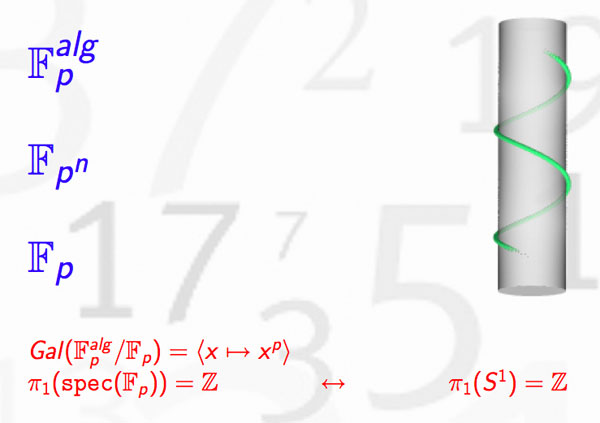
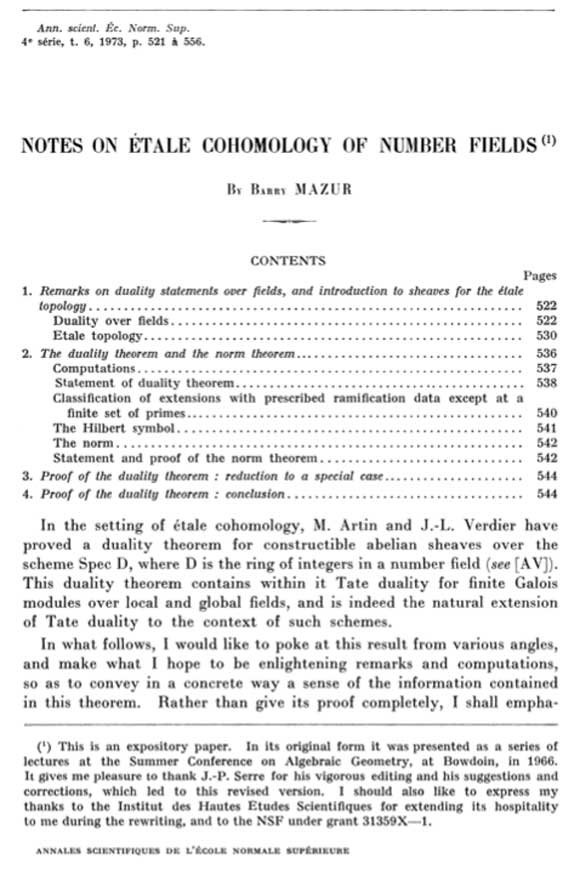
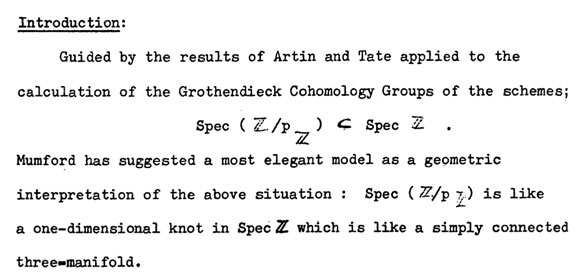
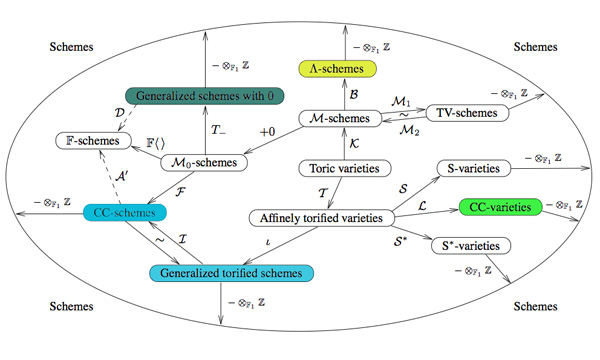
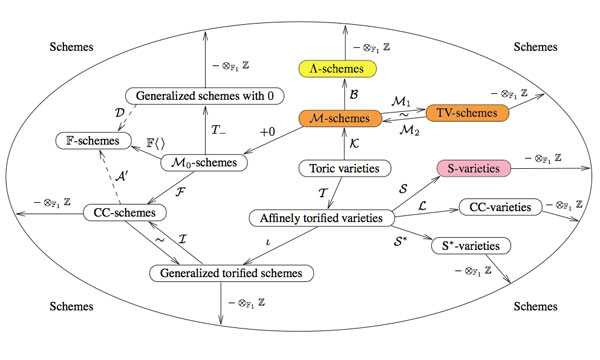
So, what are you waiting for? Here’s what I believe to be a sensible thing to try out. Over the last 4 years I must have posted well over 50 times what I believe noncommutative geometry is all about, so if you still don’t know, please consult the archive, I fear I can only repeat myself. Probably, it is more worthwhile to reach out to other approaches to noncommutative geometry, trying to figure out what, if anything, they are after, without becoming a new-age convert (’connes-vert’, I’d say). The top-left picture may give you an inkling of what I’m after… Besides, Im supposed to run a ‘capita selecta’ course for third year Bachelors and Ive chosen to read with them the book The music of the primes and to expand on the mathematics hinted only at in the book. So, I’ll totally immerse myself in Connes’ project to solve the Riemann-hypothesis in the upcoming months.

Again, rereading old posts, it strikes me how much effort I’ve put into trying to check whether technology can genuinely help mathematicians to do what they want to do more efficiently (all post categorized as iMath). I plan some series of posts re-exploring these ideas. The first series will be about the overhyped Web-2 thing of social-bookmarking. So, in the next weeks I’ll go undercover and check out which socialsites are best for mathematicians (in particular, noncommutative geometers) to embrace…

Apart from these, admittedly vague, plans I am as always open for suggestions you might have. So, please drop a comment..

AWSOM Powered