Posts Tagged ‘apple’


Klein’s dessins d’enfant and the buckyball

Monday, June 30th, 2008

We saw that the icosahedron can be constructed from the alternating group A_5 by considering the elements of a conjugacy class of order 5 elements as the vertices and edges between two vertices if their product is still in the conjugacy class.

This description is so nice that one would like to have a similar construction for the buckyball. But, the buckyball has 60 vertices, so they surely cannot correspond to the elements of a conjugacy class of A_5. But, perhaps there is a larger group, somewhat naturally containing A_5, having a conjugacy class of 60 elements?

This is precisely the statement contained in Galois’ last letter. He showed that 11 is the largest prime p such that the group L_2(p)=PSL_2(\mathbb{F}_p) has a (transitive) permutation presentation on p elements. For, p=11 the group L_2(11) is of order 660, so it permuting 11 elements means that this set must be of the form X=L_2(11)/A with A \subset L_2(11) a subgroup of 60 elements… and it turns out that A \simeq A_5

Actually there are TWO conjugacy classes of subgroups isomorphic to A_5 in L_2(11) and we have already seen one description of these using the biplane geometry (one class is the stabilizer subgroup of a ‘line’, the other the stabilizer subgroup of a point).

Here, we will give yet another description of these two classes of A_5 in L_2(11), showing among other things that the theory of dessins d’enfant predates Grothendieck by 100 years.

In the very same paper containing the first depiction of the Dedekind tessellation, Klein found that there should be a degree 11 cover \mathbb{P}^1_{\mathbb{C}} \rightarrow \mathbb{P}^1_{\mathbb{C}} with monodromy group L_2(11), ramified only in the three points \{ 0,1,\infty \} such that there is just one point lying over \infty, seven over 1 of which four points where two sheets come together and finally 5 points lying over 0 of which three where three sheets come together. In 1879 he wanted to determine this cover explicitly in the paper “Ueber die Transformationen elfter Ordnung der elliptischen Funktionen” (Math. Annalen) by describing all Riemann surfaces with this ramification data and pick out those with the correct monodromy group.

He manages to do so by associating to all these covers their ‘dessins d’enfants’ (which he calls Linienzuges), that is the pre-image of the interval [0,1] in which he marks the preimages of 0 by a bullet and those of 1 by a +, such as in the innermost darker graph on the right above. He even has these two wonderful pictures explaining how the dessin determines how the 11 sheets fit together. (More examples of dessins and the correspondences of sheets were drawn in the 1878 paper.)

The ramification data translates to the following statements about the Linienzuge : (a) it must be a tree (\infty has one preimage), (b) there are exactly 11 (half)edges (the degree of the cover), (c) there are 7 +-vertices and 5 o-vertices (preimages of 0 and 1) and (d) there are 3 trivalent o-vertices and 4 bivalent +-vertices (the sheet-information).

Klein finds that there are exactly 10 such dessins and lists them in his Fig. 2 (left). Then, he claims that one the two dessins of type I give the correct monodromy group. Recall that the monodromy group is found by giving each of the half-edges a number from 1 to 11 and looking at the permutation \tau of order two pairing the half-edges adjacent to a +-vertex and the order three permutation \sigma listing the half-edges by cycling counter-clockwise around a o-vertex. The monodromy group is the group generated by these two elements.

Fpr example, if we label the type V-dessin by the numbers of the white regions bordering the half-edges (as in the picture Fig. 3 on the right above) we get \sigma = (7,10,9)(5,11,6)(1,4,2) and \tau=(8,9)(7,11)(1,5)(3,4).

Nowadays, it is a matter of a few seconds to determine the monodromy group using GAP and we verify that this group is A_{11}.

Of course, Klein didn’t have GAP at his disposal, so he had to rule out all these cases by hand.

gap> g:=Group((7,10,9)(5,11,6)(1,4,2),(8,9)(7,11)(1,5)(3,4));
Group([ (1,4,2)(5,11,6)(7,10,9), (1,5)(3,4)(7,11)(8,9) ])
gap> Size(g);
19958400
gap> IsSimpleGroup(g);
true

Klein used the fact that L_2(7) only has elements of orders 1,2,3,5,6 and 11. So, in each of the remaining cases he had to find an element of a different order. For example, in type V he verified that the element \tau.(\sigma.\tau)^3 is equal to the permutation (1,8)(2,10,11,9,6,4,5)(3,7) and consequently is of order 14.

Perhaps Klein knew this but GAP tells us that the monodromy group of all the remaining 8 cases is isomorphic to the alternating group A_{11} and in the two type I cases is indeed L_2(11). Anyway, the two dessins of type I correspond to the two conjugacy classes of subgroups A_5 in the group L_2(11).

But, back to the buckyball! The upshot of all this is that we have the group L_2(11) containing two classes of subgroups isomorphic to A_5 and the larger group L_2(11) does indeed have two conjugacy classes of order 11 elements containing exactly 60 elements (compare this to the two conjugacy classes of order 5 elements in A_5 in the icosahedral construction). Can we construct the buckyball out of such a conjugacy class?

To start, we can identify the 12 pentagons of the buckyball from a conjugacy class C of order 11 elements. If x \in C, then so do x^3,x^4,x^5 and x^9, whereas the powers \{ x^2,x^6,x^7,x^8,x^{10} \} belong to the other conjugacy class. Hence, we can divide our 60 elements in 12 subsets of 5 elements and taking an element x in each of these, the vertices of a pentagon correspond (in order) to ~(x,x^3,x^9,x^5,x^4).

Group-theoretically this follows from the fact that the factorgroup of the normalizer of x modulo the centralizer of x is cyclic of order 5 and this group acts naturally on the conjugacy class of x with orbits of size 5.

Finding out how these pentagons fit together using hexagons is a lot subtler… and in The graph of the truncated icosahedron and the last letter of Galois Bertram Kostant shows how to do this.

Fix a subgroup isomorphic to A_5 and let D be the set of all its order 2 elements (recall that they form a full conjugacy class in this A_5 and that there are precisely 15 of them). Now, the startling observation made by Kostant is that for our order 11 element x in C there is a unique element a \in D such that the commutator~b=[x,a]=x^{-1}a^{-1}xa belongs again to D. The unique hexagonal side having vertex x connects it to the element b.xwhich belongs again to C as b.x=(ax)^{-1}.x.(ax).

Concluding, if C is a conjugacy class of order 11 elements in L_2(11), then its 60 elements can be viewed as corresponding to the vertices of the buckyball. Any element x \in C is connected by two pentagonal sides to the elements x^{3} and x^4 and one hexagonal side connecting it to \tau x = b.x.

music of the primes (1)

Wednesday, February 13th, 2008

This semester, I’m running a 3rd year course on Marcus du Sautoy’s The music of the primes. The concept being that students may suggest topics, merely sketched in the book, and then we’ll go a little deeper into them.

I’ve been rather critical about the book before, but, rereading it last week (and knowing a bit better the limitations of bringing mathematics to the masses…) I think du Sautoy did a great job. Sure, it focusses too much on people and places and too little on mathematics, but that goes with the format.

I wanted to start off gently by playing the open-university dvd-series so that students would have a very rough outline of the book from the very start (as well as a mental image to some of the places mentioned, such as Bletchley Park, the IAS, Gottingen…). However, the vagueness of it all seemed to work on their nerves … in particular the trumpet scenes

Afterwards, they demanded that I should explain next week what on earth the zeroes of the Riemann zeta function had to do with counting primes and what all this nonsensical ‘music of the primes’ was about.

Well, here is the genuine music of the primes (taken from the Riemann page by Jeffrey Stopple whose excellent introductory text A Primer of Analytic Number Theory I’ll use to show them some concrete stuff (they have their first course on complex analysis also this semester, so I cannot go too deep into it).

Jeffrey writes “This sound is best listened to with headphones or external speakers. For maximum effect, play it LOUD.” But, what is the story behind it?

The Von Mangoldt function \Lambda(n) assigns log(p) whenever n=p^k is a prime power and zero otherwise. One can then consider the function

\Psi(x) = \frac{1}{2}(\sum_{n < x} \Lambda(n) + \sum_{n \leq x} \Lambda(n))

which makes a jump at prime power values and the jump-size depends on the prime. Here is a graph of its small values

It’s not quite the function \pi(x) (counting the number of primes smaller than x) but it sure contains enough information to obtain this provided we have a way of describing \Psi(x).

The Riemann zeta function (or rather ~(s-1)\zeta(s)) has two product descriptions, the Hadamard product formula (running over all zeroes, both the trivial ones at -2n and those in the critical strip), which is valid for all complex s and the Euler product valid for all Re(s) > 1. This will allow us to calculate in two different ways \zeta'(s)/\zeta(s) which in turn allows us to have an explicit description of \Psi(s) known as the Von Mangoldt formula

\Psi(x) = x - \frac{1}{2}log(1 - \frac{1}{x^2}) - log(2 \pi) - \sum_{\rho} \frac{x^{\rho}}{\rho}

where only the last term depends on the zeta-zeroes \rho lying in the critical strip (and conjecturally all lying on the line Re(x) = \frac{1}{2}. The first few terms (those independent of the zeroes) give a continuous approximation of \Psi(x) but how on earth can we get from that approxamation (on the left) to the step-like function itself (on the right)?

We can group together zeta-zeroes \rho=\beta + i \gamma with their comlex conjugate zeroes \overline{\rho} and then one shows that the attribution to the Von Mangoldt formula is

\frac{x^{\rho}}{\rho} + \frac{x^{\overline{\rho}}}{\overline{rho}} = \frac{2 x^{\beta}}{| \rho | }cos(\gamma log(x) - arctan(\gamma/\beta))

Ignoring the term x^{\beta} this is a peridodic function with amplitude 2/| \rho | (so getting smaller for larger and larger zeroes) and period 2\pi/ \gamma. If the Riemann hypothesis holds (meaning that \beta=1/2 for all zeroes) one can even split a term in this contribution of every zero as a sort of ‘universal amplitude’. What is left is then a sum of purely periodic functions which a physicist will view as a superposition of (sound) waves and that is the music played by the primes!

Below, a video of the influence of adding the first 100 zeroes to a better and better approximation of \Psi(x) (again taken from the Riemann page by Jeffrey Stopple). Surely watching the video will convince anyone of the importance of the Riemann zeta-zeroes to the prime-counting problem..

censured post : bloggers’ block

Wednesday, February 6th, 2008

Below an up-till-now hidden post, written november last year, trying to explain the long blog-silence at neverendingbooks during october-november 2007…


A couple of months ago a publisher approached me, out of the blue, to consider writing a book about mathematics for the general audience (in Dutch (?!)). Okay, I brought this on myself hinting at the possibility in this post

Recently, I’ve been playing with the idea of writing a book for the general public. Its title is still unclear to me (though an idea might be “The disposable science”, better suggestions are of course wellcome) but I’ve fixed the subtitle as “Mathematics’ puzzling fall from grace”. The book’s concept is simple : I would consider the mathematical puzzles creating an hype over the last three centuries : the 14-15 puzzle for the 19th century, Rubik’s cube for the 20th century and, of course, Sudoku for the present century. For each puzzle, I would describe its origin, the mathematics involved and how it can be used to solve the puzzle and, finally, what the differing quality of these puzzles tells us about mathematics’ changing standing in society over the period. Needless to say, the subtitle already gives away my point of view. The final part of the book would then be more optimistic. What kind of puzzles should we promote for mathematical thinking to have a fighting chance to survive in the near future?

While I still like the idea and am considering the proposal, chances are low this book ever materializes : the blog-title says it all…

Then, about a month ago I got some incoming links from a variety of Flemish blogs. From their posts I learned that the leading Science-magazine for the low countries, Natuur, Wetenschap & Techniek (Nature, Science & Technology), featured an article on Flemish science-blogs and that this blog might be among the ones covered. It sure would explain the publisher’s sudden interest. Of course, by that time the relevant volume of NW&T was out of circulation so I had to order a backcopy to find out what was going on. Here’s the relevant section, written by their editor Erick Vermeulen (as well as an attempt to translate it)

Sliding puzzle For those who want more scientific depth1, there is the English blog by Antwerp professor algebra & geometry Lieven Le Bruyn, MoonshineMath2. Le Bruyn offers a number of mathematical descriptions, most of them relating to group theory and in particular the so called monster-group and monstrous moonshine. He mentions some puzzles in passing such as the well known sliding puzzle with 15 pieces sliding horizontally and vertically in a 4 by 4 matrix. Le Bruyn argues that this ‘15-puzzle3’ was the hype of the 19th century as was the Rubik cube for the 20th and is Sudoku for the 21st century.
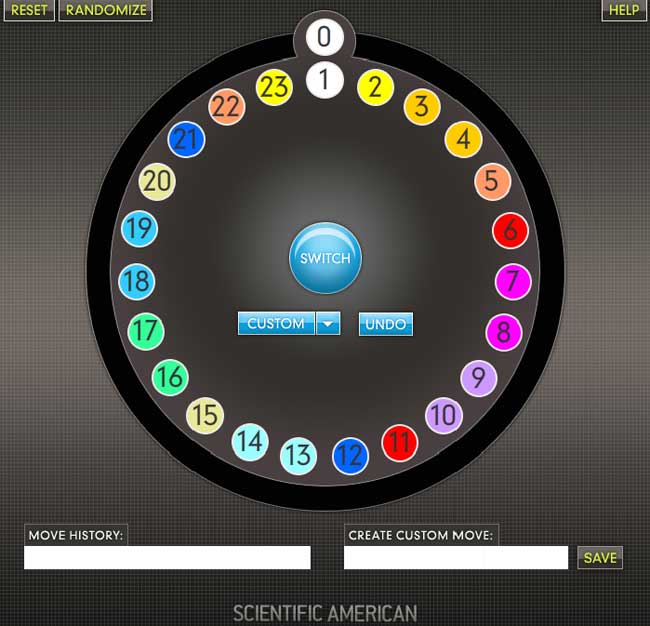
Interesting is Le Bruyn’s mathematical description of the M(13)-puzzle4 developed by John Conway. It has 13 points on a circle, twelve of them carrying a numbered counter. Every point is connected via lines to all others5. Whenever a counter jumps to the empty spot, two others exchange places. Le Bruyn promises the blog-visitor new variants to come6. We are curious.
Of course, the genuine puzzler can leave all this theory for what it is, use the Java-applet7 and painfully try to move the counters around the circle according to the rules of the game.

Some people crave for this kind of media-attention. On me it merely has a blocking-effect. Still, as the end of my first-semester courses comes within sight, I might try to shake it off…

  1. their interpretation, not mine []
  2. indicates when the article was written… []
  3. The 15-puzzle groupoid []
  4. Conway’s M(13)-puzzle []
  5. a slight simplification []
  6. did I? []
  7. Egner’s M(13)-applet []

quick iTouch links

Wednesday, January 16th, 2008

MacBookAir? Is this really the best Apple could come up with? A laptop you can slide under the door or put in an envelop? Yeez… Probably the hot-air-book is about as thick as an iTouch. The first thing I did was to buy a leather case to protect the vulnerable thing, making it as thick as a first generation iPod… (needless to say, when my MacBookPro breaks down, ill replace it with a MacBookAir, clearly!)

Ranting about MacWorlds : Wired has a great article on last year’s event. Steve Job’s iPhone presentation is something that will be part of the collective memory when it comes to 2007-recollections. Few people will have realized that the Apple-team didnt have a working prototype a few weeks before… Here’s The Untold Story: How the iPhone Blew Up the Wireless Industry. A good read!

If you plug in your jailbroken iTouch, you will be asked wether you want to upgrade to 1.1.3, something we all feared for a long time and so it takes just nanoseconds to hit the cancel-button. But, there is good news! Rupert Gee reports that you can downgrade to 1.1.1 and redo jailbreak. I won’t try it for some time, but still…

In the unlikely event that you come here being a mathematician, here’s what I did with my iTouch today. Ive downloaded the Connes-Marcolli talks on Renormalization and Motives part 1, part 2, part 3, part 4, part 5, part 6, part 7 and part 8 at work. They are in mp4-format so you can load them into iTunes and onto your iTouch!!! Weather is not favorable for outdoor-cycling at the moment, so I used the home-trainer, put the iTouch in front of me and, boy, was I educated…

top iTouch hacks

Sunday, December 30th, 2007

So, you did jailbreak your iTouch and did install some fun or useful stuff via the Install.app … but then, suddenly, the next program on your wish-list fails to install ??!! I know you hate to do drastic things to your iTouch, but sooner or later you’ll have to do it, so why not NOW?

Move the Applications Folder

The problem is that there are two disk partitions (a small one, meant only to host the apple-software and a large one to contain all your music, videos and stuff) and Install.app installs programs in the /Apllications folder on the smaller partition. So, we want to move it to the other partition using a symbolic link trick (as in the wiki-hack post). Here a walkthrough, more details can be found on Koos Kasper’s site.

  • Have BSDsubsystem and OpenSSH installed, so that you can ssh into the iTouch.
  • verify that the second line of the /etc/fstab file reads as below (or edit it if necessary, in my case it was already ok, perhaps this is done during jailbreak?) and reboot the iTouch (if you had to change it)

/dev/disk0s2 /private/var hfs rw 0 2

  • ssh into the iTouch and type in the following commands (to move the folder and make the symbolic link)

cd /
cp -pr Applications /var/root
mv Applications Applications.old
ln -s private/var/root/Applications /Applications

  • reboot the iTouch, ssh into it and remove the old Application-folder to free space

cd /
rm -rf Applications.old

From now on, all (most) new programs are installed on the larger partition. If you reinstall the OpenSSH application (as suggested) make sure to remove on your computer the old key for iTouch.

Stream your Music!

I use the iTouch to read my mail, to read RSS feeds, to administer this blog, to VNC to the home-server and when needed to ssh into the computer at work (running this blog) to restart the apache server. Unless I have to write a lot, there is no need to fire up a computer… But, when someone has a Mac running, I would like to be able to stream the music on my iTouch to hear it loudly. Here’s the procedure, via Rupert Gee’s blog :

  • Have the Auto-Lock set to “Never” in Settings/General
  • Install the UIctl applications (under Utilities)
  • Add a source to Install.app (click on Sources-button lower-right, Edit upper-right and then Add upper-left) http://home.mike.tl/iphone
  • Relaunch Install.app and install FireFlyMediaServer (under Multimedia).
  • Write down the address given during installation to change your password and monitor the Firefly-server (the default root password is ‘dottie’ and so the address should be

http://root:dottie@127.0.0.1:3689

  • Open up UIctl and scoll down to a line saying “org.fireflymediaserver.mt-daapd” and tap on it. Tap on “load-w” and then on “Do It”
  • Now, at the Mac your iTouch should be vusible under Shared in iTunes, click on it and give the password and your music is available!

AWSOM Powered