neverendingbooks

lieven le bruyn's blog

Follow me on TwitterRSS Feeds

  • Home
  • ScholaCantorum

    Seriously now, where was the Bourbaki wedding?

    A few days before Halloween, Norbert Dufourcq (who died december 17th 1990...), sent me a comment, containing lots of useful information, hinting I did get it wrong about the church of the Bourbali wedding in the previous post. Norbert Dufourcq, an organist and student of Andre Machall, the organist-in-charge at the Saint-Germain-des-Prés church in 1939, the place where I speculated the Bourbaki wedding took ...
    More
  • Capoulade

    the bumpy road to the first Bourbaki congress

    The first Bourbaki congress took eventually place in Besse-en-Chandesse. But, its organization suffered from the 'usual' inter-departemental fighting, and also from a power-struggle within the group itself. On many issues de Possel and André Weil were on opposite sides, and it didn't really help that there was a woman involved... Because Mandelbrojt, de Possel and Coulomb all held a position at the University ...
    More
  • Knights16

    Seating the first few thousand Knights

    The Knight-seating problems asks for a consistent placing of n-th Knight at an odd root of unity, compatible with the two different realizations of the algebraic closure of the field with two elements. The first identifies the multiplicative group of its non-zero elements with the group of all odd complex roots of unity, under complex multiplication. The second uses Conway's 'simplicity rules' to define an addition...
    More
  • ConwayNorton

    Conway's big picture

    Conway and Norton showed that there are exactly 171 moonshine functions and associated two arithmetic subgroups to them. We want a tool to describe these and here's where Conway's big picture comes in very handy. All moonshine groups are arithmetic groups, that is, they are commensurable with the modular group. Conway's idea is to view several of these groups as point- or set-wise stabilizer subgroups of finite...
    More
  • Besse2

    Where is the Royal Poldavian Academy?

    Among the items found on Andre Weil at the time of his arrest was "a packet of calling cards belonging to Nicolas Bourbaki, member of the Royal Academy of Poldavia". But then, where is the Royal Poldavian Academy situated? Well, surely in the Kingdom of Poldavia, which is a very strange country indeed, its currency unit being the bourbaki and there exist only two types of coins: gold ones (worth n bourbakis)...
    More
  • duncanpicture

    E(8) from moonshine groups

    Are the valencies of the 171 moonshine groups are compatible, that is, can one construct a (disconnected) graph on the 171 vertices such that in every vertex (determined by a moonshine group G) the vertex-valency coincides with the valency of the corresponding group? Duncan describes a subset of 9 moonshine groups for which the valencies are compatible. These 9 groups are characterized as those moonshine groups G ...
    More
  • scottishballs2

    The Scottish solids hoax

    A truly good math-story gets spread rather than scrutinized. And a good story it was : more than a millenium before Plato, the Neolithic Scottish Math Society classified the five regular solids : tetrahedron, cube, octahedron, dodecahedron and icosahedron. And, we had solid evidence to support this claim : the NSMS mass-produced stone replicas of their finds and about 400 of them were excavated, most of them in...
    More
  • MumfordsTreasureMap

    Mumford's treasure map

    David Mumford did receive earlier this year the 2007 AMS Leroy P. Steele Prize for Mathematical Exposition. The jury honors Mumford for "his beautiful expository accounts of a host of aspects of algebraic geometry". Not surprisingly, the first work they mention are his mimeographed notes of the first 3 chapters of a course in algebraic geometry, usually called "Mumford's red book" because the notes were wrapped in...
    More
  • chancay2

    Where's Bourbaki's Escorial?

    Early 1936, Andre Weil and Evelyne Gillet made a pre-honeymooning trip to Spain and visited El Escorial. Weil was so taken by the place that he planned the next Bourbaki-conference to be held in a nearby college. However, the Bourbakis never made it to to Spain that summer as the Spanish Civil War broke out July 17th, a few weeks before the intended conference. Can we GEO-tag the exact location of Bourbaki's...
    More
  • CantorP

    On2 : transfinite number hacking

    In ONAG, John Conway proves that the symmetric version of his recursive definition of addition and multiplcation on the surreal numbers make the class On of all Cantor's ordinal numbers into an algebraically closed Field of characteristic two : On2 (pronounced 'Onto'), and, in particular, he identifies a subfield with the algebraic closure of the field of two elements. What makes all of this somewhat confusing is...
    More
  • mazurdictionary

    Mazur's knotty dictionary

    In the roaring 60-ties, Barry Mazur launched the seemingly crazy idea of viewing the affine spectrum of the integers as a 3-dimensional manifold and prime numbers themselves as knots in this 3-manifold... In the previous posts, we have depicted the 'arithmetic line', that is the prime numbers, as a 'line' and individual primes as 'points'. However, sometime in the roaring 60-ties, [Barry...
    More
chancay2

Where’s Bourbaki’s Escorial?

Feb 8th

Posted by lievenlb in Bourbaki

2 comments

Early 1936, Andre Weil and Evelyne Gillet made a pre-honeymooning trip to Spain and visited El Escorial. Weil was so taken by the place that he planned the next Bourbaki-conference to be held in a nearby college. However, the Bourbakis never made it to to Spain that summer as the Spanish Civil War broke out July 17th, a few weeks before the intended conference. Can we GEO-tag the exact location of Bourbaki’s “Escorial”?

As explained in the bumpy-road-post, Andre Weil and Evelyne Gillet became involved sometime in 1935. Early 1936, they made a pre-honeymooning trip to Spain and visited El Escorial. Weil was so taken by the place that he planned the next Bourbaki-conference to be held in a nearby college.

However, the Bourbakis never made it to to Spain that summer as the Spanish Civil War broke out July 17th, a few weeks before the intended conference. Still, the second Bourbaki-meeting remains often referred to as the ‘Escorial conference’. Can we GEO-tag the exact location of Bourbaki’s “Escorial”?

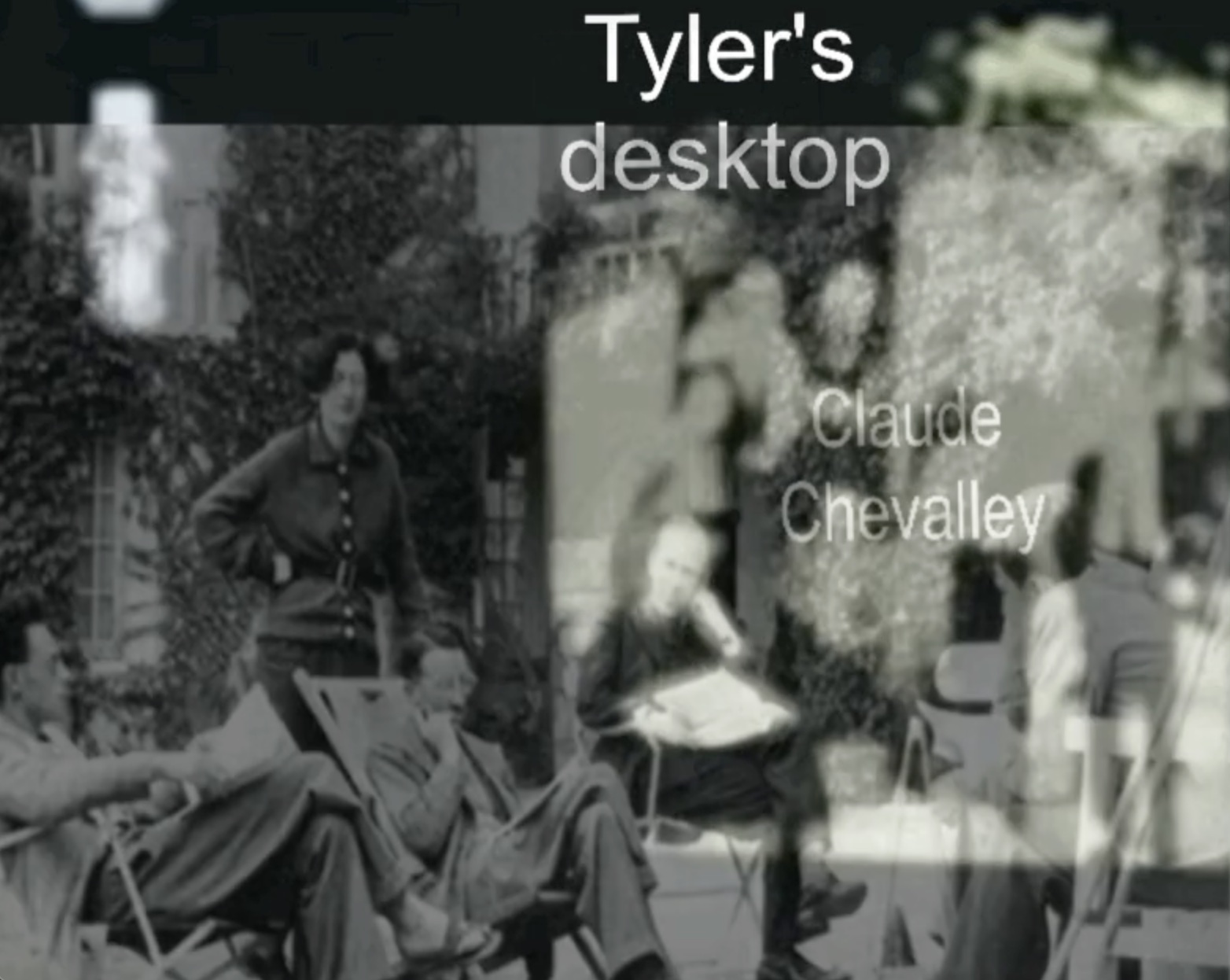
Claude Chevalley came up with a Plan-B and suggested they would use his parents’ place in Chançay as their venue. Chevalley’s father was a French diplomat and his house sure did possess a matching ‘grandeur’ as can be seen from the famous picture below, taken at the (second) Chançay meeting in 1937 (Weil to the left, Chevalley to the right and Weil’s sister Simonne standing).

Thanks to the Bourbaki archives we know that the meeting took place from september 16th to 28th, that each of them had to pay 16 francs for full pension and had to bring along their own sheets and towels.

But where exactly is this beautiful house? Jacques Borowczyk has written a nice paper Bourbaki et la touraine in which he describes the Bourbaki congresses of 1936 and 1937 at the Chevalley-house in Chançay and further those held in 1956, 1957 and 1959 in ‘hôtel de la Brèche’ in Amboise.

Borowczyk places the Chevalley house in the little hamlet of Chançay, called “La Massoterie”. The village files assert that in 1931 three people were living at La Massoterie : father Abel Chevalley, who took residence there after his retirement in 1931, his wife Marguerite and their son Claude. But, at the time of the Bourbaki congres in 1936, Marguerite remained the only permanent inhabitant. Sadly, Abel Chevalley, who together with Marguerite compiled the The concise Oxford French dictionary, died in 1934.

Usually when you know the name of the hamlet, of the village and add just to be certain ‘France’, Google Maps takes you there within metres. So, this was going to be a quick post, for a change… Well, much to my surprise, typing ‘La Massoterie, Chançay, France’ only produced the answer “We could not understand the location La Massoterie, Chançay, France”.

Did I spell it wrong? Or, did the name change over times? No, Googling for it the first hit gives you the map of a 10km walk around Chançay passing through la Massoterie!

Now what? Fortunately Borowczyk included in his paper an old map, from Napoleonic times, showing the exact location of La Massoterie (just above the flash-sign), facing the castle of Volmer. If you compare it with the picture below from present day Chançay (via Google earth) it is surprising how many of the landmarks have survived the changes over two centuries.

It is now easy to pinpoint the exact location and zoom into the Chavalley-house, and, you’re in for a small surprise : the place is called La Massotterie with 2 t’s…

Probably, Googles database is more reliable than the information provided by the village of Chançay, or the paper by Borowczyk as it is the same spelling as on the old Napoleonic map. Anyway, feel free to have a peek at Bourbaki’s Escorial yourself!

Print Friendly
bourbaki, geo, google, google earth

Lambda-rings for formula-phobics

Feb 5th

Posted by lievenlb in geometry

1 comment

In 1956, Alexander Grothendieck (middle) introduced \lambda-rings in an algebraic-geometric context to be commutative rings A equipped with a bunch of operations \lambda^i (for all numbers i \in \mathbb{N}_+) satisfying a list of rather obscure identities. From the easier ones, such as

\lambda^0(x)=1, \lambda^1(x)=x, \lambda^n(x+y) = \sum_i \lambda^i(x) \lambda^{n-i}(y)

to those expressing \lambda^n(x.y) and \lambda^m(\lambda^n(x)) via specific universal polynomials. An attempt to capture the essence of \lambda-rings without formulas?

Lenstra’s elegant construction of the 1-power series rings ~(\Lambda(A),\boxplus,\boxtimes) requires only one identity to remember

~(1-at)^{-1} \boxtimes (1-bt)^{-1} = (1-abt)^{-1}.

Still, one can use it to show the existence of ringmorphisms \gamma_n~:~\Lambda(A) \rightarrow A, for all numbers n \in \mathbb{N}_+. Consider the formal ‘logarithmic derivative’

\gamma = \frac{t u(t)'}{u(t)} = \sum_{i=1}^\infty \gamma_i(u(t))t^i~:~\Lambda(A) \rightarrow \Lambda(A)

where u(t)' is the usual formal derivative of a power series. As this derivative satisfies the chain rule, we have

\gamma(u(t) \boxplus v(t)) = \frac{t (u(t)v(t))'}{u(t)v(t)} = \frac{t(u(t)'v(t)+u(t)v(t)'}{u(t)v(t))} = \frac{tu(t)'}{u(t)} + \frac{tv(t)'}{v(t)} = \gamma(u(t)) + \gamma(v(t))

and so all the maps \gamma_n~:~\Lambda(A) \rightarrow A are additive. To show that they are also multiplicative, it suffices by functoriality to verify this on the special 1-series ~(1-at)^{-1} for all a \in A. But,

\gamma((1-at)^{-1}) = \frac{t \frac{a}{(1-at)^2}}{(1-at)} = \frac{at}{(1-at)} = at + a^2t^2 + a^3t^3+\hdots

That is, \gamma_n((1-at)^{-1}) = a^n and Lenstra’s identity implies that \gamma_n is indeed multiplicative! A first attempt :

hassle-free definition 1 : a commutative ring A is a \lambda-ring if and only if there is a ringmorphism s_A~:~A \rightarrow \Lambda(A) splitting \gamma_1, that is, such that \gamma_1 \circ s_A = id_A.

In particular, a \lambda-ring comes equipped with a multiplicative set of ring-endomorphisms s_n = \gamma_n \circ s_A~:~A \rightarrow A satisfying s_m \circ s_m = s_{mn}. One can then define a \lambda-ringmorphism to be a ringmorphism commuting with these endo-morphisms.

The motivation being that \lambda-rings are known to form a subcategory of commutative rings for which the 1-power series functor is the right adjoint to the functor forgetting the \lambda-structure. In particular, if A is a \lambda-ring, we have a ringmorphism A \rightarrow \Lambda(A) corresponding to the identity morphism.

But then, what is the connection to the usual one involving all the operations \lambda^i? Well, one ought to recover those from s_A(a) = (1-\lambda^1(a)t+\lambda^2(a)t^2-\lambda^3(a)t^3+...)^{-1}.

For s_A to be a ringmorphism will require identities among the \lambda^i. I hope an expert will correct me on this one, but I’d guess we won’t yet obtain all identities required. By the very definition of an adjoint we must have that s_A is a morphism of \lambda-rings, and, this would require defining a \lambda-ring structure on \Lambda(A), that is a ringmorphism s_{AH}~:~\Lambda(A) \rightarrow \Lambda(\Lambda(A)), the so called Artin-Hasse exponential, to which I’d like to return later.

For now, we can define a multiplicative set of ring-endomorphisms f_n~:~\Lambda(A) \rightarrow \Lambda(A) from requiring that f_n((1-at)^{-1}) = (1-a^nt)^{-1} for all a \in A. Another try?

hassle-free definition 2 : A is a \lambda-ring if and only if there is splitting s_A to \gamma_1 satisfying the compatibility relations f_n \circ s_A = s_A \circ s_n.

But even then, checking that a map s_A~:~A \rightarrow \Lambda(A) is a ringmorphism is as hard as verifying the lists of identities among the \lambda^i. Fortunately, we get such a ringmorphism for free in the important case when A is of ‘characteristic zero’, that is, has no additive torsion. Then, a ringmorphism A \rightarrow \Lambda(A) exists whenever we have a multiplicative set of ring endomorphisms F_n~:~A \rightarrow A for all n \in \mathbb{N}_+ such that for every prime number p the morphism F_p is a lift of the Frobenius, that is, F_p(a) \in a^p + pA.

Perhaps this captures the essence of \lambda-rings best (without the risk of getting an headache) : in characteristic zero, they are the (commutative) rings having a multiplicative set of endomorphisms, generated by lifts of the Frobenius maps.

Print Friendly
fun, Grothendieck, lambda rings, Lenstra, numbers
Knights16

Seating the first few thousand Knights

Feb 3rd

Posted by lievenlb in games

No comments

The Knight-seating problems asks for a consistent placing of n-th Knight at an odd root of unity, compatible with the two different realizations of the algebraic closure of the field with two elements. The first identifies the multiplicative group of its non-zero elements with the group of all odd complex roots of unity, under complex multiplication. The second uses Conway’s ‘simplicity rules’ to define an addition and multiplication on the set of all ordinal numbers.

The odd Knights of the round table-problem asks for a specific one-to-one correspondence between two realizations of ‘the’ algebraic closure \overline{\mathbb{F}_2} of the field of two elements.

The first identifies the multiplicative group of its non-zero elements with the group of all odd complex roots of unity, under complex multiplication. The addition on \overline{\mathbb{F}_2} is then recovered by inducing an involution on the odd roots, pairing the one corresponding to x to the one corresponding to x+1.

The second uses Conway’s ‘simplicity rules’ to define an addition and multiplication on the set of all ordinal numbers. Conway proves in ONAG that this becomes an algebraically closed field of characteristic two and that \overline{\mathbb{F}_2} is the subfield of all ordinals smaller than \omega^{\omega^{\omega}}. The finite ordinals (the natural numbers) form the quadratic closure of \mathbb{F}_2.

On the natural numbers the Conway-addition is binary addition without carrying and Conway-multiplication is defined by the properties that two different Fermat-powers N=2^{2^i} multiply as they do in the natural numbers, and, Fermat-powers square to its sesquimultiple, that is N^2=\frac{3}{2}N. Moreover, all natural numbers smaller than N=2^{2^{i}} form a finite field \mathbb{F}_{2^{2^i}}. Using distributivity, one can write down a multiplication table for all 2-powers.

The Knight-seating problems asks for a consistent placing of n-th Knight K_n at an odd root of unity, compatible with the two different realizations of \overline{\mathbb{F}_2}. Last time, we were able to place the first 15 Knights as below, and asked where you would seat K_{16}

K_4 was placed at e^{2\pi i/15} as 4 was the smallest number generating the ‘Fermat’-field \mathbb{F}_{2^{2^2}} (with multiplicative group of order 15) subject to the compatibility relation with the generator 2 of the smaller Fermat-field \mathbb{F}_2 (with group of order 15) that 4^5=2.

To include the next Fermat-field \mathbb{F}_{2^{2^3}} (with multiplicative group of order 255) consistently, we need to find the smallest number n generating the multiplicative group and satisfying the compatibility condition n^{17}=4. Let’s first concentrate on finding the smallest generator : as 2 is a generator for 1st Fermat-field \mathbb{F}_{2^{2^1}} and 4 a generator for the 2-nd Fermat-field \mathbb{F}_{2^{2^2}} a natural conjecture might be that 16 is a generator for the 3-rd Fermat-field \mathbb{F}_{2^{2^3}} and, more generally, that 2^{2^i} would be a generator for the next field \mathbb{F}_{2^{2^{i+1}}}.

However, an “exercise” in the 1978-paper by Hendrik Lenstra Nim multiplication asks : “Prove that 2^{2^i} is a primitive root in the field \mathbb{F}_{2^{2^{i+1}}} if and only if i=0 or 1.”

I’ve struggled with several of the ‘exercises’ in Lenstra’s paper to the extend I feared Alzheimer was setting in, only to find out, after taking pen and paper and spending a considerable amount of time calculating, that they are indeed merely exercises, when looked at properly… (Spoiler-warning : stop reading now if you want to go through this exercise yourself).

In the picture above I’ve added in red the number x(x+1)=x^2+1 to each of the involutions. Clearly, for each pair these numbers are all distinct and we see that for the indicated pairing they make up all numbers strictly less than 8.

By Conway’s simplicity rules (or by checking) the pair (16,17) gives the number 8. In other words, the equation x^2+x+8 is an irreducible polynomial over \mathbb{F}_{16} having as its roots in \mathbb{F}_{256} the numbers 16 and 17. But then, 16 and 17 are conjugated under the Galois-involution (the Frobenius y \mapsto y^{16}). That is, we have 16^{16}=17 and 17^{16}=16 and hence 16^{17}=8. Now, use the multiplication table in \mathbb{F}_{16} given in the previous post (or compute!) to see that 8 is of order 5 (and NOT a generator). As a consequence, the multiplicative order of 16 is 5×17=85 and so 16 cannot be a generator in \mathbb{F}_{256}. For general i one uses the fact that 2^{2^i} and 2^{2^i}+1 are the roots of the polynomial x^2+x+\prod_{j<i} 2^{2^j} over \mathbb{F}_{2^{2^i}} and argues as before.

Right, but then what is the minimal generator satisfying n^{17}=4? By computing we see that the pairings of all numbers in the range 16…31 give us all numbers in the range 8…15 and by the above argument this implies that the 17-th powers of all numbers smaller than 32 must be different from 4. But then, the smallest candidate is 32 and one verifies that indeed 32^{17}=4 (use the multiplication table given before).

Hence, we must place Knight K_{32} at root e^{2 \pi i/255} and place the other Knights prior to the 256-th at the corresponding power of 32. I forgot the argument I used to find-by-hand the requested place for Knight 16, but one can verify that 32^{171}=16 so we seat K_{16} at root e^{342 \pi i/255}.

But what about Knight K_{256}? Well, by this time I was quite good at squaring and binary representations of integers, but also rather tired, and decided to leave that task to the computer.

If we denote Nim-addition and multiplication by \oplus and \otimes, then Conway’s simplicity results in ONAG establish a field-isomorphism between ~(\mathbb{N},\oplus,\otimes) and the field \mathbb{F}_2(x_0,x_1,x_2,\hdots ) where the x_i satisfy the Artin-Schreier equations

x_i^2+x_i+\prod_{j &lt; i} x_j = 0

and the i-th Fermat-field \mathbb{F}_{2^{2^i}} corresponds to \mathbb{F}_2(x_0,x_1,\hdots,x_{i-1}). The correspondence between numbers and elements from these fields is given by taking x_i \mapsto 2^{2^i}. But then, wecan write every 2-power as a product of the x_i and use the binary representation of numbers to perform all Nim-calculations with numbers in these fields.

Therefore, a quick and dirty way (and by no means the most efficient) to do Nim-calculations in the next Fermat-field consisting of all numbers smaller than 65536, is to use sage and set up the field \mathbb{F}_2(x_0,x_1,x_2,x_3) by

R.< x,y,z,t > =GF(2)[]
S.< a,b,c,d >=R.quotient((x^2+x+1,y^2+y+x,z^2+z+x*y,t^2+t+x*y*z))

To find the smallest number generating the multiplicative group and satisfying the additional compatibility condition n^{257}=32 we have to find the smallest binary number i_1i_2 \hdots i_{16} (larger than 255) satisfying

(i1*a*b*c*t+i2*b*c*t+i3*a*c*t+i4*c*t+i5*a*b*t+i6*b*t+
i7*a*t+i8*t+i9*a*b*c+i10*b*c+i11*a*c+i12*c+i13*a*b+
i14*b+i15*a+i16)^257=a*c

It takes a 2.4GHz 2Gb-RAM MacBook not that long to decide that the requested generator is 1051 (killing another optimistic conjecture that these generators might be 2-powers). So, we seat Knight K_{1051} at root e^{2 \pi i/65535} and can then arrange seatings for all Knight queued up until we reach the 65536-th! In particular, the first Knight we couldn’t place before, that is Knight K_{256}, will be seated at root e^{65826 \pi i/65535}.

If you’re lucky enough to own a computer with more RAM, or have the patience to make the search more efficient and get the seating arrangement for the next Fermat-field, please drop a comment.

I’ll leave you with another Lenstra-exercise which shouldn’t be too difficult for you to solve now : “Prove that x^3=2^{2^i} has three solutions in \mathbb{N} for each i \geq 2.”

Print Friendly
Conway, fun, Galois, games, ONAG, ordinals

big Witt vectors for everyone (1/2)

Feb 2nd

Posted by lievenlb in geometry

2 comments

Next time you visit your math-library, please have a look whether these books are still on the shelves : Michiel Hazewinkel‘s Formal groups and applications, William Fulton’s and Serge Lange’s Riemann-Roch algebra and Donald Knutson’s lambda-rings and the representation theory of the symmetric group.

I wouldn’t be surprised if one or more of these books are borrowed out, probably all of them to the same person. I’m afraid I’m that person in Antwerp…

Lately, there’s been a renewed interest in \lambda-rings and the endo-functor W assigning to a commutative algebra its ring of big Witt vectors, following Borger’s new proposal for a geometry over the absolute point.

However, as Hendrik Lenstra writes in his 2002 course-notes on the subject Construction of the ring of Witt vectors : “The literature on the functor W is in a somewhat unsatisfactory state: nobody seems to have any interest in Witt vectors beyond applying them for a purpose, and they are often treated in appendices to papers devoting to something else; also, the construction usually depends on a set of implicit or unintelligible formulae. Apparently, anybody who wishes to understand Witt vectors needs to construct them personally. That is what is now happening to myself.”

Before doing a series on Borger’s paper, we’d better run through Lenstra’s elegant construction in a couple of posts. Let A be a commutative ring and consider the multiplicative group of all ‘one-power series’ over it \Lambda(A)=1+t A[[t]]. Our aim is to define a commutative ring structure on \Lambda(A) taking as its ADDITION the MULTIPLICATION of power series.

That is, if u(t),v(t) \in \Lambda(A), then we define our addition u(t) \boxplus v(t) = u(t) \times v(t). This may be slightly confusing as the ZERO-element in \Lambda(A),\boxplus will then turn be the constant power series 1…

We are now going to define a multiplication \boxtimes on \Lambda(A) which is distributively with respect to \boxplus and turns \Lambda(A) into a commutative ring with ONE-element the series ~(1-t)^{-1}=1+t+t^2+t^3+\hdots.

We will do this inductively, so consider \Lambda_n(A) the (classes of) one-power series truncated at term n, that is, the kernel of the natural augmentation map between the multiplicative group-units ~A[t]/(t^{n+1})^* \rightarrow A^*. Again, taking multiplication in A[t]/(t^{n+1}) as a new addition rule \boxplus, we see that ~(\Lambda_n(A),\boxplus) is an Abelian group, whence a \Z-module.

For all elements a \in A we have a scaling operator \phi_a (sending t \rightarrow at) which is an A-ring endomorphism of A[t]/(t^{n+1}), in particular multiplicative wrt. \times. But then, \phi_a is an additive endomorphism of ~(\Lambda_n(A),\boxplus), so is an element of the endomorphism-RING End_{\Z}(\Lambda_n(A)). Because composition (being the multiplication in this endomorphism ring) of scaling operators is clearly commutative (\phi_a \circ \phi_b = \phi_{ab}) we can define a commutative RING E being the subring of End_{\Z}(\Lambda_n(A)) generated by the operators \phi_a.

The action turns ~(\Lambda_n(A),\boxplus) into an E-module and we define an E-module morphism E \rightarrow \Lambda_n(A) by \phi_a \mapsto \phi_a((1-t)^{-1}) = (1-at)^{-a}.

All of this looks pretty harmless, but the upshot is that we have now equipped the image of this E-module morphism, say L_n(A) (which is the additive subgroup of ~(\Lambda_n(A),\boxplus) generated by the elements ~(1-at)^{-1}) with a commutative multiplication \boxtimes induced by the rule ~(1-at)^{-1} \boxtimes (1-bt)^{-1} = (1-abt)^{-1}.

Explicitly, L_n(A) is the set of one-truncated polynomials u(t) with coefficients in A such that one can find elements a_1,\hdots,a_k \in A such that u(t) \equiv (1-a_1t)^{-1} \times \hdots \times (1-a_k)^{-1}~mod~t^{n+1}. We multiply u(t) with another such truncated one-polynomial v(t) (taking elements b_1,b_2,\hdots,b_l \in A) via

u(t) \boxtimes v(t) = ((1-a_1t)^{-1} \boxplus \hdots \boxplus (1-a_k)^{-1}) \boxtimes ((1-b_1t)^{-1} \boxplus \hdots \boxplus (1-b_l)^{-1})

and using distributivity and the multiplication rule this gives the element \prod_{i,j} (1-a_ib_jt)^{-1}~mod~t^{n+1} \in L_n(A). Being a ring-qutient of E we have that ~(L_n(A),\boxplus,\boxtimes) is a commutative ring, and, from the construction it is clear that L_n behaves functorially.

For rings A such that L_n(A)=\Lambda_n(A) we are done, but in general L_n(A) may be strictly smaller. The idea is to use functoriality and do the relevant calculations in a larger ring A \subset B where we can multiply the two truncated one-polynomials and observe that the resulting truncated polynomial still has all its coefficients in A.

Here’s how we would do this over \Z : take two irreducible one-polynomials u(t) and v(t) of degrees r resp. s smaller or equal to n. Then over the complex numbers we have u(t)=(1-\alpha_1t) \hdots (1-\alpha_rt) and v(t)=(1-\beta_1) \hdots (1-\beta_st). Then, over the field K=\mathbb{Q}(\alpha_1,\hdots,\alpha_r,\beta_1,\hdots,\beta_s) we have that u(t),v(t) \in L_n(K) and hence we can compute their product u(t) \boxtimes v(t) as before to be \prod_{i,j}(1-\alpha_i\beta_jt)^{-1}~mod~t^{n+1}. But then, all coefficients of this truncated K-polynomial are invariant under all permutations of the roots \alpha_i and the roots \beta_j and so is invariant under all elements of the Galois group. But then, these coefficients are algebraic numbers in \mathbb{Q} whence integers. That is, u(t) \boxtimes v(t) \in \Lambda_n(\Z). It should already be clear from this that the rings \Lambda_n(\Z) contain a lot of arithmetic information!

For a general commutative ring A we will copy this argument by considering a free overring A^{(\infty)} (with 1 as one of the base elements) by formally adjoining roots. At level 1, consider M_0 to be the set of all non-constant one-polynomials over A and consider the ring

A^{(1)} = \bigotimes_{f \in M_0} A[X]/(f) = A[X_f, f \in M_0]/(f(X_f) , f \in M_0)

The idea being that every one-polynomial f \in M_0 now has one root, namely \alpha_f = \overline{X_f} in A^{(1)}. Further, A^{(1)} is a free A-module with basis elements all \alpha_f^i with 0 \leq i &lt; deg(f).

Good! We now have at least one root, but we can continue this process. At level 2, M_1 will be the set of all non-constant one-polynomials over A^{(1)} and we use them to construct the free overring A^{(2)} (which now has the property that every f \in M_0 has at least two roots in A^{(2)}). And, again, we repeat this process and obtain in succession the rings A^{(3)},A^{(4)},\hdots. Finally, we define A^{(\infty)} = \underset{\rightarrow}{lim}~A^{(i)} having the property that every one-polynomial over A splits entirely in linear factors over A^{(\infty)}.

But then, for all u(t),v(t) \in \Lambda_n(A) we can compute u(t) \boxtimes v(t) \in \Lambda_n(A^{(\infty)}). Remains to show that the resulting truncated one-polynomial has all its entries in A. The ring A^{(\infty)} \otimes_A A^{(\infty)} contains two copies of A^{(\infty)} namely A^{(\infty)} \otimes 1 and 1 \otimes A^{(\infty)} and the intersection of these two rings in exactly A (here we use the freeness property and the additional fact that 1 is one of the base elements). But then, by functoriality of L_n, the element u(t) \boxtimes v(t) \in L_n(A^{(\infty)} \otimes_A A^{(\infty)}) lies in the intersection \Lambda_n(A^{(\infty)} \otimes 1) \cap \Lambda_n(1 \otimes A^{(\infty)})=\Lambda_n(A). Done!

Hence, we have endo-functors \Lambda_n in the category of all commutative rings, for every number n. Reviewing the construction of L_n one observes that there are natural transformations L_{n+1} \rightarrow L_n and therefore also natural transformations \Lambda_{n+1} \rightarrow \Lambda_n. Taking the inverse limits \Lambda(A) = \underset{\leftarrow}{lim} \Lambda_n(A) we therefore have the ‘one-power series’ endo-functor \Lambda~:~\wis{comm} \rightarrow \wis{comm} which is ‘almost’ the functor W of big Witt vectors. Next time we’ll take you through the identification using ‘ghost variables’ and how the functor \Lambda can be used to define the category of \lambda-rings.

Print Friendly
fun, Galois, geometry, google, Grothendieck, groups, lambda rings, Lenstra, numbers, Riemann, Witt

The odd knights of the round table

Jan 28th

Posted by lievenlb in games

No comments

Here’s a tiny problem illustrating our limited knowledge of finite fields : “Imagine an infinite queue of Knights \{ K_1,K_2,K_3,\hdots \}, waiting to be seated at the unit-circular table. The master of ceremony (that is, you) must give Knights K_a and K_b a place at an odd root of unity, say \omega_a and \omega_b, such that the seat at the odd root of unity \omega_a \times \omega_b must be given to the Knight K_{a \otimes b}, where a \otimes b is the Nim-multiplication of a and b. Which place would you offer to Knight K_{16}, or Knight K_n, or, if you’re into ordinals, Knight K_{\omega}?”

What does this have to do with finite fields? Well, consider the simplest of all finite field \mathbb{F}_2 = \{ 0,1 \} and consider its algebraic closure \overline{\mathbb{F}_2}. Last year, we’ve run a series starting here, identifying the field \overline{\mathbb{F}_2}, following John H. Conway in ONAG, with the set of all ordinals smaller than \omega^{\omega^{\omega}}, given the Nim addition and multiplication. I know that ordinal numbers may be intimidating at first, so let’s just restrict to ordinary natural numbers for now. The Nim-addition of two numbers n \oplus m can be calculated by writing the numbers n and m in binary form and add them without carrying. For example, 9 \oplus 1 = 1001+1 = 1000 = 8. Nim-multiplication is slightly more complicated and is best expressed using the so-called Fermat-powers F_n = 2^{2^n}. We then demand that F_n \otimes m = F_n \times m whenever m &lt; F_n and F_n \otimes F_n = \frac{3}{2}F_n. Distributivity wrt. \oplus can then be used to calculate arbitrary Nim-products. For example, 8 \otimes 3 = (4 \otimes 2) \otimes (2 \oplus 1) = (4 \otimes 3) \oplus (4 \otimes 2) = 12 \oplus 8 = 4. Conway’s remarkable result asserts that the ordinal numbers, equipped with Nim addition and multiplication, form an algebraically closed field of characteristic two. The closure \overline{\mathbb{F}_2} is identified with the subfield of all ordinals smaller than \omega^{\omega^{\omega}}. For those of you who don’t feel like going transfinite, the subfield ~(\mathbb{N},\oplus,\otimes) is identified with the quadratic closure of \mathbb{F}_2.

The connection between \overline{\mathbb{F}_2} and the odd roots of unity has been advocated by Alain Connes in his talk before a general public at the IHES : “L’ange de la géométrie, le diable de l’algèbre et le corps à un élément” (the angel of geometry, the devil of algebra and the field with one element). He describes its content briefly in this YouTube-video

At first it was unclear to me which ‘coupling-problem’ Alain meant, but this has been clarified in his paper together with Caterina Consani Characteristic one, entropy and the absolute point. The non-zero elements of \overline{\mathbb{F}_2} can be identified with the set of all odd roots of unity. For, if x is such a unit, it belongs to a finite subfield of the form \mathbb{F}_{2^n} for some n, and, as the group of units of any finite field is cyclic, x is an element of order 2^n-1. Hence, \mathbb{F}_{2^n}- \{ 0 \} can be identified with the set of 2^n-1-roots of unity, with e^{2 \pi i/n} corresponding to a generator of the unit-group. So, all elements of \overline{\mathbb{F}_2} correspond to an odd root of unity. The observation that we get indeed all odd roots of unity may take you a couple of seconds1.

Assuming we succeed in fixing a one-to-one correspondence between the non-zero elements of \overline{\mathbb{F}_2} and the odd roots of unity \mu_{odd} respecting multiplication, how can we recover the addition on \overline{\mathbb{F}_2}? Well, here’s Alain’s coupling function, he ties up an element x of the algebraic closure to the element s(x)=x+1 (and as we are in characteristic two, this is an involution, so also the element tied up to x+1 is s(x+1)=(x+1)+1=x. The clue being that multiplication together with the coupling map s allows us to compute any sum of two elements as x+y=x \times s(\frac{y}{x}) = x \times (\frac{y}{x}+1). For example, all information about the finite field \mathbb{F}_{2^4} is encoded in this identification with the 15-th roots of unity, together with the pairing s depicted as

Okay, we now have two identifications of the algebraic closure \overline{\mathbb{F}_2} : the smaller ordinals equipped with Nim addition and Nim multiplication and the odd roots of unity with complex-multiplication and the Connes-coupling s. The question we started from asks for a general recipe to identify these two approaches.

To those of you who are convinced that finite fields (LOL, even characteristic two!) are objects far too trivial to bother thinking about : as far as I know, NOBODY knows how to do this explicitly, even restricting the ordinals to merely the natural numbers!

Please feel challenged! To get you started, I’ll show you how to place the first 15 Knights and give you a procedure (though far from explicit) to continue. Here’s the Nim-picture compatible with that above

To verify this, and to illustrate the general strategy, I’d better hand you the Nim-tables of the first 16 numbers. Here they are

It is known that the finite subfields of ~(\mathbb{N},\oplus,\otimes) are precisely the sets of numbers smaller than the Fermat-powers F_n. So, the first one is all numbers smaller than F_1=4 (check!). The smallest generator of the multiplicative group (of order 3) is 2, so we take this to correspond to the unit-root e^{2 \pi i/3}. The next subfield are all numbers smaller than F_2 = 16 and its multiplicative group has order 15. Now, choose the smallest integer k which generates this group, compatible with the condition that k^{\otimes 5}=2. Verify that this number is 4 and that this forces the identification and coupling given above.

The next finite subfield would consist of all natural numbers smaller than F_3=256. Hence, in this field we are looking for the smallest number k generating the multiplicative group of order 255 satisfying the extra condition that k^{\otimes 17}=4 which would fix an identification at that level. Then, the next level would be all numbers smaller than F_4=65536 and again we would like to find the smallest number generating the multiplicative group and such that the appropriate power is equal to the aforementioned k, etc. etc.

Can you give explicit (even inductive) formulae to achieve this? I guess even the problem of placing Knight 16 will give you a couple of hours to think about… (to be continued).

  1. If m is odd, then (2,m)=1 and so 2 is a unit in the finite cyclic group ~(\mathbb{Z}/m\mathbb{Z})^* whence 2^n = 1 (mod~m), so the m-roots of unity lie within those of order 2^n-1 [↩]
Print Friendly
arxiv, Connes, Conway, fun, Galois, games, geometry, ONAG, ordinals, simples
«12345»102030...Last »
    • Recent comments
    • Popular posts
    • Archives
    • Tags
    • Categories
    • books (3)
    • Bourbaki (11)
    • egotism (25)
    • featured (3)
    • games (45)
    • general (117)
    • geometry (135)
    • groups (77)
    • iMath (65)
    • lazy blogging (7)
    • mac (45)
    • modular (37)
    • numbers (9)
    • rants (65)
    apple arty arxiv blogging brain Brauer Connes Conway Cuntz Dedekind differential Galois games geometry google Grothendieck groups hyperbolic itouch Klein Kontsevich LaTeX latexrender mac Manin Marcolli Mathieu modular moduli monster moonshine non-commutative noncommutative OSX permutation representation puzzle Quillen quivers representations Riemann simples symmetry teaching topology wordpress
    • July 2010 (3)
    • June 2010 (1)
    • February 2010 (5)
    • January 2010 (1)
    • December 2009 (1)
    • November 2009 (1)
    • October 2009 (8)
    • September 2009 (2)
    • August 2009 (2)
    • July 2009 (2)
    • June 2009 (2)
    • May 2009 (6)
    • April 2009 (2)
    • March 2009 (3)
    • February 2009 (5)
    • January 2009 (5)
    • December 2008 (5)
    • October 2008 (9)
    • September 2008 (2)
    • August 2008 (3)
    • July 2008 (5)
    • June 2008 (11)
    • May 2008 (1)
    • April 2008 (5)
    • March 2008 (7)
    • February 2008 (18)
    • January 2008 (33)
    • December 2007 (18)
    • November 2007 (2)
    • September 2007 (4)
    • August 2007 (2)
    • July 2007 (11)
    • June 2007 (15)
    • May 2007 (4)
    • April 2007 (4)
    • March 2007 (13)
    • February 2007 (8)
    • January 2007 (3)
    • December 2006 (4)
    • November 2006 (1)
    • October 2006 (3)
    • September 2006 (7)
    • August 2006 (1)
    • June 2006 (9)
    • May 2006 (4)
    • April 2006 (2)
    • March 2006 (7)
    • February 2006 (7)
    • January 2006 (11)
    • December 2005 (7)
    • October 2005 (3)
    • September 2005 (5)
    • August 2005 (1)
    • July 2005 (2)
    • June 2005 (8)
    • May 2005 (7)
    • April 2005 (7)
    • March 2005 (5)
    • January 2005 (7)
    • December 2004 (12)
    • November 2004 (17)
    • October 2004 (6)
    • September 2004 (21)
    • August 2004 (3)
    • June 2004 (4)
    • April 2004 (6)
    • March 2004 (13)
    • February 2004 (11)
    • January 2004 (28)
    • December 2003 (1)
    • The Scottish solids hoax (15)
    • please, use this bookmarklet! (14)
    • first things first : jailbreak (11)
    • quotes of the day (11)
    • Arnold’s trinities (11)
    • The miracle of 163 (10)
    • Finding Moonshine (10)
    • exotic chess positions (2) (10)
    • Shameless Self-Promotion (9)
    • the iguanodon dissected (9)
    • Ashley: Nice! I'm going to have to check this out. I like LateX but had some of the same problems as you....
    • Dan P: Great detective work. Just one thing though: All I claim is that this ball-carving thing was...
    • Seyed Hamid Banihashemi: Some years ago, in a book of Seyed Hosein Nasr I read a hint of Faust of Goethe. I already had a...
    • Mazur’s knotty dictionary | neverendingbooks: [...] case both of them can be defined? Well, by construction the algebraic fundamental group is...
    • Anon: For the sake of future readers, there's a typo in the second to last paragraph. In the sentence...
    • admin: Yes, Rene de Possel, see for example this post.
    • E S: Who was the former husband of Evelyn Gillet? Was is another mathematician?
    • lieven: Hi Georges, thanks but really i dont mind not being on this list... Some people appear to read...
  • My latest tweets

    Loading tweets...
    Follow me on Twitter!
  • User Login


    • Lost your password?
  • Blogroll

    • annoying precisions
    • arcadian functor
    • ars mathematica
    • concrete nonsense
    • embuche tissues
    • f_un mathematics
    • low dimensional topology
    • mind for madness
    • motivic stuff
    • noncommutative geometry blog
    • noncommutative geometry with point
    • not even wrong
    • rigorous trivialities
    • secret blogging seminar
    • stacks project blog
    • terry tao's whats new
    • the everything seminar
    • the geomblog
    • the infinite seminar
    • the n-category cafe
    • the n-geometry cafe
    • the unapologetic mathematician
    • theorema egregium
    • topological musings
    • zoran skoda's blog
    • Series of posts

      • Brave New Geometries
      • Dessins d'enfants
      • Field with one element
      • Mathematical Games
      • Moonshine Mathematics
      • Noncommutative Geometry
      • The Bourbaki Code
    • Who's Online

      17 visitors online now
      17 guests, 0 members

    • About Me

      Hi, I'm a professor of mathematics at the University of Antwerp, in Belgium. My research areas are non-commutative algebra and non-commutative geometry. Sometimes, you can also find me here :

Mystique theme by digitalnature | Powered by WordPress
RSS Feeds XHTML 1.1 Top