lieven le bruyn's blog
geometry
noncommutative space quiz
May 21st
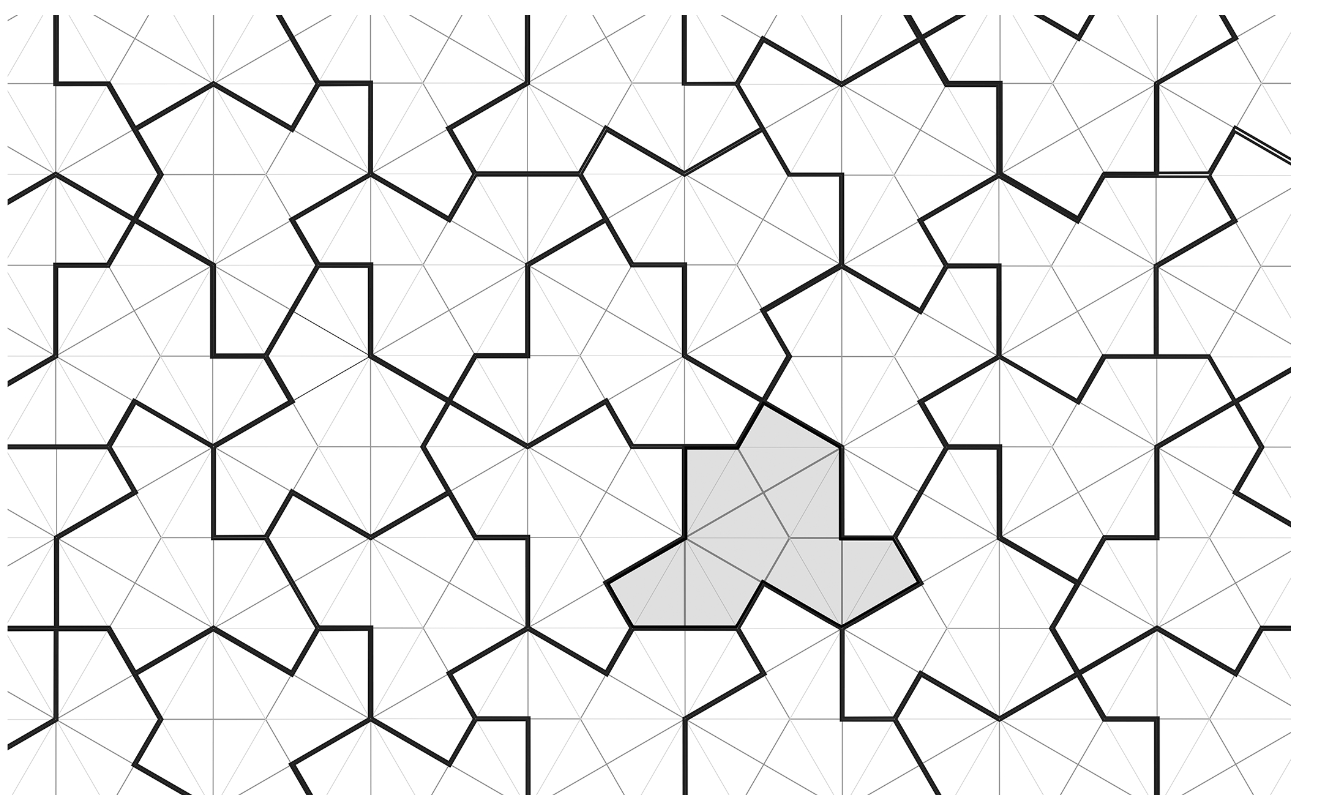
Creating (or taking) an image and explaining how it depicts your mental picture of a noncommutative space is one thing. Ideally, the image should be strong enough so that other people familiar with it might have a reasonable guess what you attempt to depict.
But, is there already enough concordance in our views of noncommutative spaces? I doubt it, whence this experiment. Below my attempt1 to depict one of the most popular noncommutative spaces around :
Can you guess what space this is? How does it agree with (resp. differ from) your own mental image of it?
Further, if you know of links to other depictions of noncommutative spaces, please leave a comment, or, send me an email.
- the image is taken from Cran’s fractal art [↩]
Pollock your own noncommutative space
May 19th
I really like Matilde Marcolli’s idea to use some of Jackson Pollock’s paintings as metaphors for noncommutative spaces. In her talk she used this painting
and refered to it (as did I in my post) as : Jackson Pollock “Untitled N.3”. Before someone writes a post ‘The Pollock noncommutative space hoax’ (similar to my own post) let me point out that I am well aware of the controversy surrounding this painting.
This painting is among 32 works recently discovered and initially attributed to Pollock.
In fact, I’ve already told part of the story in Doodles worth millions (or not)? (thanks to PD1). The story involves the people on the right : from left to right, Jackson Pollock, his wife Lee Krasner, Mercedes Matter and her son Alex Matter.
Alex Matter, whose father, Herbert, and mother, Mercedes, were artists and friends of Jackson Pollock, discovered after his mother died a group of small drip paintings in a storage locker in Wainscott, N.Y. which he believed to be authentic Pollocks.
Read the post mentioned above if you want to know how mathematics screwed up his plan, or much better, reed the article Anatomy of the Jackson Pollock controversy by Stephen Litt.
So, perhaps the painting above was not the smartest choice, but we could take any other genuine Pollock ‘drip-painting’, a technique he taught himself towards the end of 1946 to make an image by splashing, pouring, sloshing colors onto the canvas. Typically, such a painting consists of blops of paint, connected via thin drip-lines.
What does this have to do with noncommutative geometry? Well, consider the blops as ‘points’. In commutative geometry, distinct points cannot share tangent information1. In the noncommutative world though, they can!, or if you want to phrase it like this, noncommutative points ‘can talk to each other’. And, that’s what we cherish in those drip-lines.
But then, if two points share common tangent informations, they must be awfully close to each other… so one might imagine these Pollock-lines to be strings holding these points together. Hence, it would make more sense to consider the ‘Pollock-quotient-painting’, that is, the space one gets after dividing out the relation ‘connected by drip-lines’2.
For this reason, my own mental picture of a genuinely noncommutative space 3 looks more like the picture below
The colored blops you see are really sets of points which you might view as, say, a FacebookGroup4. Some chatter may occur between two distinct FacebookGroups, the more chatter the thicker the connection depicted5. Now, there are some tiny isolated spots (say blue ones in the upper right-hand quadrant). These should really be looked at as remote clusters of noncommutative points (sharing no (tangent) information whatsoever with the blops in the foregound). If we would zoom into them beyond the Planck scale (if I’m allowed to say a bollock-word in a Pollock-post) they might reveal again a whole universe similar to the interconnected blops upfront.
The picture was produced using the fabulous Pollock engine. Just use your mouse to draw and click to change colors in order to produce your very own noncommutative space!
For the mathematicians still around, this may sound like a lot of Pollock-bollocks but can be made precise. See my note Noncommutative geometry and dual coalgebras for a very terse reading. Now that coalgebras are gaining popularity, I really should write a more readable account of it, including some fanshi-wanshi examples…
- technically : a commutative semi-local ring splits as the direct sum of local rings and this does no longer hold for a noncommutative semi-local ring [↩]
- my guess is that Matilde thinks of the lines as the action of a group on the points giving a topological horrible quotient space, and thats precisely where noncommutative geometry shines [↩]
- that is, the variety corresponding to a huge noncommutative algebra such as free algebras, group algebras of arithmetic groups or fundamental groups [↩]
- technically, think of them as the connected components of isomorphism classes of finite dimensional simple representations of your favorite noncommutative algebra [↩]
- technically, the size of the connection is the dimension of the ext-group between generic simples in the components [↩]
Views of noncommutative spaces
May 18th
The general public expects pictures from geometers, even from non-commutative geometers. Hence, it is important for researchers in this topic to make an attempt to convey the mental picture they have of their favourite noncommutative space, … somehow. Two examples :
This picture was created by Shahn Majid. It appears on his visions of noncommutative geometry page as well as in an extremely readable Plus-magazine article on Quantum geometry, written by Marianne Freiberger, explaining Shahn’s ideas. For more information on this, read Shahn’s SpaceTime blog.
This painting is Jackson Pollock‘s “Untitled N.3″. It depicts the way Matilde Marcolli imagines a noncommutative space. It is taken from her slides of her talk for a general audience Mathematicians look at particle physics.
Geometry of the Okubo algebra
Mar 14th
Last week, Melanie Raczek gave a talk entitled ‘Cubic forms and Okubo product’ in our Artseminar, based on her paper On ternary cubic forms that determine central simple algebras of degree 3.
I had never heard of this strange non-associative product on 8-dimensional space, but I guess it is an instance of synchronicity that now the Okubo algebra seems to pop-up everywhere.
Yesterday, there was the post the Okubo algebra by John Baez at the n-cafe, telling that Susumu Okubo discovered his algebra while investigating quarks.
I don’t know a thing about the physics, but over the last days I’ve been trying to understand some of the miraculous geometry associated to the Okubo algebra. So, let’s start out by defining the ‘algebra’.
Consider the associative algebra of all 3×3 complex matrices
with the usual matrix-multiplication. In this algebra there is the 8-dimensional subspace of trace zero matrices, usually called the Lie algebra
. However, we will not use the Lie-bracket, only matrix-multiplication. Typical elements of
will be written as
and their entries will be denoted as

For any two elements
one defines their Okubo-product to be the 3×3 matrix

where
is a primitive 3-rd root of unity and
is the identity matrix. Written out in the entries of X and Y this operation looks horribly complicated

with

The crucial remark to make is that
is again a trace zero matrix. That is, we have defined a new operation on
.

This Okubo-product is neither a Lie-bracket, nor an associative multiplication. In fact, it is a lot ‘less associative’ than that other 8-dimensional algebra, the octonions. The only noteworthy identity it has is that
. So, why should we be interested in this horrible algebra?
Well, let us consider the subset of
consisting of those matrices X satusfying
. That is, with the above notation, all matrices X such that

In the 8-dimensional affine space
these matrices form a singular quadric with top the zero-matrix. So, it is better to go projective. That is, any non-zero matrix
determines a point in 7-dimensional projective space
with homogeneous coordinates
![\overline{X} = [x_0:x_1:x_2:x_3:x_4:x_5:x_6:x_7] \in \mathbb{P}^7 \overline{X} = [x_0:x_1:x_2:x_3:x_4:x_5:x_6:x_7] \in \mathbb{P}^7](/latexrender/pictures/abf863c11bda8eec6c894b039bac843c.gif)
and the points
corresponding to solutions of
form a smooth 6-dimensional quadric
with homogeneous equation

6-dimensional quadrics may be quite hard to visualize, so it may help to recall the classic situation of lines on a 2-dimensional quadric (animated gif taken from surfex).
A 2-dimensional quadric contains two families of lines, often called the ‘blue lines’ and the ‘red lines’, each of these lines isomorphic to
. The rules-of-intersection of these are :
- different red lines are disjoint as are different blue lines
- any red and any blue line intersect in exactly one point
- every point of the quadric lies on exactly one red and one blue line
The lines in either family are in one-to-one correspondence with the points on the projective line. We therefore say that there is a
-family of red lines and a
-family of blue lines on a 2-dimensional quadric.
A 6-dimensional quadric
contains two families of ’3-planes’. That is, there is a family of red
‘s contained in Q and a family of blue
‘s. Can we determine these red and blue 3-planes explicitly?
Yes we can, using the Okubo algebra-product on
. Take
defining the point
(that is,
). then all 3×3 matrices one obtains by taking the Okubo-product with left X-factor form a 4-dimensional linear subspace in 

so its non-zero matrices determine a 3-plane in
(consisting of all points with homogeneous coordinates
, using the above formulas) which actually lies entirely in the quadric Q. These are precisely the bLue 3-planes in Q. That is, the family of all bLue 3-planes consists precisely of the 3-planes
with
satisfying 
Phrased differently, any point
determines a blue 3-plane
.
Similarly, any point
determines a Red 3-plane by taking Okubo-products with Right X-factor, that is,
is a 3-plane for Q where

and all Red 3-planes for Q are of this form. But, this is not all… these correspondences are unique! That is, any point on the quadric defines a unique red and a unique blue 3-plane, or, phrased differently, there is a Q-family of red 3-planes and a Q-family of blue 3-planes in Q. This is a consequence of triality.
To see this, note that the automorphism group of a 6-dimensional smooth quadric is the rotation group
and this group has Dynkin diagram
, the most symmetrical of them all!
In general, every node in a Dynkin diagram has an interesting projective variety associated to it, a so called homogeneous space. I’ll just mention what these spaces are corresponding to the 4 nodes of
. Full details can be found in chapter 23 of Fulton and Harris’ Representation theory, a first course.
The left-most node corresponds to the orthogonal Grassmannian of isotropic 1-planes in
which is just a fancy way of viewing our quadric Q. The two right-most nodes correspond to the two connected components of the Grassmannians of isotropic 4-planes in
, which are our red resp. blue families of 3-planes on the quadric. Now, as the corresponding dotted Dynkin diagrams are isomorphic
there corresponding homogeneous spaces are also isomorphic. Thus indeed, there is a one-to-one correspondence between points of the quadric Q and red 3-planes on Q (and similarly with blue 3-planes on Q).
Okay, so the Okubo-product allows us to associate to a point on the 6-dimensional quadric Q a unique red 3-plane and a unique blue 3-plane (much as any point on a 2-dimensional quadric determines a unique red and blue line). Do these families of red and blue 3-planes also satisfy ‘rules-of-intersection’?
Yes they do and, once again, the Okubo-product clarifies them. Here they are :
- two different red 3-planes intersect in a unique line (as do different blue 3-planes)
- the bLue 3-plane
intersects the Red 3-plane
in a unique point if and only if the Okubo-product
- the bLue 3-plane
intersects the Red 3-plane
in a unique 2-plane if and only if the Okubo-product
That is, Right and Left Okubo-products determine the Red and bLue families of 3-planes on the 6-dimensional quadric as well as their intersections!
Connes & Consani go categorical
Mar 12th
Today, Alain Connes and Caterina Consani arXived their new paper Schemes over and zeta functions. It is a follow-up to their paper On the notion of geometry over
, which I’ve tried to explain in a series of posts starting here.
As Javier noted already last week when they updated their first paper, the main point of the first 25 pages of the new paper is to repace abelian groups by abelian monoids in the definition, making it more in tune with other approaches, most notably that of Anton Deitmar. The novelty, if you want, is that they package the two functors
and
into one functor
by using the ‘glued category’
(an idea they attribute to Pierre Cartier).
In general, if you have two categories
and
and a pair of adjoint functors between them, then one can form the glued-category
by taking as its collection of objects the disjoint union of the objects of the two categories and by defining the hom-sets between two objects the hom-sets in either category (if both objects belong to the same category) or use the adjoint functors to define the new hom-set when they do not (the very definition of adjoint functors makes that this doesn’t depend on the choice).
Here, one uses the functor
assigning to a monoid
its integral monoid-algebra
, having as its adjoint the functor
forgetting the additive structure of the commutative ring.
In the second part of the paper, they first prove some nice results on zeta-functions of Noetherian
-schemes and extend them, somewhat surprisingly, to settings which do not (yet) fit into the
-framework, namely elliptic curves and the hypothetical
-curve
.