lieven le bruyn's blog
books
The artist and the mathematician
Oct 19th
Over the week-end I read The artist and the mathematician (subtitle : The story of Nicolas Bourbaki, the genius mathematician who never existed) by Amir D. Aczel.
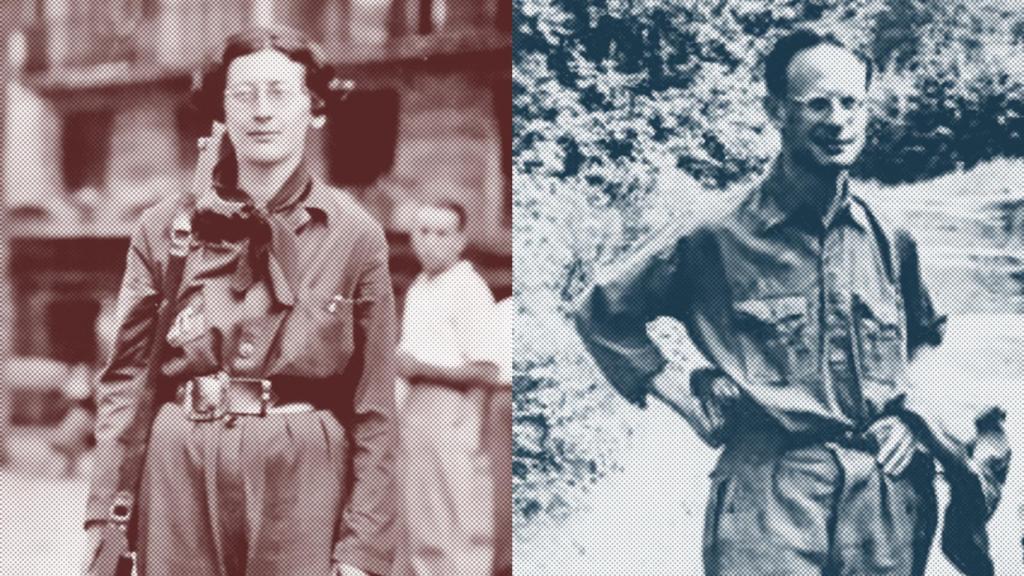
Whereas the central character of the book should be Bourbaki, it focusses more on two of Bourbaki’s most colorful members, André Weil and Alexander Grothendieck, and the many stories and myths surrounding them.
The opening chapter (‘The Disappearance’) describes the Grothendieck’s early years (based on the excellent paper by Allyn Jackson Comme Appelé du Néant ) and his disappearance in the Pyrenees in the final years of last century. The next chapter (‘An Arrest in Finland’) recount the pre-WW2 years of Weil and the myth of his arrest in Finland and his near escape from execution (based on Weil’s memoires The Apprenticeship of a Mathematician). Chapter seven (‘The Café’) describes the first 10 proto-Bourbaki meetings following closely the study ‘A Parisian Café and Ten Proto-Bourbaki Meetings (1934-1935)‘ by Liliane Beaulieu. Etc. etc.
All the good ‘Bourbaki’-stories get a place in this book, not always historically correct. For example, on page 90 it is suggested that all of the following jokes were pulled at the Besse-conference, July 1935 : the baptizing of Nicolas, the writing of the Comptes-Rendus paper, the invention of the Bourbaki-daughter Betti and the printing of the wedding invitation card. In reality, all of these date from much later, the first two from the autumn of 1935, the final two no sooner than april 1939…
One thing I like about this book is the connection it makes with other disciplines, showing the influence of Bourbaki’s insistence on ‘structuralism’ in fields as different as philosophy, linguistics, anthropology and literary criticism. One example being Weil’s group-theoretic solution to the marriage-rules problem in tribes of Australian aborigines studied by Claude Lévi-Strauss, another the literary group Oulipo copying Bourbaki’s work-method.
Another interesting part is Aczel’s analysis of Bourbaki’s end. In the late 50ties, Grothendieck tried to convince his fellow Bourbakis to redo their work on the foundations of mathematics, changing these from set theory to category theory. He failed as others felt that the foundations had already been laid and there was no going back. Grothendieck left, and Bourbaki would gradually decline following its refusal to accept new methods. In Grothendieck’s own words (in “Promenade” 63, n. 78, as translated by Aczel) :
“Additionally, since the 1950s, the idea of structure has become passé, superseded by the influx of new ‘categorical’ methods in certain of the most dynamical areas of mathematics, such as topology or algebraic geometry. (Thus, the notion of ‘topos’ refuses to enter into the ‘Bourbaki sack’ os structures, decidedly already too full!) In making this decision, in full cognizance, not to engage in this revision, Bourbaki has itself renounced its initial ambition, which has been to furnish both the foundations and the basic language for all of modern mathematics.”
Finally, it is interesting to watch Aczel’s own transformation throughout the book, from slavishly copying the existing Weil-myths and pranks at the beginning of the book, to the following harsh criticism on Weil, towards the end (p. 209) :
“From other information in his autobiography, one gets the distinct impression that Weil was infatuated with the childish pranks of ‘inventing’ a person who never existed, creating for him false papers and a false identity, complete with a daughter, Betti, who even gets married, parents and relatives, and membership in a nonexistent Academy of Sciences of the nonexistent nation of Polvedia (sic).
Weil was so taken with these activities that he even listed, as his only honor by the time of his death ‘Member, Poldevian Academy of Sciences’. It seems that Weil could simply not go beyond these games: he could not grasp the deep significance and power of the organization he helped found. He was too close, and thus unable to see the great achievements Bourbaki was producing and to acknowledge and promote these achievements. Bourbaki changed the way we do mathematics, but Weil really saw only the pranks and the creation of a nonexistent person.”
Judging from my own reluctance to continue with the series on the Bourbaki code, an overdose reading about Weil’s life appears to have this effect on people…
When was the Bourbaki wedding?
Oct 7th
The Bourbaki Code
It’s great fun trying to decode some of the puns contained in Betti Bourbaki’s wedding invitation. Below a photograph, taken on May 13th 1939, of three of the practical jokers (from left to right : Ralph Boas, Frank Smithies and Andre Weil), the others were Claude Chabauty, Weil’s wife Eveline and Louis Bouckaert (from Louvain).
Part of this picture is on the front cover of the book Lion Hunting & other Mathematical Pursuits. This book clarifies the ‘Secrétaire de l’Oevre du Sou du Lion’-phrase as well as some of the names on the card.
Inspired by the Bourbaki-hoax, a group of postdoctoral fellows visiting Princeton University in 1937-1938 (Boas, Smithies and John Tuckey) published their inventions, allegedly devised by Hector Pétard (aka ‘H(oist) W(ith) O(wn) Petard’ after the Shakespeare line “For ’tis the sport to have the engineer, hoist with his own petard…” Hamlet act III scene IV) who was writing under the pseudonym of E.S. Pondiczery. Pétard’s existence was asserted in the paper “A Contribution to the Mathematical Theory of Big-Game Hunting” Amer. Math. Monthly 45 (1938) 446-447.
Smithies recalls the spring 1939 period in Cambridge as follows : “The climax of the academic year, as far as we were concerned, came in the Easter term. André Weil, Claude Chabauty, and Louis Bouckaert (from Louvain) were all in Cambridge, and the proposal was mooted that a marriage should be arranged between Bourbaki’s daughter Betti and Hector Pétard; the marriage announcement was duly printed in the canonical French style – on it Pétard was described as the ward of Ersatz Stanislas Pondiczery – and it was circulated to the friends of both parties. A couple of weeks later the Weils, Louis Bouckaert, Max Krook (a South African astrophysicist), Ralph and myself made a river excursion to Grantchester by punt and canoe to have tea at the Red Lion; there is a photograph of Ralph and myself, with our triumphantly captured lion between us and André Weil looking benevolently on.”
From this and the date of the photograph (May 13th 1939) one can conclude that the marriage-card was drawn up around mid april 1939. As weddings tend to follow their announcement by a couple of months, this contradicts the following passage from Notice sur la Vie et l ‘oeuvre de Nicolas Bourbaki by an unidentified author :
“Nominated as Privat-Dozent at the University of Dorpat in 1913, he (that is, N. Bourbaki) married two years later; a single girl, Betti, married in 1938 to the Lion hunter H. Pétard, was born out of this marriage.”
But then, when was the Bourbaki-Pétard wedding scheduled? Surely, a wedding announcement should provide that information. Here’s the relevant part :
“The trivial isomorphism (aka the sacrament of matrimony) will be given to them by P. Adic, of the Diophantine Order, at the Principal Cohomology of the Universal Variety, the 3 Cartember, year VI, at the usual hour.”
Here’s my guess : the first Bourbaki-meeting took place December 10th 1934. Actually, it was a ‘proto-Bourbaki-meeting’, but nevertheless founding members such as [Jean Delsarte counted 1934 as the first Bourbaki year as is clear from the ‘Remarque’ at the top of his notes of the first meeting : 34+25=59, trying to figure out when the 25-year festivity was going to be held …
Thus, if 1934 is year 1 of the Bourbaki-calender, year VI should be 1939. The notules also give a hint of ‘the usual hour’. In the 1934-1940 period, the Bourbakis met twice a month before the monday-afternoon seminar, at 12 o’clock sharp, the ‘sacred hour’, for a meeting over lunch.
Remains the ‘Cartembre’-puzzle. We know ‘Septembre (7), Novembre (9), Decembre (10)’ so if ‘Cart’ is short for ‘Quatre’ (4), Cartembre might be June. I guess the wedding was scheduled to be held on June 3rd, 1939 at 12h.
It fits with the date the announcement was drawn up and June 3rd, 1939 sure enough was a saturday, the ‘canonical’ day for a wedding. Remains the problem of the wedding place. Suggestions anyone?
maths for aspiring chatelains
Oct 3rd
Some French real estate agents don’t try to sell you property, but a dream. There’s nothing wrong with pursuing dreams as long as you’re doing the necessary maths. If not, your dream may soon become an horrible nightmare…
Just finished reading A Chateau Of One’s Own (subtitle : “Restoration misadventures in France”) by Sam Juneau. From the back-cover :
“Sam and Bud were ordinary first-time homebuyers in their early thirties. Their intention in moving to France was to create a simple life and spend more time with their children. The home they actually bought was an impressive seventeenth-century chateau in the Loire valley with over thirty rooms, 156 windows and 40 acres of land. With only modest savings, the couple launched the challenging project of restoring this crumbling monster of a building to its former glory and opening a bed and breakfast in the process.”
A couple of hours before flying back to the States, the two fall madly in love with a chateau that had served as home to more than 30 adults with Down’s syndrome until four years ago, when it closed its doors and has been empty ever since. Some basic structures such as plumbing and electricity may still be functioning somewhat, but it is going to be a huge project. And why hasn’t anyone else bought the beast in the four years it’s on the market? A simple comparison is required between asking price + restoration costs estimate and the available resources of the couple. We get this information on page 42 :
“The asking price was well beyond our meagre resources. Philippe told us the chateau could be had for about 20 per cent less than the asking price or about 2.9 million francs. This came to about 300,000 pounds at the time, plus fees and government taxes. Persistent, I pointed out again that this was the price of a modest closet in Manhattan or London. Of course, the difference was you could make a living in these cities. The B&B might never bring in sufficient income to cover the loan. A specious venture at best, disastrous at worst. We had managed to pull together about $170,000 in our time in New York. Our life’s savings. At 33 years of age, not terribly bad, but far from sufficient.”
So, here we are, about 1/8th into the book and certain that they do not have a fighting chance whatsoever. The essential sub-sentence being ‘you could make a living in these cities’. To pursue their project, they will have to give up their jobs and income and hope that the B&B-money will be coming in soon and plentiful to pay-off their loans. Now, if you want to charge people a sizable amount of money for staying in a chateau, you’d better restore it up to B&B-standards, or better.
Any DIY-book on restoring old French houses will give you estimates for this. To renovate a semi-derelict property to a quality standard suitable for short time letting or as a bed and breakfast business : between 1,100 and 2,000 Euros per square metre. So, for a luxury chateau-B&B they’ll have to go for at least 1,500 Euros/m2. One final ingredient in still missing but we learned this already on page 34 : the chateau measures 15,000 square foot (that’s about 1,400m2).
Hence, they need about 2,100,000 Euros for the restoration and 328,707 Euros to buy the place, having only 116,822 Euros to spend… No way! But then, the back-cover seems to suggest that they did succeed after all : “Sam Juneau was born in New Orleans and is a television producer and writer in the UK and the US. He and his wife live in France with their children and 22 cats.”
So, I continued reading, eager to discover the flaw in my calculations. About 3/4th into the book, I started to believe in a miracle when they could take over the business of a neighboring chateau, specializing in wedding-arrangements. But then, in the closing chapter, the inevitable happened, they had to sell the chateau and planned to redo a similar (but smaller) stunt with a “beautiful chartreuse, an eighteenth-century manor house” in the Dordogne. The latest internet-sighting of Sam Juneau is a twitter message dated June 29th “riding in a cab on 5th ave, no a/c, one of life’s gentle pleasures”. I guess he failed to do his maths, even the second time around…