Skip to content →

Month: July 2010

math & manic-depression, a Faustian bargain

In the wake of a colleague’s suicide and the suicide of three students, Matilde Marcolli gave an interesting and courageous talk at Caltech in April : The dark heart of our brightness: bipolar disorder and scientific creativity. Although these slides give a pretty good picture of the talk, if you can please take the time to watch it (the talk starts 44 minutes into the video).

Courageous because as the talk progresses, she gives more and more examples from her own experiences, thereby breaking the taboo surrounding the topic of bipolar mood disorder among scientists. Interesting because she raises a couple of valid points, well worth repeating.

We didn’t can see it coming

We are always baffled when someone we know commits suicide, especially if that person is extremely successful in his/her work. ‘(S)he was so full of activity!’, ‘We did not see it coming!’ etc. etc.

Matilde argues that if a person suffers from bipolar mood disorder (from mild forms to full-blown manic-depression), a condition quite common among scientists and certainly mathematicians, we can see it coming, if we look for the proper signals!

We, active scientists, are pretty good at hiding a down-period. We have collected an arsenal of tricks not to send off signals when we feel depressed, simply because it’s not considered cool behavior. On the other hand, in our manic phases, we are quite transparent because we like to show off our activity and creativity!

Matilde tells us to watch out for people behaving orders-of-magnitude out of their normal-mode behavior. Say, someone who normally posts one or two papers a year on the arXiv, suddenly posting 5 papers in one month. Or, someone going rarely to a conference, now spending a summer flying from one conference to the next. Or, someone not blogging for months, suddenly flooding you with new posts…

As scientists we are good at spotting such order-of-magnitude-out-behavior. So we can detect friends and colleagues going through a manic-phase and hence should always take such a person serious (and try to offer help) when they send out signals of distress.

Mood disorder, a Faustian bargain

The Faust legend :
“Despite his scholarly eminence, Faust is bored and disappointed. He decides to call on the Devil for further knowledge and magic powers with which to indulge all the pleasures of the world. In response, the Devil’s representative Mephistopheles appears. He makes a bargain with Faust: Mephistopheles will serve Faust with his magic powers for a term of years, but at the end of the term, the Devil will claim Faust’s soul and Faust will be eternally damned.”

Mathematicians suffering from mood disorder seldom see their condition as a menace, but rather as an advantage. They know they do their best and most creative work in short spells of intense activity during their manic phase and take the down-phase merely as a side effect. We fear that if we seek treatment, we may as well loose our creativity.

That is, like Faust, we indulge the pleasures of our magic powers during a manic-phase, knowing only too well that the devilish depression-phase may one day claim our life or mental sanity…

5 Comments
Bourbaki and the miracle of silence

The last pre-war Bourbaki congress, held in september 1938 in Dieulefit, is surrounded by mystery. Compared to previous meetings, fewer documents are preserved in the Bourbaki archives and some sentences in the surviving notules have been made illegible. We will have to determine the exact location of the Dieulefit-meeting before we can understand why this had to be done. It’s Bourbaki’s own tiny contribution to ‘le miracle de silence’…

First, the few facts we know about this Bourbaki congress, mostly from Andre Weil‘s autobiography ‘The Apprenticeship of a Mathematician’.
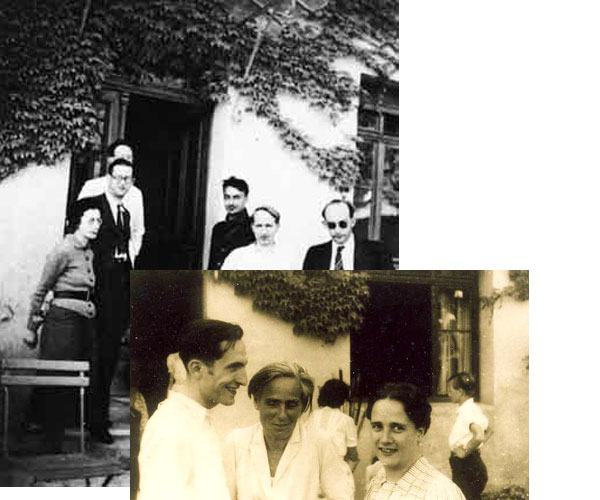
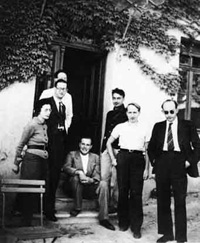
The meeting was held in Dieulefit in the Drome-Provencale region, sometime in september 1938 prior to the Munich Agreement (more on this next time). We know that Elie Cartan did accept Bourbaki’s invitation to join them and there is this one famous photograph of the meeting. From left to right : Simone Weil (accompanying Andre), Charles Pison, Andre Weil (hidden), Jean Dieudonne (sitting), Claude Chabauty, Charles Ehresmann, and Jean Delsarte.

Failing further written documentation, ‘all’ we have to do in order to pinpoint the exact location of the meeting is to find a match between this photograph and some building in Dieulefit…

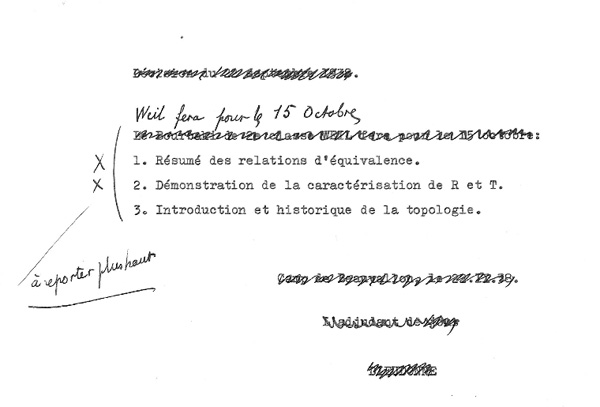
The crucial clue is provided by the couple of sentences, on the final page of the Bourbaki-archive document deldi_001 Engagements de Dieulefit, someone (Jean Delsarte?) has tried to make illegible (probably early on).


Blowing the picture up, it isn’t too hard to guess that the header should read ‘Décision du 22 septembre 1938’ and that the first sentence is ‘Le Bourbaki de 2e classe WEIL fera pour le 15 octobre’. The document is signed

Camp de Beauvallon, le 22.IX.38.
L’adjudant de jour
DIEUDONNE

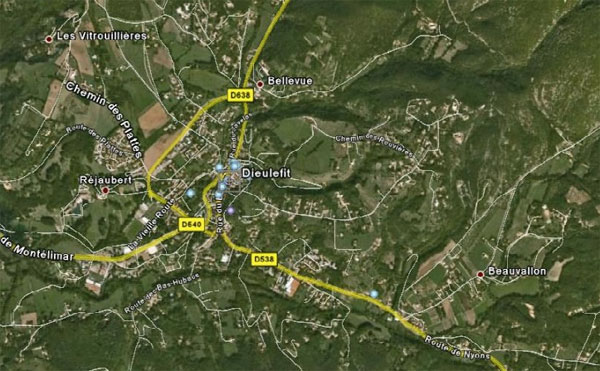
Now we are getting somewhere. Beauvallon is the name of an hamlet of Dieulefit, situated approximately 2.5km to the east of the center.

Beauvallon is rather famous for its School, founded in 1929 by Marguerite Soubeyran and Catherine Krafft, which was the first ‘modern’ boarding school in France for both boys and girls having behavioral problems. From 1936 on the school’s director was Simone Monnier.

These three women were politically active and frequented several circles. Already in 1938 (at about the time of the Bourbaki congress) they knew the reality of the Nazi persecutions and planned to prepare their school to welcome, care for and protect refugees and Jewish children.

From 1936 on about 20 Spanish republican refugees found a home here and in the ‘pension’ next to the school. When the war started, about 1500 people were hidden from the German occupation in Dieulefit (having a total population of 3500) : Jewish children, intellectuals, artists, trade union leaders, etc. etc. many in the Ecole and the Pension.

Because of the towns solidarity with the refugees, none were betrayed to the Germans, Le miracle de silence à Dieulefit.
It earned the three Ecole-women the title of “Juste” after the war. More on this period can be read here.

But what does this have to do with Bourbaki? Well, we claim that the venue of the 1938 Bourbaki congress was the Ecole de Beauvallon and they probably used Le Pension for their lodgings.

We have photographic evidence comparing the Bourbaki picture with a picture taken in 1943 at the Ecole (the woman in the middle is Marguerite Soubeyran). Compare the distance between door and window, the division of the windows and the ivy on the wall.

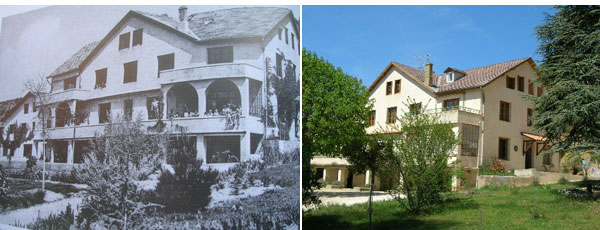
Below two photographs of the entire school building : on the left, the school with ‘Le Pension’ next to it around 1938 (the ivy clad wall with the Bourbaki-door is to the right) and on the right, the present Ecole de Beauvallon (this site also contains a lot of historical material). The ivy has gone, but the main features of the building are still intact, only the shape of the small roof above the Bourbaki-door has changed.

During their stay, it is likely the Bourbakis became aware of the plans the school had would war break out. Probably, Jean Delsarte removed all explicit mention to the Ecole de Beauvallon from the archives upon their return. Bourbaki’s own small contribution to Dieulefit’s miracle of silence.

Leave a Comment

Who was ‘le P. Adique’?

Last year we managed to solve the first few riddles of the Bourbaki code, but several mysteries still remain. For example, who was the priest performing the Bourbaki-Petard wedding ceremony? The ‘faire part’ identifies him as ‘le P. Adique, de l’Ordre des Diophantiens’.

As with many of these Bourbaki-jokes, this riddle too has several layers. There is the first straightforward mathematical interpretation of the p-adic numbers $latex \hat{\mathbb{Z}}_p$ being used in the study of Diophantine problems.

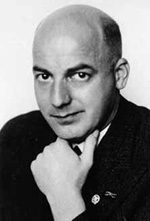
For example, the local-global, or Hasse principle, asserting that an integral quadratic form has a solution if and only if there are solutions over all p-adic numbers. Helmut Hasse was a German number theorist, held in high esteem by the Bourbaki group.

After graduating from the ENS in 1929, Claude Chevalley spent some time at the University of Marburg, studying under Helmut Hasse. Hasse had come to Marburg when Kurt Hensel (who invented the p-adic numbers in 1902) retired in 1930.

Hasse picked up a question from E. Artin’s dissertation about the zeta function of an algebraic curve over a finite field and achieved the first breakthrough establishing the conjectured property for zeta functions of elliptic curves (genus one).

Extending this result to higher genus was the principal problem Andre Weil was working on at the time of the wedding-card-joke. In 1940 he would be able to settle the general case. What we now know as the Hasse-Weil theorem implies that the number N(p) of rational points of an elliptic curve over the finite field Z/pZ, where p is a prime, can differ from the mean value p+1 by at most twice the square root of p.

So, Helmut Hasse is a passable candidate for the first-level, mathematical, decoding of ‘le P. adique’.

However, there is often a deeper and more subtle reading of a Bourbaki-joke, intended to be understood only by the select inner circle of ‘normaliens’ (graduates of the Ecole Normale Superieure). Usually, this second-level interpretation requires knowledge of events or locations within the 5-th arrondissement of Paris, the large neighborhood of the ENS.

For an outsider (both non-Parisian and non-normalien) decoding this hidden message is substantially harder and requires a good deal of luck.

As it happens, I’m going through a ‘Weil-phase’ and just started reading the three main Weil-biographies : Andre Weil the Apprenticeship of a Mathematician, Chez les Weil : André et Simone by Sylvie Weil and La vie de Simone Weil by Simone Petrement.


[abp:3764326506] [abp:2283023696] [abp:2213599920]

From page 35 of ‘Chez les Weil’ : “Après la guerre, pas tout de suite mais en 1948, toute la famille avait fini par revenir à Paris, rue Auguste-Comte, en face des jardins du Luxembourg.” Sylvie talks about the Parisian apartment of her grandparents (father and mother of Andre and Simone) and I wanted to know its exact location.

More details are given on page 103 of ‘La vie de Simone Weil’. The apartment consists of the 6th and 7th floor of a building on the Montagne Sainte-Geneviève. The Weils bought it before it was even built and when they moved in, in may 1929, it was still unfinished. Compensating this, the apartment offered a splendid view of the Sacre-Coeur, the Eiffel-tower, la Sorbonne, Invalides, l’Arc de Triomphe, Pantheon, the roofs of the Louvre, le tout Paris quoi…

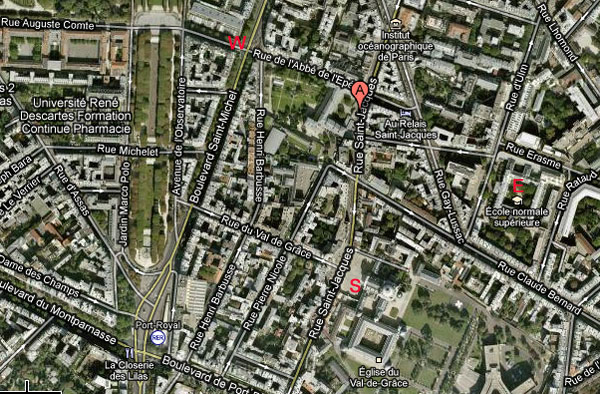
As to its location : “Juste au-dessous de l’appartement se trouvent l’Ecole des mines et les serres du Luxembourg, avec la belle maison ancienne où mourut Leconte de Lisle.” This and a bit of googling allows one to deduce that the Weils lived at 3, rue Auguste-Comte (the W on the map below).

Crossing the boulevard Saint-Michel, one enters the 5-th arrondissement via the … rue de l’Abbe de l’Epee…
We did deduce before that the priest might be an abbot (‘from the order of the Diophantines’) and l’Epee is just ‘le P.’ pronounced in French (cheating one egue).

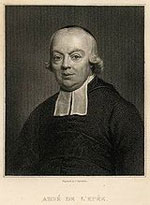
Abbé Charles-Michel de l’Épée lived in the 18th century and has become known as the “Father of the Deaf” (compare this to Diophantus who is called “Father of Algebra”). Épée turned his attention toward charitable services for the poor, and he had a chance encounter with two young deaf sisters who communicated using a sign language. Épée decided to dedicate himself to the education and salvation of the deaf, and, in 1760, he founded a school which became in 1791 l’Institution Nationale des Sourds-Muets à Paris. It was later renamed the Institut St. Jacques (compare Rue St. Jacques) and then renamed again to its present name: Institut National de Jeunes Sourds de Paris located at 254, rue Saint-Jacques (the A in the map below) just one block away from the Schola Cantorum at 269, rue St. Jacques, where the Bourbaki-Petard wedding took place (the S in the map).

Completing the map with the location of the Ecole Normale (the E) I was baffled by the result. If the Weil apartment stands for West, the Ecole for East and the Schola for South, surely there must be an N (for N.Bourbaki?) representing North. Suggestions anyone?

Leave a Comment