Error-correcting codes can be used to construct interesting lattices, the best known example being the Leech lattice constructed from the binary Golay code. Recall that a lattice $L $ in $\mathbb{R}^n $ is the set of all integral linear combinations of n linearly independent vectors $\{ v_1,\ldots,v_n \} $, that is
$L = \mathbb{Z} v_1 \oplus \ldots \oplus \mathbb{Z} v_n $
The theta function of the lattice is the power series
$\Theta_L(q) = \sum_l a_l q^l $
with $a_l $ being the number of vectors in $L $ of squared length $l $. If all squared lengths are even integers, the lattice is called even and if it has one point per unit volume, we call it unimodular. The theta function of an even unimodular lattice is a modular form. One of the many gems from Conway’s book The sensual (quadratic) form is the chapter “Can You Hear the Shape of a Lattice?” or in other words, whether the theta function determines the lattice.
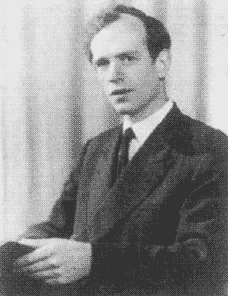 Ernst Witt knew already that there are just two even unimodular lattices in 16 dimensions : $E_* \oplus E_8 $ and $D_{16}^+ $ and as there is just one modular form of weigth 8 upto scalars, the theta function cannot determine the latice in 16 dimensions. The number of dimensions for a counterexamle was sunsequently reduced to 12 (Kneser), 8 (Kitaoka),6 (Sloane) and finally 4 (Schiemann).
Sloane and Conway found an elegant counterexample in dimension 4 using two old friends : the tetracode and the taxicab number 1729 = 7 x 13 x 19.
2 Comments