Skip to content →

Month: October 2009

Where was the Bourbaki wedding?

I’m pretty certain I got the intended date & time of the Bourbaki-Pétard wedding right : June 3rd 1939 at 12h.
Finding the exact location of the wedding-ceremony is an entirely different matter. And, quite probably, we are reading way too much in these pranks of the Weil-clan.

Still, it’s fun trying to find an elegant answer, based on the (intended or imagined) clues in the text and the little we know about the early Bourbaki-days. Here, the translation of the relevant part of the wedding announcement :


“They will receive the trivial isomorphism from P. Adic, of the Order of the Diophantines, in the Principal Cohomology of the Universal Variety, on the third of Cartember, year VI, at the usual hour.
The organ will be played by Monsieur Modulo, Assintant Simplex of the Grassmannian (with lemmas sung by the Scholia Cartanorum). The collection will be donated in full to the retirement home for Poor Abstracts. Convergence will be guaranteed.”

First solution : Perhaps one might read “in the Principal Cohomology of the Universal Variety” as : “in the Principal Church of the generic type/name”. In many French cities the main church is the Cathedral and an awful lot of them are called Notre Dame, so it might mean : in the Notre Dame Cathedral. But even then, we have to choose between these two
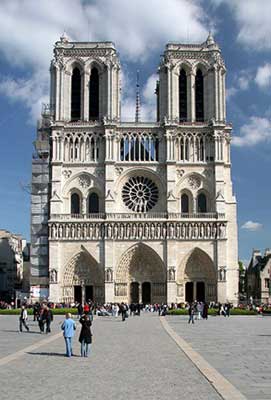
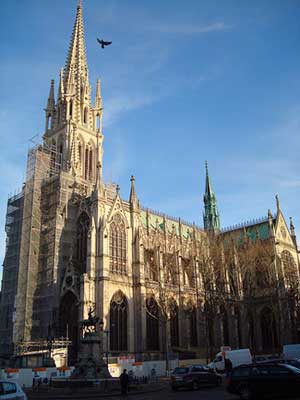


On the left, the Notre Dame Cathedral in Paris. On the right the Cathédrale Notre-Dame-de-l’Annonciation in Nancy. As the invitation promises guests to be entertained after the ceremony by Monsieur et Madame Bourbaki at their ‘Fundamental Domains’, the choice depends on the location of the Bourbaki-household in June 1939.

‘Bourbaki’ made two applications to become an AMS-member. The first, in 1948, tells us that Bourbaki is a scientific advisor to the Hermann Publishing Co. in Paris since 1934, and, the second in 1950, that he is ‘Directeur Libre de Recherches a l’Université de Nancy’.
I couldn’t find out when exactly Nicolas did change cities, and even Liliane Beaulieu’s talk Bourbaki a Nancy does not provide an answer.

Second solution : Or, one can read that sentence as a mathematical, perhaps proto-motivic, statement, and, hunt for clues elsewhere in the text. But then, what are these clues?

  • Mass is celebrated by “P. Adic, of the Order of the Diophantines”. This suggests that the church itself belongs to a monastic order, and is perhaps a convent-church.
  • Hymns are “sung by the Scholia Cartanorum”. Scholia Cartanorum is Latin of sorts and refers perhaps to the Paris’ Latin Quarter, le Quartier Latin.
  • The collection is donated to the “retirement home for Poor Abstracts”. Perhaps the church is connected to a saint for the poor.
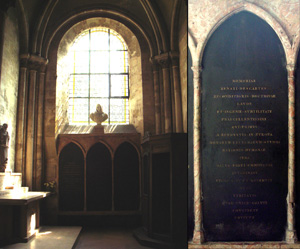
Let’s consider “Scholia Cartanorum” more closely. It may be Latin, admittedly very bad Latin, for ‘the Scholiums of Cartesius’, that is, ‘of Descartes‘.

One of the more famous ‘Scholia’ in scientific history is Newton’s general scholium to the Principia, which is a prime example of Descartes-bashing. Newton attacks Descartes on his vortical theory of planetary motion, his aeter to explain gravity, his God-axiom (unlike Descartes, Newton induced God from nature, rather than starting with God as an axiom) and his hypothetico-deductive method. So, there is a link between Descartes and ‘Scholium’, although the genitive form ‘Cartesiorum’ might be fairly inappropriate…

But then, Descartes died on 11 February 1650 in Stockholm (Sweden) where he was buried, so there won’t be a connection to a French or Parisian church, right? Well, not quite. The fate of Descartes’ remains is a rather strange story : “In 1666, sixteen years after his death, the bones of René Descartes
were dug up in the middle of the night and transported from Sweden to
France under the watchful eye of the French Ambassador. This was only
the beginning of the journey for Descartes’ bones, which, over the
next 350 years, were fought over, stolen, sold, revered as relics,
studied by scientists, used in séances, and passed surreptitiously
from hand to hand. ” For example, during the French Revolution, his remains were disinterred for burial
in the Pantheon in Paris among the great French thinkers. But today, his ashes are burried in…
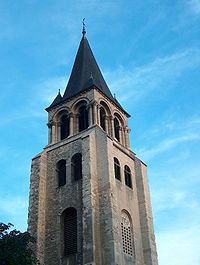
the abbay church of Saint-Germain-des-Prés, located in the Quartier Latin, within walking distance of the Bourbaki-café Capoulade and the Ecole Normal Superieure.

Now all the hints fall handsomely in place. St-Germain-des-Prés is the oldest church in Paris. Parts of it date to the 6th century, when a Benedictine abbey was founded on the site by Childebert, son of Clovis. Hence the sentence ‘in the Principal Cohomology of the Universal Variety’ might simply mean ‘in the first church, ever’. In medieval times, the Left Bank of Paris was prone to flooding from the Seine, so much of the land could not be built upon and the Abbey stood in the middle of fields, or prés in French, thereby explaining its appellation.

The other part of its name, Saint Germain, comes from Saint Germanus of Paris, also known as the ‘father of the poor’ (!). His remains were interred in St. Symphorien’s chapel in the vestibule of St. Vincent’s church, but in 754, when he was canonized, his relics were solemnly removed into the body of the church, in the presence of Pepin and his son, Charlemagne, then a child of seven, and the church was reconsecrated as Saint-Germain-des-Prés. That is, also the remains of the ‘father of the poor’ are buried in this church.

Here’s my best guess : the Bourbaki-Pétard wedding was held on June 3rd 1939 in the church Saint-Germain-des-Prés at 12h. Genuine aficionados of the Da Vinci code may regret it wasn’t held in the neighboring Saint-Sulpice church, but then, perhaps someone can bend the clues accordingly…

Remains this problem : who was the organist, Monsieur Modulo? Suggestions anyone?

7 Comments
the bumpy road to the first Bourbaki congress

The first Bourbaki congress took eventually place in Besse-en-Chandesse. But, its organization suffered from the ‘usual’ inter-departemental fighting, and also from a power-struggle within the group itself. On many issues de Possel and André Weil were on opposite sides, and it didn’t really help that there was a woman involved…

Because Mandelbrojt, de Possel and Coulomb all held a position at the University Blaise Pascal of Clermont-Ferrand I assumed that the Bourbaki-group had no problem procuring the universities’ biology-outpost in Besse-en-Chandesse for their first congress in 1935. However, the relevant Bourbaki files tell a different story. As might have been expected, the project suffered from the ‘usual’ inter-departemental fighting, but also from a power-struggle within the group itself.

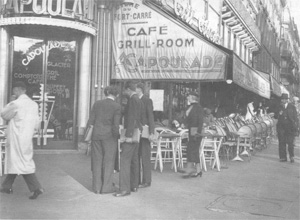
An excellent account of the first 10 ‘proto-Bourbaki’ meetings in the Capoulade-Café, 63 boulevard Saint- Michel, is told magnificently by Liliane Beaulieu in her 1993 paper A Parisian Café and Ten Proto-Bourbaki Meetings(1934-1935). Here we will concentrate on the preparations of the Besse congress.
At their very first meeting on december 10th 1934, they already state the importance of the upcoming summer-congress where a precise plan and a distribution of the writing-load for the first volumes will be discussed : “Aux prochaines grandes vacances aura lieu une réunion pléniere d’ou sortira un plan définitif tres précis et une répartition du travail de rédaction des différents fascicules”. The second meeting, on january 14th 1935, decides that the definite list of Bourbaki-members will consist of those (among the nine ‘possibles’ Weil, Delsarte, Mandelbrojt, Cartan, Dubreil, Dieudonné, de Possel, Chevalley and Leroy) present at the congress : “Il est entendu que la liste définitive, extraite de la précédente, sera composée des noms des membres présents a la réunion pléniere d’Aout ou Septembre prochain, réunion dans laquelle sera dressé le plan définitif et précis du traité”.

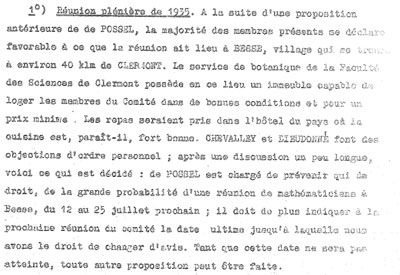
On march 25th 1935, the first precise plans are made about the location, the lodgings and the extremely important issue of the meals which will be taken in a nearby Hotel of which “la cuisine est, parait-il, fort bonne”.
René de Possel obtained a mandate to do whatever it took for the group to have their congress in Besse between 12 and 25 July, and, to enquire until what date they could still change their mind.
His biography contains the following lines :
“On many issues de Possel and André Weil were on opposite sides in the arguments. At the first Bourbaki congress in July 1935 de Possel was still an active member of the group and much involved with contributing but, largely due to differences with Weil, he dropped out of the project. De Possel married Yvonne Liberati on 12 August 1935; they had three children, Yann, Maya, and Daphné.”

By and large, the Bourbaki-differences between de Possel and Weil were of a professional nature. They had different mathematical interests, different mathematical talents, different ambitions, and, a different level of commitment wrt. the work ahead (Weil being the lazier one of the two). Still, it is difficult to understand the group-dynamics of the first generation Bourbakis without mentioning a personal tragedy, often ‘forgotten’ (as in the above biography) or given no more than half a sentence, in passing…

Aged 24, René de Possel marries Evelyne Gillet in 1929 and their son, Alain, is born on august 16th 1931. However, the marriage breaks up, one account dates the separation in 1933, another around the time of the Besse conference in 1935.
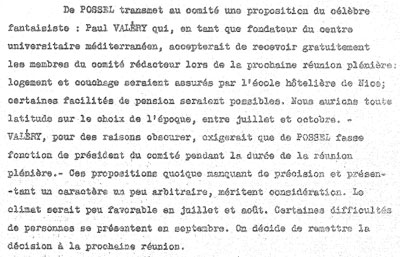

What is certain is that Evelyne Gillet and André Weil start a relationship no later than the autumn of 1935. At that time, Weil is concocting the Bourbaki Comptes-Rendus note and as the Academy demands a short biography of the author, he has to come up with a first name (at the Besse conference, they only decided on the name ‘N. Bourbaki’). Evelyne chooses Nicolas and is referred to ever after as ‘Bourbaki’s godmother’. Early 1936, the couple spends a vacation together in Spain.

Early 1937, the official divorce papers come through, allowing Weil and Evelyne to marry on october 30th 1937. The very same year, René de Possel remarries with Yvonne Liberati. For more information, you can traverse Evelyne’s genealogy-tree here, but bear in mind that not all information is included (for example, Evelyne died on may 24th, 1986).

Contrary to the suggestion made in the biography, there is no evidence that de Possel left the Bourbaki-group as a result of this affaire or because of his arguments with Weil. In fact, at least until the second Chançay-congress in 1937, de Possel was one of the hardest workers in the group, present at all meetings, doing his share of the write-up and even chastising his fellow-Bourbakis for not being as committed to the project as they ought to be, see for example the 7 theses of Chançay document. It was only in the fall of 1941 that de Possel asked to be transferred to the university of Algiers and left the Bourbaki-group.


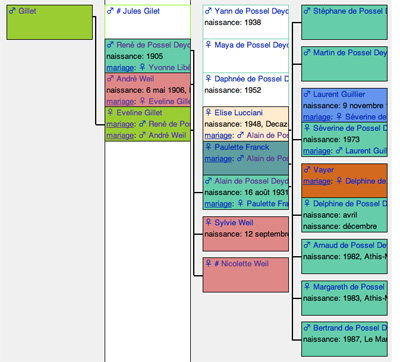
At the meeting of march 25th 1935, de Possel attempts a coup d’état. He comes up with an entirely new plan for the summer-congress. Paul Valéry, the French poet, essayist, and philosopher (in the notules he is described as ‘le célebre fantaisiste’) proposed the Bourbaki-group to use his ‘centre universitaire mediterranéen’ (the proto-University of Nice) as their place of venue. They could choose any period between july and october and they wouldn’t have to pay a thing! de Possel was in contact with Valéry at that time, he was writing a 44 page booklet on game theory Sur la théorie mathématique des jeux de hasard et de réflexion, with a preface by Paul Valéry, which appeared later in 1937 via Valéry’s center for mediterranean studies.

There is one small catch though … Valéry insists that de Possel should be president of the Bourbaki-group during the meeting! Naturally, this wasn’t received enthusiastically by the others, but they didn’t rule the plan out, requesting additional information and observing that july and august may be way too hot in Nice.

The next meeting (May 6th 1935), de Possel tries to increase the pressure by asserting that the original Besse-plan is in danger because “Les naturalistes de Clermond-Ferrand semblent vouloir se servir de ce qui leur appartient” (the biologists of Clermond-Ferrand want to use their facilities themselves). But the others are not impressed and they give de Possel “pleins pouvoirs pour réagir avec violence.”

A fortnight later, Weil demands to know the latest on the Besse-negotiations and de Possel replies “en principe les biologistes de Clermond-Ferrand pourront y séjourner des le 15 juin, il y a tout lieu de présumer que ces derniers ne seront que trois ou quatre; ils seront donc fort peu génante étant donné le nombre des locaux dont nous pourrons disposer”, that is, there won’t be more than 3 or 4 biologists around, and, there’s plenty of room for everyone!

Putsch averted, the Bourbakis can start packing their suitcases, hire a secretary for the meeting, and split the costs among all committee-members. Because even this circulaire is preserved, we now know such trivia as the cost of full-pension in the Besse-Hotel with the excellent kitchen : 25 Ffr/day…

One Comment

The artist and the mathematician

Over the week-end I read The artist and the mathematician (subtitle : The story of Nicolas Bourbaki, the genius mathematician who never existed) by Amir D. Aczel.

Whereas the central character of the book should be Bourbaki, it focusses more on two of Bourbaki’s most colorful members, André Weil and Alexander Grothendieck, and the many stories and myths surrounding them.

The opening chapter (‘The Disappearance’) describes the Grothendieck’s early years (based on the excellent paper by Allyn Jackson Comme Appelé du Néant ) and his disappearance in the Pyrenees in the final years of last century. The next chapter (‘An Arrest in Finland’) recount the pre-WW2 years of Weil and the myth of his arrest in Finland and his near escape from execution (based on Weil’s memoires The Apprenticeship of a Mathematician). Chapter seven (‘The Café’) describes the first 10 proto-Bourbaki meetings following closely the study ‘A Parisian Café and Ten Proto-Bourbaki Meetings (1934-1935)‘ by Liliane Beaulieu. Etc. etc.

All the good ‘Bourbaki’-stories get a place in this book, not always historically correct. For example, on page 90 it is suggested that all of the following jokes were pulled at the Besse-conference, July 1935 : the baptizing of Nicolas, the writing of the Comptes-Rendus paper, the invention of the Bourbaki-daughter Betti and the printing of the wedding invitation card. In reality, all of these date from much later, the first two from the autumn of 1935, the final two no sooner than april 1939…

One thing I like about this book is the connection it makes with other disciplines, showing the influence of Bourbaki’s insistence on ‘structuralism’ in fields as different as philosophy, linguistics, anthropology and literary criticism. One example being Weil’s group-theoretic solution to the marriage-rules problem in tribes of Australian aborigines studied by Claude Lévi-Strauss, another the literary group Oulipo copying Bourbaki’s work-method.

Another interesting part is Aczel’s analysis of Bourbaki’s end. In the late 50ties, Grothendieck tried to convince his fellow Bourbakis to redo their work on the foundations of mathematics, changing these from set theory to category theory. He failed as others felt that the foundations had already been laid and there was no going back. Grothendieck left, and Bourbaki would gradually decline following its refusal to accept new methods. In Grothendieck’s own words (in “Promenade” 63, n. 78, as translated by Aczel) :

“Additionally, since the 1950s, the idea of structure has become passé, superseded by the influx of new ‘categorical’ methods in certain of the most dynamical areas of mathematics, such as topology or algebraic geometry. (Thus, the notion of ‘topos’ refuses to enter into the ‘Bourbaki sack’ os structures, decidedly already too full!) In making this decision, in full cognizance, not to engage in this revision, Bourbaki has itself renounced its initial ambition, which has been to furnish both the foundations and the basic language for all of modern mathematics.”

Finally, it is interesting to watch Aczel’s own transformation throughout the book, from slavishly copying the existing Weil-myths and pranks at the beginning of the book, to the following harsh criticism on Weil, towards the end (p. 209) :

“From other information in his autobiography, one gets the distinct impression that Weil was infatuated with the childish pranks of ‘inventing’ a person who never existed, creating for him false papers and a false identity, complete with a daughter, Betti, who even gets married, parents and relatives, and membership in a nonexistent Academy of Sciences of the nonexistent nation of Polvedia (sic).
Weil was so taken with these activities that he even listed, as his only honor by the time of his death ‘Member, Poldevian Academy of Sciences’. It seems that Weil could simply not go beyond these games: he could not grasp the deep significance and power of the organization he helped found. He was too close, and thus unable to see the great achievements Bourbaki was producing and to acknowledge and promote these achievements. Bourbaki changed the way we do mathematics, but Weil really saw only the pranks and the creation of a nonexistent person.”

Judging from my own reluctance to continue with the series on the Bourbaki code, an overdose reading about Weil’s life appears to have this effect on people…

Leave a Comment